

Share This Article
Off-road electric scooters and city commuter models share a category name but little else once the specifications are compared side by side. iscooterglobal maintains separate lines for rough terrain and daily pavement travel, each shaped by different motors, frames, and tire choices. The gap between a trail-ready scooter and a street-ready one shows up in nearly every spec sheet. Understanding those differences explains why a scooter built for gravel paths looks and rides nothing like one built for smooth commuting lanes.
Motor Power and Performance: iX Series vs i-Series Specifications
The iX series carries noticeably higher motor output than the i-series commuter lineup. The iX5S runs on a 1000W motor, while the iF1 steps up further with a 1200W unit built for all-terrain use. By comparison, the i9Max uses a 500W motor and the i10Plus runs an 800W motor, both aimed at steady city riding rather than aggressive acceleration.
That power gap reflects the demands of each environment. Off-road electric scooters need stronger torque to climb loose or uneven ground, while commuter models prioritise consistent, efficient output for paved routes. The iX3, with its 800W motor, sits between rougher paths and everyday streets.
Suspension and Frame Design in Off-Road vs Commuter Models
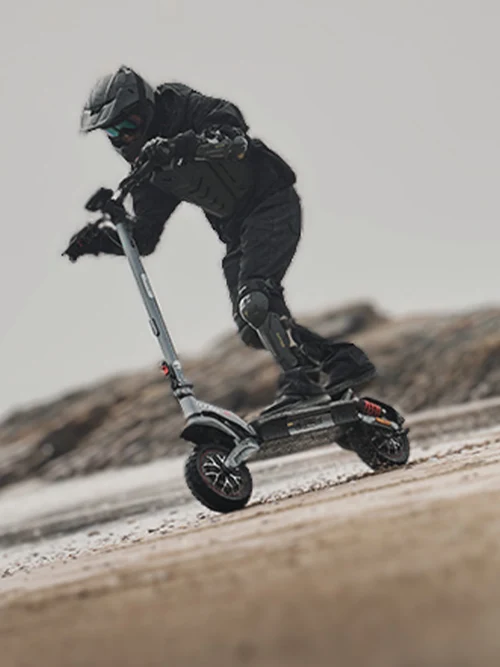
Frame construction is another clear separation point. The iX3 uses a durable aluminum alloy frame paired with a front and rear shock absorption system designed to handle muddy trails and rocky paths. This dual suspension setup cushions impacts that a rigid commuter frame would transmit straight through.
iscooterglobal builds its i-series commuter models around lighter frames tuned for predictable, flat-surface riding rather than absorbing repeated terrain shocks. The structural choices reflect each scooter’s intended environment rather than a simple difference in build quality. A frame suited to packed trails is not necessarily better, just different in purpose.
Battery Capacity and Range: iX5S, iF1, and F7Ultra Versus i9Max and i10Plus
Range figures vary by model and reflect how each scooter is meant to be used. The i9Max offers a 40km one-charge range from its high-capacity battery, supporting daily back-and-forth commuting. The F7Ultra pairs with a 52V 20Ah (1040Wh) battery option, reflecting the larger energy reserves that off-road and longer-distance riding demand.
The iF1 is described as a scooter built to go further, supported by battery options such as the 48V 10Ah (480Wh) unit listed among its accessories. Meanwhile, the iX3 also delivers up to 40km of range per charge despite being positioned as an off-road model. These figures show that battery sizing is matched to each scooter’s motor demands rather than following a single standard across the range.

Terrain Handling: All-Terrain Capabilities of the iX4 and DX5Pro
The iX4 is built around widened footboards, ergonomic grips, auto-grade pneumatic off-road tires, and a full lighting system for daily cruising across mixed surfaces. Its design supports app control, giving riders access to additional settings beyond the basic throttle and brake controls found on simpler models. It is marketed specifically around speed and all-terrain capability, making it one of the more capable off-road electric scooters in the lineup from iscooterglobal.
The DX5Pro takes a different approach, built as a 2000W moped-style electric scooter with a stated range of up to 62 miles (100km). Its description emphasizes stability across varied terrain rather than aggressive off-road performance alone. Both models show how terrain handling can be engineered through different combinations of tires, power, and frame geometry.
Portability and Folding Mechanisms Across the Range
Many models, including the i9 and iX5S, are listed among the foldable electric scooters that iscooterglobal offers, allowing them to collapse for storage or transport. Folding mechanisms matter differently depending on scooter type. Commuter models tend to prioritise a compact fold for carrying onto transit or into offices, while heavier off-road electric scooters with pneumatic tires and larger frames fold mainly for storage rather than daily carrying.
The size and weight differences across the lineup mean portability is not uniform even among folding models. A lighter i-series scooter folds into a more manageable package than a heavier all-terrain unit like the iF1. This distinction matters when weighing daily portability against rugged capability.
Specialized Features: Seats, Baskets, and the DX5Pro Moped-Style Design

Some models in the range go beyond the standard stand-up scooter format. The DX5Pro includes a built-in seat, moving it closer to a moped-style riding position than a typical commuter scooter. This seat is paired with a large basket, giving the model practical carrying capacity that most other scooters in the lineup do not offer.
A front stored basket accessory, sold separately, carries a rust-proof coating and strong load-bearing capacity, suited to commuting, leisure riding, or family outings. Such accessories extend practicality beyond the core scooter hardware itself. These additions matter for anyone who needs to carry belongings rather than just travel point to point.
- The iF1 runs a 1200W motor, which is notably stronger than the 500W motor found on the i9Max.
- The iX3 relies on a front and rear shock absorption system, while the i-series commuter models are not described with the same dual suspension setup.
- Off-road models like the iX4 use auto-grade pneumatic tires, contrasting with the firmer tires typically suited to flat urban riding.
- Heavier, suspension-equipped models such as the iF1 and DX5Pro carry a different weight distribution than lighter commuter scooters like the i9.
- Battery capacity scales with motor demand, as seen in the F7Ultra’s 52V 20Ah (1040Wh) option compared with smaller batteries paired with entry commuter models.
Motor wattage, suspension, tire type, and added features like seats or baskets all shift depending on whether a scooter is meant for trails or pavement, and that pattern holds across the entire range offered by iscooterglobal. The spread between the iX and i-series lines shows two genuinely different engineering briefs rather than one scooter dressed up two ways. That distinction marks the clearest signal of what each model was actually built to do.
That contrast is ultimately what separates the two sides of the lineup.
