
Share This Article
High-power USB-C charging now covers far more than a single flagship phone plugged into a wall brick. AOHI builds its catalogue around that range, moving from compact single-port adapters up to six-port desktop stations. Port configuration shifts depending on whether a laptop, a tablet, or a smartphone sits at the other end of the cable. Comparing these specifications clarifies which station or charger lines up with a given workload.
Understanding PD 3.2 and GaN+ Technology in AOHI Chargers
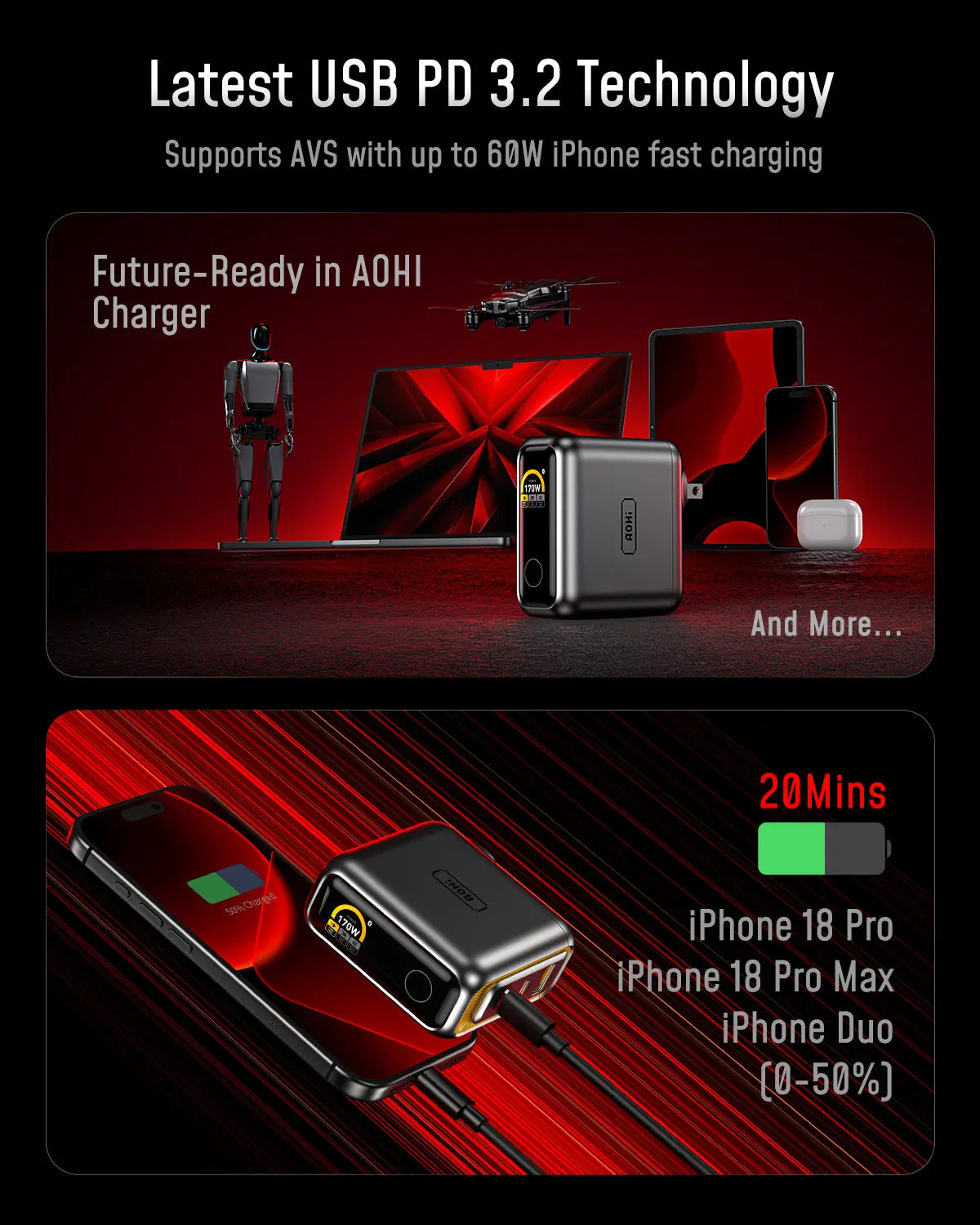
Several products reference PD 3.2 as the underlying charging protocol, including the 240W cable sets and the 170W desktop charger line. PD 3.2 extends standard USB Power Delivery negotiation, letting compatible cables and adapters carry higher sustained wattage between devices. AOHI also applies GaN and GaN+ semiconductor designs across chargers such as the Magcube and Youth series, pairing them with compact adapter housings at higher output levels. Protocol and component design run through most of the catalogue rather than sitting in one isolated model.
AOHI The Future AI Desktop Charging Stations: 280W Capacity and Port Architecture
The Future AI PD3.2 280W 6-Port Desktop Charging Station is described as one of the world’s highest-power desktop chargers, consolidating six ports into a single housing. It is positioned as a replacement for multiple separate adapters, built to power a MacBook Pro, an iPhone, an iPad, an Apple Watch, and additional accessories from one unit. Bundles pair this 280W station with either the Starship 40,000mAh 140W power bank or the Adonis USB4 2.0 USB-C to USB-C cable, and the station ships with its own AC cord offered in US, EU, UK, and AU plug options at 4.92FT. That six-port layout separates this AOHI station from its wall chargers, which top out at three ports.
Wall Chargers from 100W to 170W: Power Delivery Differences in the Youth and Magcube Lines

The Youth line and the Magcube line sit alongside each other, spanning a 100W PD GaN 3-Port Fast Charger, a 140W PD3.1 GaN 3-Port Fast Charger, a Magcube 100W GaN+ 2-Port Mini Fast Charger, and a Magcube Pro 140W GaN+ charger that combines two USB-C ports with one USB-A port. A bundled version of the Magcube Pro also pairs it with a 3-Port Fast Charger inside the Starship 2-in-1 power bank set. The Magcube 100W model can reportedly bring a 16-inch MacBook Pro from 0% to 45% in 30 minutes from a single port. The Magcube Pro 140W unit is described as able to maintain a constant 140W output rather than tapering, with both USB-C ports supporting 140W fast charging for a 16-inch MacBook Pro when paired with the appropriate cable, while the standalone 170W 3-Port LED Display Wall Charger under The Future AI line lists 140W across its dual USB-C ports as part of its total 170W output.
AOHI Power Banks: Choosing Between 140W and 240W Output Models
The portable AOHI lineup spans several capacities built around different maximum outputs. The Starship 40,000mAh power bank pairs with a 140W GaN+ charger and a 240W C-C cable, while the Starship 240W 27,600mAh LED Display Power Bank carries 2 USB-C ports and 1 USB-A port for a combined 240W output, letting three devices draw power at once. The BLACK WARRIOR line adds further variety, including a 25,200mAh 170W PD3.0 model and a smaller 10,000mAh 65W unit, alongside the Starship Pro PD3.1 310W 20,000mAh and the Starship Pro PD3.1 210W 10,000mAh models. Selecting between these largely comes down to whether high-power USB-C charging from a single port or distributed multi-port output across USB-C and USB-A better matches a given set of devices, a distinction that runs through nearly every power bank in this range.
Cable Specifications and Data Transfer Capabilities in AOHI’s Adonis USB4 Line
The Adonis USB4 2.0 USB-C to USB-C cable appears in bundles alongside the Starship 240W power bank, functioning as a single connector built for both charging and data duties. Separately, The Future PRO Creative Power PD3.2 240W Cable Set is listed with 40Gbps data transfer and 8K video display support, along with a stated 100-Year Bend Durability figure and a 3-Stage Quick Glance Charging Status. These cables are described as fully customizable, assembled from shorter handheld lengths up to longer runs depending on the configuration chosen. This positions the cable range as a companion layer to the charging hardware, since data throughput and video output depend on the cable as much as the charger itself.
Multi-Device Simultaneous Charging: Real-World Power Distribution Scenarios
A desktop station with six ports, a wall charger with three, and a power bank with two or three USB outputs each distribute wattage differently once more than one device is plugged in. The 280W desktop station is built around replacing several single-device adapters on a desk, while the Starship 240W power bank’s combined output across its three ports supports a laptop, a smartphone, and a tablet from one portable unit. Professionals managing a laptop alongside a phone and a tablet effectively choose between a stationary high-port hub and a travel-ready power bank, depending on whether the setup is fixed or mobile. Both paths rely on the same underlying high-power USB-C charging standard to move wattage where it is needed, a thread that connects AOHI‘s desktop, wall, and portable lines into one coherent catalogue.
- The Future AI 280W desktop station carries six ports, the highest count in the lineup, aimed at replacing multiple separate adapters on one desk.
- Wall chargers in the Youth and Magcube lines cap out at three ports and span 100W to 170W depending on the model chosen.
- The Starship 240W power bank distributes its output across two USB-C ports and one USB-A port to charge three devices at once.
- The BLACK WARRIOR 170W power bank and the Starship 40,000mAh 140W model offer different capacity-to-output balances for travel use.
- Cable sets such as the Adonis USB4 2.0 and The Future PRO Creative Power line determine whether a connection also carries high-speed data and video alongside power.
Wattage, port count, and cable capability shift together across this lineup, giving each format its own place in a daily charging routine.
