
Share This Article
A rider living in a small apartment often faces a simple conflict. A fat tire bike is too bulky to store near a doorway, yet a narrow-tire commuter bike struggles on a gravel towpath or a sandy beach road. Folding fat tire e-bikes solve that conflict by combining a hinged, collapsible frame with wide tires built for mixed terrain, letting one bike cover a transit commute and a rough weekend trail without needing a second bike. This article looks at what defines the category, how the main components work together, and where Heybike’s current lineup sits within that broader electric bike market.
What Are E-bikes and Why They Matter
Folding fat tire e-bikes pair a hinged frame with tires typically around four inches wide, a combination meant to handle gravel, sand, and uneven pavement while still shrinking down for an elevator ride or a car trunk. That dual purpose is what separates the category from both standard folding e-bikes and fixed-frame fat tire models, since neither alternative covers both jobs at once. As a result, the format has grown from a niche accessory into a recognizable segment of the wider electric bike market.
Consider a commuter who rides several miles to a train platform, folds the bike, and carries it aboard before unfolding it again at the other end. The same bike then needs to handle a rutted farm road on a weekend trip without being swapped for a different machine. That everyday back-and-forth is exactly why e-bikes have moved beyond a specialty product.
The Core Components: Motors, Batteries, and Full Suspension Systems
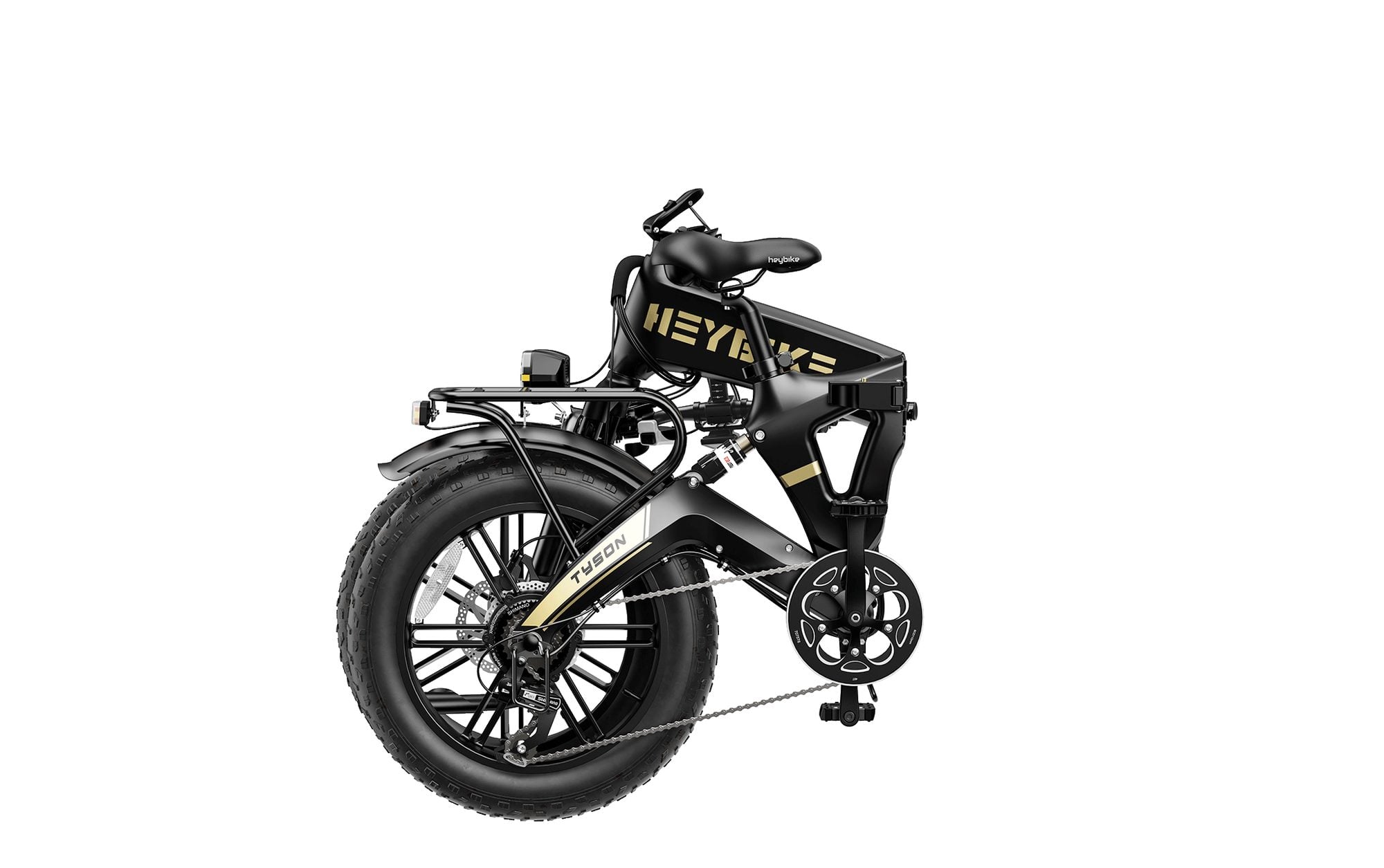
Three components largely define how a folding fat tire e-bike performs. Peak wattage shows how much power a motor can deliver on demand, while torque, measured in newton-meters, shapes how quickly the bike accelerates and climbs a hill. Battery capacity, expressed in watt-hours, governs how far a single charge can carry a rider before a recharge is needed.
Suspension design is the other major variable to weigh. Some models rely on front suspension only, which softens impacts at the front wheel, while full suspension systems add a rear shock for a smoother ride over rougher ground. Heybike builds several models around full suspension setups, treating that comfort feature as part of the fat tire format rather than a separate add-on.
Heybike Mars Series: Powerful All-Terrain Folding Platforms

The Mars series represents an all-terrain folding approach within the Heybike lineup. The Mars 3.0 pairs full suspension comfort with 95 N.m of torque and a stated 440 lbs max load, riding on 20-inch by 4-inch fat tires in a folding frame, and it also includes NFC tap-to-unlock access, a detail not found on simpler folding fat tire designs. That torque figure suits a rider hauling cargo up a steep gravel driveway or crossing a muddy trailhead.
The Mars 2.5 takes a more accessible path within the same family. It runs a 1000W peak motor, a 600Wh battery, and a listed 45-mile max range, with a 28 mph top speed on the same folding fat tire format. Both Mars models keep the wide tire footprint that defines this part of the market while still collapsing down for storage, a detail that separates them from fixed-frame fat tire bikes.
Heybike Ranger Series: Long-Range Comfort and Versatility
Where the Mars series leans toward terrain capability, the Ranger series leans toward range and everyday comfort. The Ranger 3.0 Pro also runs full suspension, but it pairs that comfort feature with a torque sensor for smoother pedal response and a stated 90 miles of max range, keeping the same 20-inch by 4-inch folding fat-tire layout and adding color choices such as Ruby Red, Emerald Green, and Sapphire Blue. That range figure fits a rider who runs weekend errands across town without stopping to recharge.
The Ranger S 2.0 uses a step-through frame for easier mounting, combined with a 1400W peak motor, a 692Wh battery, and a 55-mile max range. It is described as a versatile folding fat tire e-bike suited to everyday rides as well as weekend outings. Across the Mars and Ranger lines, the folding fat tire format adapts toward terrain capability, long range, or easier access depending on the specific model chosen.
Storage, Portability, and Real-World Practicality
The practical appeal of folding fat tire e-bikes comes down to where they end up when not being ridden. A hinge that collapses the frame means the bike can fit into a car trunk, a hallway closet, or a storage locker that a full-size fat tire bike never would. A renter with no garage, for example, can tuck a folded Heybike model behind a couch or inside a closet between rides.
Weight and dimensions still matter once a bike is folded. Folding does not make a fat tire e-bike light, since the motor, battery, and frame add real mass, but it does make the bike easier to maneuver through doorways or up a few stairs. That balance between portability and bulk remains one of the defining tensions of the folding fat tire category.
- Peak wattage indicates how much power a motor can deliver during short bursts, such as climbing a hill.
- Torque ratings, measured in newton-meters, describe how strongly a motor can turn the wheel from a stop.
- Range capacity, usually listed as a max figure, shows how far a single battery charge can carry a rider under favorable conditions.
- Tire width, often around four inches on fat tire models, affects traction and stability on loose surfaces.
- Suspension type, whether front-only or full suspension, changes how much vibration and impact reaches a rider.
- A foldable frame allows a bike to be stored in smaller spaces and transported more easily than a fixed-frame model.
Accessories and Customization Options for Extended Use
Beyond the bike itself, Heybike offers a set of accessories that extend day-to-day use of its folding fat tire e-bikes. Waterproof pannier bags, available in single and double configurations, add enclosed cargo space that converts from a bike-mounted pannier to a shoulder bag. A dedicated rear rack built for the Saturn model adds further carrying capacity for longer trips, such as a grocery run that would otherwise need a backpack.
Other accessories address upkeep and visibility rather than storage. An alloy kickstand with anti-skid pads is offered across multiple models, including Mars and Ranger, to keep a bike upright on uneven ground. An LED long headlight is also listed as a universal-fit accessory, aimed at lighting the path ahead on an early morning ride or a late commute home.
These accessory options suggest that e-bikes within this lineup are treated as platforms that can be adapted over time, rather than fixed packages. Collections across the site also note UL 2849 and UL 2271 safety certification language, alongside a stated 2-year warranty and a 14-day trial period, details that sit alongside the hardware itself when comparing models.
Those certification and warranty details, paired with the range of Mars and Ranger configurations, round out the broader picture of where folding fat tire e-bikes stand today.
