
Share This Article
Shoppers researching heavier window treatments often run into a tangle of marketing claims that are hard to verify from a product photo. Thermal and soundproof curtains myths spread quickly because fabric performance cannot be judged by sight or touch. This article walks through where those misconceptions come from, what the specifications actually measure, and how to read them without expecting more than any curtain can deliver.
What Thermal Curtains Really Do: Beyond Simple Insulation Myths
A common assumption is that any thick curtain automatically becomes a thermal curtain. In reality, thermal performance depends on fabric density and how closely a panel seals against the window frame. Kurtens states that its thermal and acoustic blackout curtain reaches up to 7°C of thermal gain, a figure tied to that specific 620 g/m² fabric rather than a general property of heavy drapery.
That distinction matters because a loosely hung curtain, however thick, leaves gaps where air still moves. Thermal gain depends on coverage as much as on the material itself. This is one of the thermal and soundproof curtains myths worth setting aside before comparing two unrelated products on specification alone.
The 3-in-1 Curtain Myth: Can One Fabric Truly Deliver 22 dB Sound Reduction and 7°C Thermal Gain?
Sceptics often assume a single fabric cannot combine blackout, thermal, and acoustic properties at once. Kurtens describes its 3-in-1 range as combining 100% blackout, up to 7°C of thermal gain, and up to 22 dB of sound attenuation under optimal installation and test conditions. Those figures come from laboratory measurement, which means they describe the fabric’s ceiling performance rather than a guaranteed outcome in every room.
Laboratory testing fixes variables that a bedroom or living room cannot always fix, such as airtight mounting and a sealed test chamber. Real windows have drafts, uneven frames, and gaps that a lab test does not have to contend with. That gap between a controlled result and a lived-in room is not a flaw in the number itself, but it explains why the same curtain can feel more effective in one home than another depending on how closely the installation matches those original test conditions.
Why Standard Curtains Fail: Understanding the 620 g/m² Difference in Kurtens Fabric
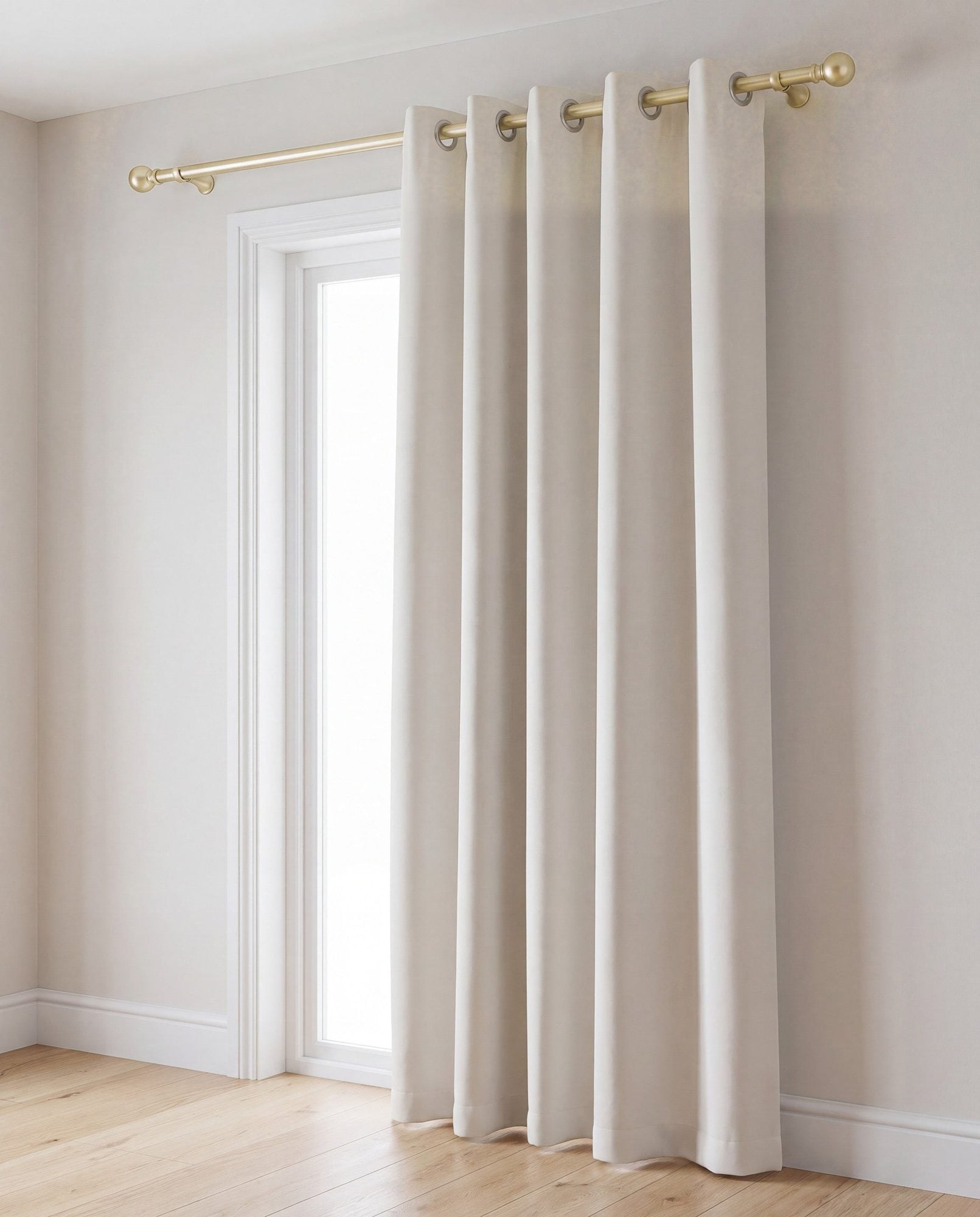
Fabric weight is one of the clearest ways to separate marketing language from measurable difference. According to the brand’s own figures, a standard curtain of 150 to 300 g/m² typically achieves only 5 to 7 dB of sound reduction and 1 to 2°C of thermal gain. At 620 g/m², the density used in the Kurtens 3-in-1 curtain, that performance is described as multiplied by three to four times over a standard fabric.
This helps explain why a curtain marketed loosely as “soundproof” or “insulating” without any stated weight or test figure deserves scrutiny. Weight alone does not guarantee a result, but it is one of the few numbers a shopper can compare directly across brands. Fabric construction, layering, and density together determine whether a curtain does more than block light.
Installation Mistakes That Undermine Soundproofing and Thermal Performance

Even a well-made curtain underperforms if it is mounted incorrectly. Gaps at the sides, a rail that sits too close to the frame, or a panel that does not reach the floor all let air, light, and noise slip past the fabric. These installation details are rarely discussed in product marketing, yet they affect the outcome as much as the material itself.
Mounting type also plays a role in how a curtain seals a window. Eyelet, pencil pleat, rod pocket, and pinch pleat fixings each sit differently against a rail or rod, which changes how much light or draft escapes at the top of the panel. Choosing a fixing that suits the existing rod or track is a practical step that has nothing to do with fabric quality but still shapes the final result.
Measuring Window Dimensions Correctly: How the Exact-Fit Guarantee Addresses the Most Common Ordering Error
Incorrect measurement is one of the most frequent ordering errors for made-to-measure curtains. A panel that is too narrow leaves light halos at the sides, and one that is too short breaks any blackout or thermal claim regardless of the fabric used. Kurtens offers both four standard sizes and made-to-measure dimensions ordered to the centimetre, which allows a curtain to be sized to the actual opening rather than to an approximate standard width.
Complete darkness, for example, depends on dimensions that cover the full window perimeter and remove gaps along the sides and bottom. A fabric rated for total blackout cannot reach that result if the panel itself is undersized. Measuring the frame, not just the glass, is the detail that most often separates a curtain that performs as described from one that disappoints.
Blackout Fabric Performance: 100% Blackout Does Not Mean Total Light Control
A rating of 100% blackout refers to the fabric blocking light that passes directly through the weave, not to every source of light in a room. Kurtens notes that its blackout fabric is measured at 0 lux transmitted through the material itself, while a standard curtain described as very opaque often stops at 85 to 95%. Side gaps, an uncovered top rail, or light entering beneath the panel can still brighten a room even with a fully rated fabric.
- Many assume a thermal curtain keeps a room warm regardless of how it is hung, when coverage and sealing matter just as much as the fabric.
- Some shoppers expect a soundproof curtain to eliminate noise entirely, rather than reduce it by a measured number of decibels.
- A frequent misconception is that any dark, heavy fabric qualifies as blackout, when the rating refers to light blocked through the weave specifically.
- Buyers sometimes believe a single standard size will fit most windows well enough, overlooking how gaps at the edges undercut every other performance claim.
- It is commonly assumed that higher fabric weight alone guarantees better results, without accounting for installation and fit.
These misconceptions persist partly because performance figures are easy to quote and harder to picture in a specific room. Reading them alongside fabric weight, coverage, and fixing type gives a more complete picture than any single number can on its own.
Closing Thought
Dispelling thermal and soundproof curtains myths comes down to treating fabric specifications as starting points, not guarantees. Fit, mounting, and coverage decide how close a room gets to the laboratory figure printed on the label.
