
Share This Article
Choosing between ShadowAuto vs ShadowTrack mostly comes down to one practical question: how will the tracker be mounted and powered? Both devices come from ShadowGPS, and both report location through the same mobile app, but the installation method and power source set them apart. This comparison breaks down the wired and portable designs so a buyer can match the hardware to an actual use case, whether that means a family car, a small fleet, or a piece of equipment that needs to stay out of sight.
ShadowAuto: OBD-II Port Installation and Continuous Power
ShadowAuto plugs directly into a vehicle’s OBD-II port, the diagnostic port that nearly every car and truck already has under the dashboard. The connection takes under 2 minutes with no tools or wiring involved. Because it draws power from the vehicle itself, there is no battery to charge or monitor, and the device keeps reporting for as long as the vehicle runs, which makes it a plug-and-play fit for continuous monitoring rather than scheduled check-ins.
Beyond location, ShadowAuto also pulls engine diagnostics through that same OBD-II connection. That means trip history, speed alerts, and vehicle health data all arrive through one unit instead of several separate tools. For anyone weighing ShadowAuto vs ShadowTrack on the basis of built-in vehicle data, this diagnostic layer is the clearest difference between the two.
ShadowTrack: Portable Battery-Powered Design and Flexible Placement
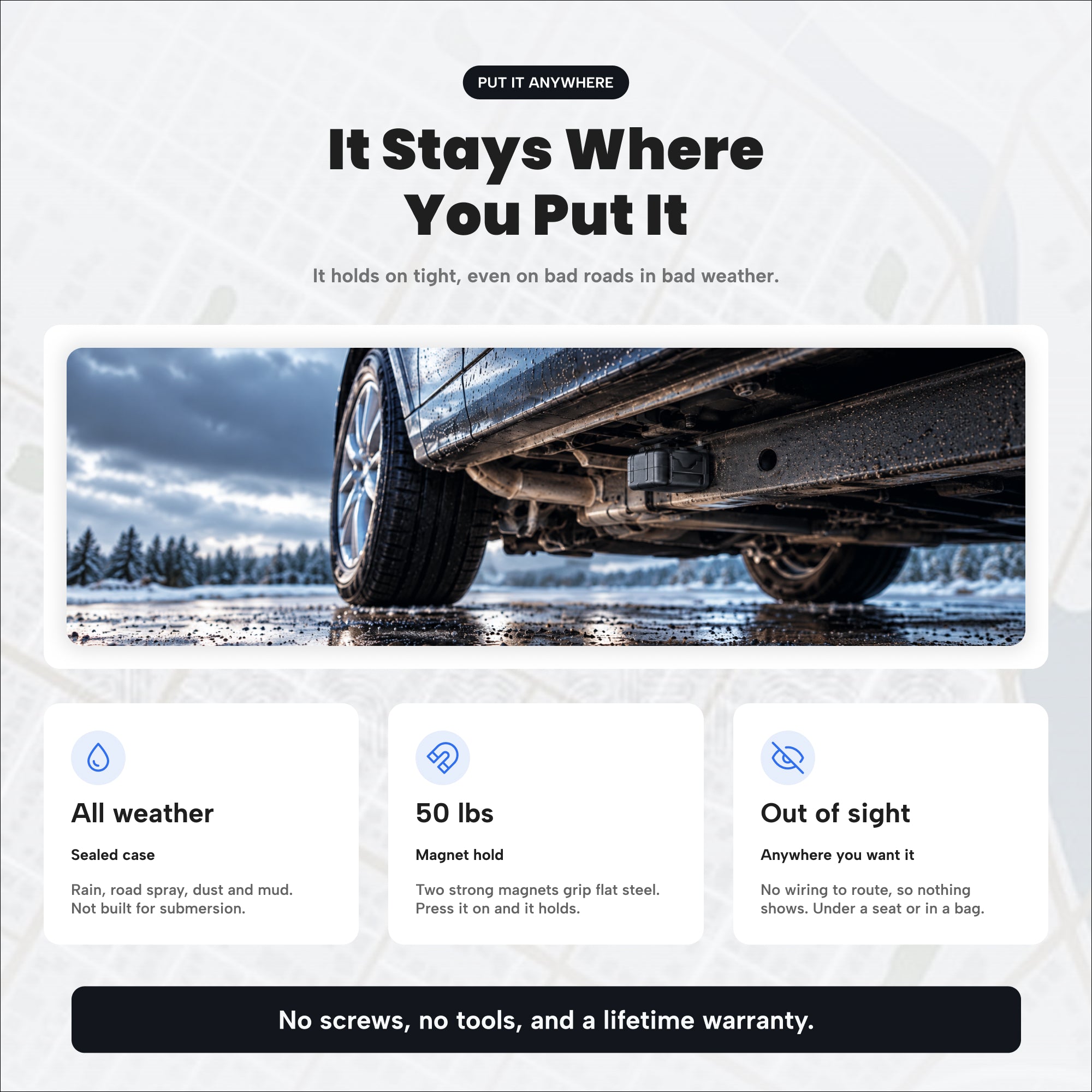
ShadowTrack takes a different approach. It is a compact, battery-powered unit that works right out of the box, with no wiring and no port to plug into. It can sit inside a car, ride along in a bag, or attach to a piece of equipment, since it does not depend on a vehicle’s electrical system at all.
Its rechargeable battery is rated for up to 15 days, which allows it to operate away from a vehicle for stretches of time. An optional magnetic, weatherproof case is also available, letting the tracker attach firmly to metal surfaces or sit discreetly under a vehicle. That flexibility is a big part of why the ShadowAuto vs ShadowTrack decision often comes down to whether the asset being tracked even has an OBD-II port to use in the first place.
Installation Speed and Technical Requirements Compared
Neither device demands technical skill, and ShadowGPS markets both as self-install products that skip the appointment and the installer altogether. ShadowTrack sets up just as quickly as its wired counterpart, since placing or magnet-mounting it also takes under 2 minutes.
The real difference is not speed but requirements. ShadowAuto needs a compatible OBD-II port, which rules it out for anything that is not a car or truck. ShadowTrack has no such restriction, so it can go into a bag, a toolbox, or a trailer without needing an electrical connection of any kind.
Real-Time Tracking and Update Frequency Across Both Devices

Both trackers update location every 5 seconds through the app, so neither sacrifices responsiveness for portability or wired power. Live location, motion alerts, and trip history appear on the same dashboard regardless of which hardware is paired with the account. That consistency matters for anyone managing both vehicles and standalone assets, since the app experience does not change between the two devices offered by ShadowGPS.
Where the devices diverge is in the kind of alerts each one is built to support. ShadowAuto’s connection to the engine allows for driver-behavior and diagnostic alerts on top of location, with over 16 customizable notifications available across the lineup. ShadowTrack instead emphasizes motion-based alerts, which fits something that might sit still for long stretches before being moved.
When to Choose ShadowAuto for Vehicle Fleets and Family Cars
ShadowAuto is built around vehicles that already have an OBD-II port, which covers most cars, trucks, and fleet vehicles. It is positioned as a fit for Turo hosts, small fleets, and family vehicles, since it combines location tracking with trip history and engine diagnostics in a single plug-in unit. For a household keeping tabs on a teen driver, or a small business managing several trucks, that always-on connection to the vehicle removes the need to think about charging a separate battery.
Fleet-style monitoring also benefits from the mileage logs and geofence features that come through the same dashboard ShadowGPS builds for both devices. Because the device stays powered whenever the vehicle runs, that always-on power source is exactly what distinguishes it from a battery-based unit that eventually needs a recharge.
When to Choose ShadowTrack for Assets, Equipment, and Hidden Placement
ShadowTrack fits situations where there is no OBD-II port to use, or where discretion matters more than a wired connection. Landscaping businesses, for example, can use it on trailers, lawnmowers, or handheld tools, while ShadowAuto covers the trucks themselves. Its magnet-mount option and weatherproof case make it suited to under-vehicle placement or outdoor equipment that faces the elements, and this is where ShadowGPS draws the clearest line between its two hardware lines.
- ShadowAuto draws continuous power from a vehicle’s OBD-II port, while ShadowTrack runs on a rechargeable battery rated for up to 15 days.
- ShadowAuto sets up by plugging into the OBD-II port in under 2 minutes, and ShadowTrack sets up by placing or magnet-mounting it in the same amount of time.
- ShadowAuto is limited to mounting through a vehicle’s OBD-II port, whereas ShadowTrack can be placed inside a bag, under a vehicle, or on equipment using an optional magnetic case.
- ShadowAuto suits family cars, Turo rentals, and small fleets that need engine diagnostics alongside location data.
- ShadowTrack suits standalone assets, trailers, tools, and equipment that have no OBD-II port of their own.
Settling the ShadowAuto vs ShadowTrack question ultimately comes down to what is being tracked rather than which device offers more features, since both report location every 5 seconds through the same app. A vehicle with an available OBD-II port can take advantage of diagnostics, while anything else, from a piece of equipment to a bag, leans on battery-powered flexibility.
