
Share This Article
Hearing loss often creeps into daily conversations long before anyone seeks help, and the cost of traditional devices can keep people waiting years longer than necessary. Affordable OTC hearing aids have changed that equation by placing clinic-style features into smaller, self-fitted packages that ship directly to a home. iBstone is one of the brands building a lineup around that idea, with several in-ear and earbud-style models designed for everyday listening rather than specialist appointments.
Why OTC Hearing Aids Have Become Accessible at iBstone’s Price Point
Over-the-counter hearing devices exist because regulators opened the category to adults with mild to moderate hearing loss, removing the requirement for a clinical fitting. That shift let companies compete on design and software instead of appointment fees. iBstone built its catalog around that opening, offering several rechargeable, FDA-registered devices that ship directly without a prescription. The result is a set of affordable OTC hearing aids aimed at people who want clearer speech and TV sound without a specialist visit.
Because the devices are self-fitted, buyers choose a model based on how it looks and feels rather than a clinician’s recommendation. That makes comparing style, battery habits, and noise handling the practical starting point. The range spans nearly invisible in-canal units, earbud-shaped designs, and Bluetooth-enabled devices, so the differences between models matter as much as the shared accessibility.
iBstone Nova CIC: Nearly Invisible In-Ear Design for Discreet All-Day Wear
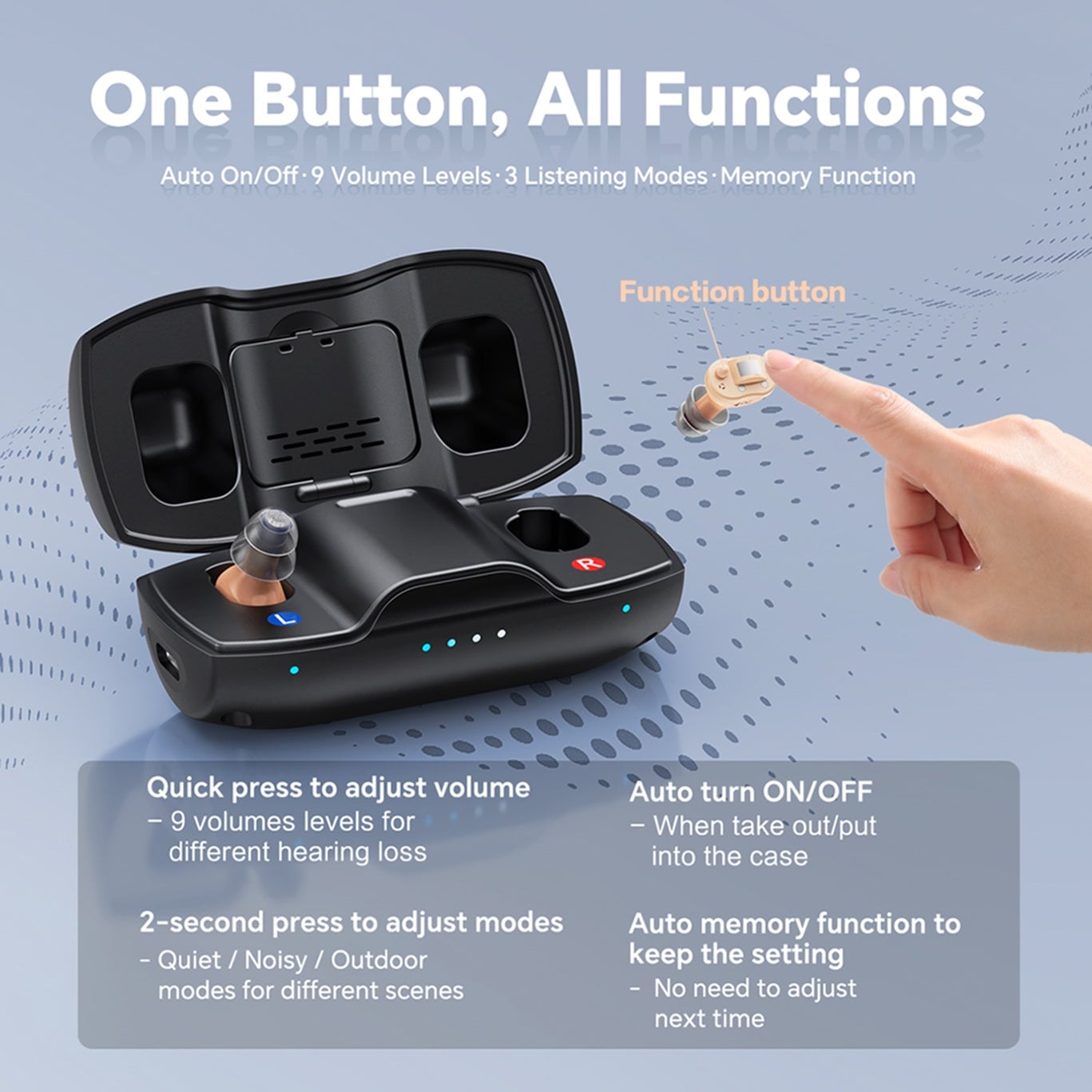
The Nova CIC sits fully in the canal, which keeps it out of sight during conversation. It runs on Onsemi semiconductor technology and offers 35db of sound gain across three listening modes. A portable charging case travels with the device, so charging does not depend on finding an outlet right away.
Its slim shape suits people who want a device nobody notices rather than one with visible tubing or hooks. Because it is rechargeable, there is no disposable battery to replace, which simplifies daily use for anyone new to hearing devices. The completely-in-canal fit also means it sits close to the eardrum, which is part of why the design stays compact.
Sensley S01 and S02: Earbud-Style Hearing Aids Without Dome Whistling

The Sensley S01 and Sensley S02 take a different approach, styled more like earbuds than traditional hearing aids. Both use a patented long-handle shape that keeps the microphone away from the receiver, which is the stated reason the design avoids the whistling common with dome-style units. Each model offers 35db of sound gain and smart touch control, with S01 built as a headphone-style design and S02 as an earbuds-style design.
Because neither model depends on a dome for fit, there is no dome blockage to manage day to day. Both come with rechargeable batteries and fast charging, plus a portable charging case. iBstone markets the earbud format toward anyone who already associates comfort with that shape rather than a discreet in-canal unit.
Rechargeable Technology and All-Day Battery Life Across the Range
Every model in the lineup, from the Nova CIC to the Sensley series to the Edge and AuraLink, uses rechargeable lithium batteries rather than disposables. The AuraLink model is rated for up to 20 hours of run time per charge, which covers a full day of use for most people. The K21 ITC model offers up to 20+ hours of use from a 2 to 3 hour charge, pairing fast charging with extended daily wear.
Portable charging cases accompany nearly every device in the range, letting a user top up power away from a wall outlet. The Edge model, built for waterproofing, also ships with its own portable charging case alongside an IP68 rating against sweat, rain, and dust. That combination of rechargeable cells and compact cases keeps these affordable OTC hearing aids simple to maintain across a full day of wear.
AI Noise Reduction and Speech Clarity in Budget-Friendly Models
Noise handling is where the lineup varies most by model. The AuraLink uses a 6nm chip with AI-driven noise reduction and integrated digital signal processing to suppress background sound and sharpen speech. The Nova CIC and K17/K19 completely-in-canal models rely on noise reduction tuned for mild to moderate hearing loss, aimed at clearer speech in everyday settings like family conversations or television.
AuraLink also pairs its processing with Bluetooth 5.4, enabling call and music streaming alongside an app-based hearing profile. That app lets a user take an in-app hearing test and adjust settings without a clinic visit. For simpler, non-Bluetooth models, the noise reduction works quietly in the background without an app layer attached, which keeps those affordable OTC hearing aids straightforward for anyone who prefers fewer settings to manage.
- 91% of surveyed users reported hearing better in group conversations after using the devices.
- 83% reported better clarity when listening to TV or radio at a normal volume.
- 89% reported increased confidence in social interactions.
- 91% said they would recommend the brand to friends and family.
- One verified buyer described RIC hearing aids as light and discreet, with dome sizing that gave a comfortable all-day fit.
What the 45-Day Money-Back Guarantee Covers for Risk-Free Trials
iBstone backs its range with a 45-day money-back guarantee, letting a buyer trial a device and return it for a full refund if it does not meet expectations. The brand describes this as a no-questions-asked policy, paired with customer support available at all times. For anyone weighing affordable OTC hearing aids against pricier clinical options, that trial period offers a way to test fit and sound without a long-term commitment upfront.
Support extends beyond the trial window too. iBstone‘s own listings mention lifetime care and support, alongside a tracking number issued for every order. Shipping is typically handled within 3 to 5 business days, according to those same listings.
Everyday Listening, Reconsidered
Across its range, the lineup treats clear conversation and comfortable TV listening as the baseline, not an upgrade. That focus has turned a once-specialist product category into something far more approachable for daily life.
