
Share This Article
Plenty of shoppers assume upcycled fashion is a polite word for secondhand basics pulled off a thrift rack. That assumption misses what actually happens when a label turns deadstock fabric and vintage garments into new designer pieces. Stuart Trevor UK builds entire collections this way, and the reality of upcycled vintage streetwear is far more deliberate than the myths suggest.
Upcycled Fashion Does Not Mean Secondhand Thrift Store Basics
The common misconception treats any reworked garment as a random find from a charity bin. In practice, Stuart Trevor UK sources specific vintage pieces from recognisable labels, not anonymous castoffs. A shirt described as a one-of-a-kind vintage Tommy Hilfiger piece, for instance, is upcycled rather than simply resold as is.
That distinction matters because upcycling involves actual design work on top of an existing garment. Panels get recombined, lettering gets added, and hems get reworked with new patch details. Calling that process thrift shopping ignores the amount of construction involved in turning an old shirt into a new silhouette.
The ‘Love Will’ Vintage Shirt Collections: Limited Editions and Designer Sourcing
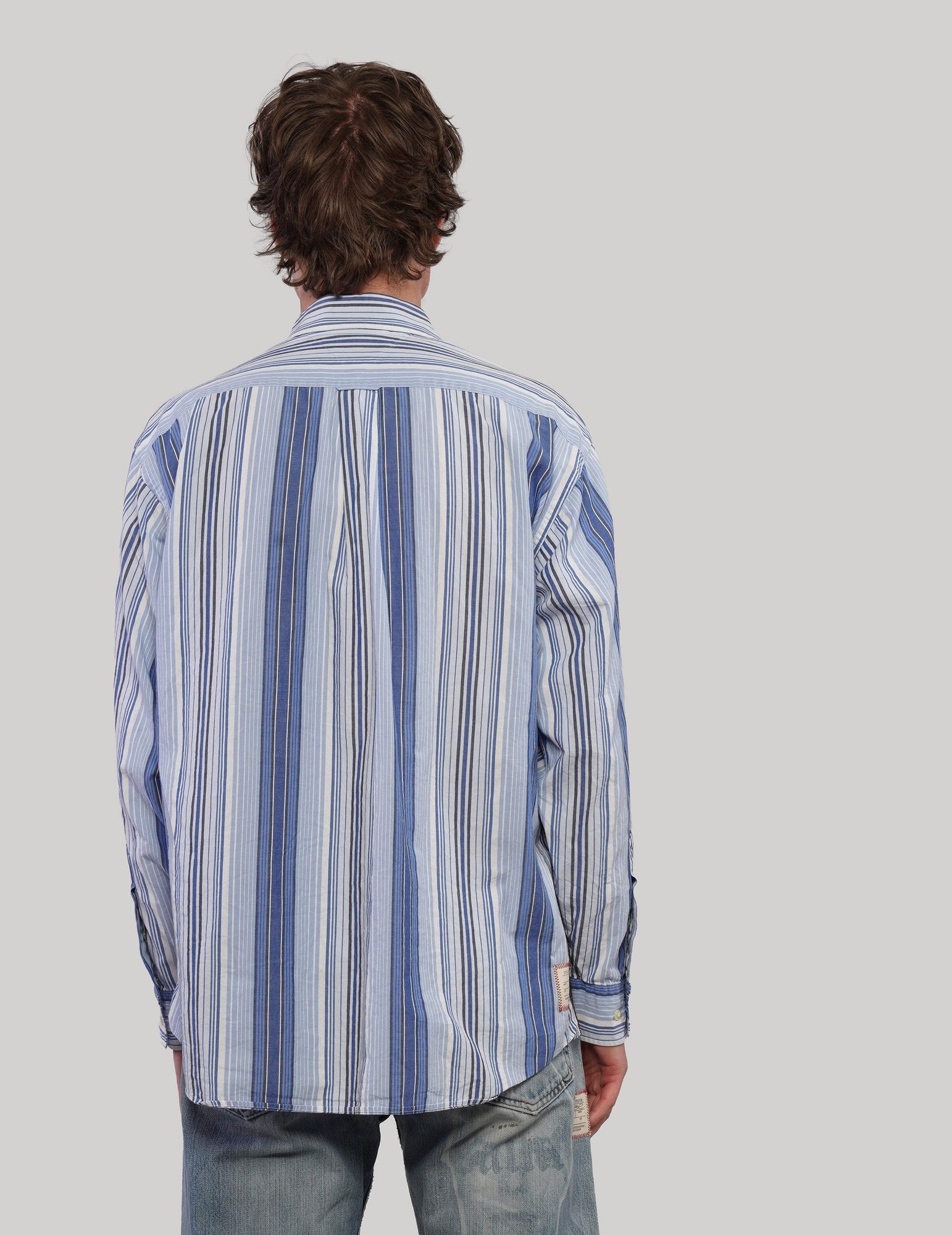
The ‘Love Will’ shirt line illustrates how limited the editions really are. Each shirt starts life as an authentic vintage piece, pulled from labels such as Christian Dior, T.M.Lewin, and COS, before being customised with the ‘Love Will Tear Us Apart’ lettering across the front. Because every base shirt is a different original garment, sizes and colourways vary from one piece to the next, from a charcoal pinstripe in a larger size to a grey fine-textured shirt in a smaller one.
This is a key reason the uniqueness claim around upcycled vintage streetwear holds up under scrutiny. A buyer is not choosing from identical stock in five sizes. The choice instead comes down to a single surviving garment, finished with a pointed collar, button-front fastening, and a curved hem bearing a patch detail.
Deadstock and Fabric Remnants: How Stuart Trevor Sources Materials

Another misconception is that sustainable labels rely entirely on recycled fibres spun from scratch. Stuart Trevor UK also works with deadstock, meaning fabric or finished stock that already exists and would otherwise sit unused. The woodland camouflage cargo trousers are one example, described as deadstock military-style trousers made from a cotton and polyester blend, complete with cargo pockets and adjustable side tabs.
Other pieces draw on genuine surplus uniforms rather than new fabric runs. A white vintage tank top, originally issued military stock over 40 years old, is individualised by hand with a painted detail over the original badge. Treating this as ordinary fast fashion overlooks the fact that no new textile production is involved at all.
Vintage Workshirts and Heritage Garments: Beyond Simple Alterations
Heritage garments in this range go further than a hemline adjustment or a button swap. The Hawaiian shirt line, for example, pairs a vintage base with a hand-sewn camouflage pocket and an added logo patch, changing the garment’s front detailing entirely. A bowling shirt made in London in a vintage gingham style carries a loop button closure and a bowling-style collar alongside the same logo patch treatment.
At the upper end of the range, a Hermès blazer gets reworked while keeping its original label intact, a cashmere, single-breasted, three-button piece finished with hand-stitched detailing. That kind of work sits well beyond a simple alteration job at a tailor. It shows how upcycled vintage streetwear can extend into tailoring-level garments, not only casual shirts and tees.
- Some assume every upcycled piece is interchangeable with ordinary secondhand clothing rather than a reworked, redesigned garment.
- Many believe limited-edition claims are a marketing trick, when in fact each base garment genuinely differs in fabric, size, and origin.
- Shoppers sometimes think deadstock material is lower quality simply because it is existing stock rather than freshly woven fabric.
- There is a persistent idea that sustainable production cannot involve recognisable designer sourcing, despite labels such as Dior and Hermès appearing in upcycled pieces.
- Some consumers assume environmental benefit only comes from recycled synthetic fibres, overlooking the role of reusing deadstock and surplus garments.
The Myth That Sustainable Streetwear Lacks Quality or Durability
A lingering belief is that anything labelled sustainable must compromise on fabric quality or finish. Several pieces from Stuart Trevor UK use 100% cotton construction, including the ‘Love Will’ shirts and the bowling shirt, rather than synthetic blends chosen purely for cost. Customer ratings across the brand’s own collections, sitting around 4.59 stars from over 150 reviews, suggest buyers are not treating these pieces as compromises.
Military-sourced garments also carry construction details associated with their original use, such as reinforced cargo pockets and adjustable side tabs on the camouflage trousers. None of that suggests upcycled streetwear is inherently flimsier than a newly manufactured equivalent. The myth tends to persist simply because people equate sustainability with scarcity of materials rather than careful reuse of well-made ones.
Viewed this way, the gap between fast fashion and upcycled vintage streetwear is less about quality and more about sourcing philosophy. Stuart Trevor UK treats existing garments and deadstock fabric as raw material for new design work, not a lesser substitute. That distinction is what separates genuine upcycling from the assumptions often made about it.
Understanding these details changes how the category reads overall. Upcycled vintage streetwear turns out to be a matter of sourcing and craft, not compromise.
