
Share This Article
Electric vehicles sold over the past decade or so rely on two different plug standards for alternating current charging, and picking the correct lead matters as much as picking the right charge point. The Type 1 vs Type 2 charging cables question comes up constantly for owners of older plug-in hybrids and early full-electric cars, since many of those vehicles were built before Type 2 became the agreed British and European standard. EV King – Electric Car Charging Acessories stocks both families, along with the adapters that let one connect to the other, covering vehicles from the pre-2018 Nissan Leaf through to current Type 2 models.
Understanding Type 1 Charging Cables for Older Electric Vehicles
A Type 1 cable uses the J1772 connector, a five-pin plug found on earlier American, Japanese, and European EVs. The Mitsubishi Outlander PHEV and the Nissan Leaf built before 2018 are two of the best-known examples still on the road. A typical Type 1 setup carries a rated voltage of 250V, with a common power rating of 7.4kW, though the car’s own onboard charger ultimately decides what current actually flows.
Because Type 1 was never adopted as the single standard across Europe, these cables now serve a shrinking but still active pool of older vehicles. Owners of these cars are not left without options, since both direct Type 1 leads and the adapters needed to reach newer infrastructure remain available through specialist suppliers. EV King – Electric Car Charging Acessories maintains stocks of compatible Type 1 leads in various configurations to support this ongoing demand.
Type 1 to Type 2 Charging Cables: Bridging Older Cars to Modern Charge Points
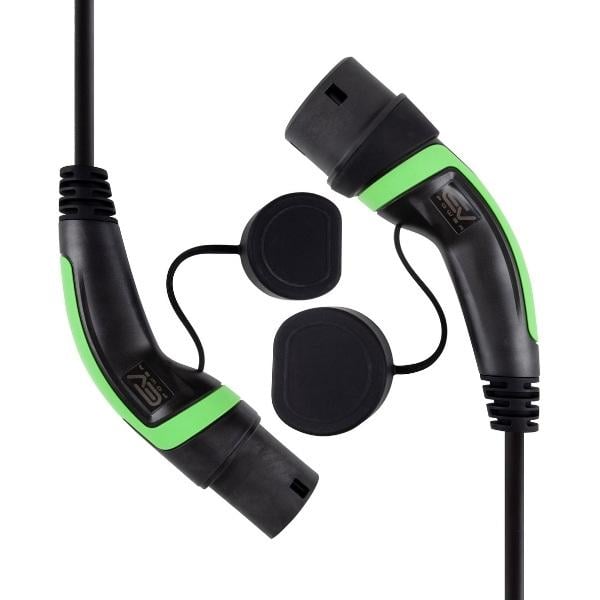
Most public charging stations across Britain now use a Type 2 socket, which creates a mismatch for any car still fitted with a Type 1 inlet. A Type 1 to Type 2 charging cable connects that older J1772 inlet to the Type 2 outlet found at almost every home wallbox and public charger. The listing comes in 5m and 10m lengths with 16A and 32A current ratings, and for most Type 1 cars the 16A version is the recommended fit since their onboard chargers rarely need more current than that.
Deciding between those ratings depends on what the vehicle’s onboard charger can actually accept, rather than defaulting to the highest number on the page. Since many Type 1 cars were built with smaller onboard chargers, a higher-rated lead does not automatically translate into a faster charge. This is one of the areas where the Type 1 vs Type 2 charging cables comparison turns less on the connector itself and more on matching the cable to the car.
Type 1 to 3 Pin Charging Cables: Domestic Socket Charging Without Installation
Not every Type 1 owner has access to a wallbox, and a Type 1 to 3 Pin charging cable addresses that gap by plugging straight into an ordinary household socket while drawing 2.3kW, a modest figure that nonetheless suits the smaller battery packs typical of older Type 1 vehicles. No installation or dedicated charging point is required, which keeps this option flexible for garages, driveways, or temporary parking.
Comparing Type 1 vs Type 2 charging cables in this context highlights a practical point. A 3-pin lead on either standard charges more slowly than a dedicated wallbox cable, but it remains a genuine backup for situations where a fixed charger is not available. For a Type 1 car with a smaller battery, that slower rate is less of a drawback than it would be on a larger modern pack. EV King – Electric Car Charging Acessories offers this configuration as part of its broader range of domestic charging solutions.
Type 2 to Type 2 Cables: The Standard for Contemporary EV Charging

Type 2 to Type 2 cables connect a current-generation EV’s Type 2 inlet to a matching Type 2 wallbox or public charger, and they form the largest part of the range. The standard listing is a 32A single-phase cable supplied in 10m, chosen because a single-phase British home supply carries 7.4kW and the 32A lead passes the full amount, giving the fastest charge available without stepping up to three-phase power. Such cables also carry warranty cover of up to 2 years, a detail that applies across the Type 2 range as much as the Type 1 one.
Vehicles such as the Mercedes EQE and Mercedes GLA 250e use this exact cable type, though their onboard chargers vary considerably by model year. The EQE Saloon, for instance, comes with an 11kW charger as standard, with a 22kW option on certain variants, while the GLA 250e takes 7.4kW on cars built up to 2023 and 11kW three-phase on later production. This spread of onboard ratings is exactly why matching cable specification to the vehicle, rather than assuming one size fits all, remains important across the Type 2 to Type 2 range.
Type 2 to 3 Pin Charging Cables: Flexible Home Charging Without a Wallbox
A Type 2 to 3 Pin charging cable, listed as the V4 version, suits situations where a wallbox has not yet been installed, where a parking space sits out of reach of a fixed charger, or where a spare lead is kept in the boot for nights away from home. Because Type 2 vehicles generally carry larger battery packs than older Type 1 cars, charging from a household socket on this route takes noticeably longer to cover the same distance. One end fits the car’s Type 2 inlet, and the other goes straight into the wall.
This option will not match the charging speed of a dedicated wallbox cable, since household sockets are not built for high current draw. It functions instead as a contingency lead, useful precisely because it needs no professional installation to work. EV King – Electric Car Charging Acessories positions this cable alongside the Type 2 to Type 2 range as a complementary, rather than competing, option for owners seeking flexible charging arrangements.
Cable Length and Power Rating Variations Across the Range
Beyond connector type, cable length and current rating both affect how a cable performs in practice, and the range carries several of each. The standard Type 2 to Type 2 lead comes in 10m, while an 8m version is offered exclusively as a 32A three-phase cable, described as the only 8m cable in the range. Longer options extend to a 15m cable, offered in two forms, and a 20m cable described as the longest available, intended for cars that cannot park close to the charge point because of on-street charging, awkward driveways, or a wallbox positioned on the wrong side of a building.
Choosing between these lengths depends on parking layout rather than vehicle type. A 15m cable is pitched as the length to reach for when a 10m lead almost works but falls just short. The points below summarise how Type 1 and Type 2 connectors differ across the areas that matter most when selecting a cable.
- Type 1 connectors use a five-pin J1772 plug fitted to older EVs such as the pre-2018 Nissan Leaf and the Mitsubishi Outlander PHEV, while Type 2 connectors use the Mennekes design standard on virtually all current EVs sold in Britain.
- Type 2 to Type 2 cables can carry higher current, with the 32A single-phase lead passing the full 7.4kW available from a typical single-phase home supply.
- Type 1 vehicles generally carry smaller onboard chargers, which is one reason a Type 1 to Type 2 cable is offered in more than one current rating.
- A 3-pin cable, whether Type 1 to 3 Pin or Type 2 to 3 Pin, allows charging from a household socket without any wallbox installation, at the cost of a slower charge rate.
- Three-phase ratings, such as the 32A three-phase specification on the 8m cable, apply to charge points and vehicles wired to accept three-phase power rather than the single-phase supply found in most homes.
Working through the Type 1 vs Type 2 charging cables distinction ultimately comes down to what inlet a vehicle has and where it will be charged. Product listings searchable by car model or registration number are built to match a given vehicle to the correct cable length, connector type, and current rating without guesswork.
The right cable depends on the car, not a generic preference.
