
Share This Article
Experienced athletes rarely need convincing that pre-workout matters. What they need is a way to match a specific formula to a specific session, rather than relying on one generic tub for every type of training. Understanding how Move Pre-Workout formulas differ in ingredients and intended use makes that kind of selection possible, instead of guessing from a label alone.
Why Experienced Athletes Need Formula Specificity, Not Generic Pre-Workout
A lifter chasing a heavy single and a runner building toward a half-marathon are not solving the same physiological problem. One needs focus and short bursts of output, while the other needs sustained stamina and hydration across a longer window. Generic pre-workout blends tend to average these needs out, which often leaves something missing for either goal. Move Pre-Workout keeps its Strength, Endurance, and Decaf formulas as separate products rather than one catch-all mix, and that separation becomes more useful once training is structured around distinct blocks rather than a single routine.
Someone cycling between strength blocks and cardio phases, or training twice in a day, benefits from formulas built around the demands of each session. Choosing among Move Pre-Workout formulas, rather than defaulting to one variant for everything, is the practical outcome of that structure. It also means a training bag can carry more than one option without duplicating the same stimulant load each time.
MOVE Strength Formula: Caffeine, Focus, and Power Output Without Beta-Alanine
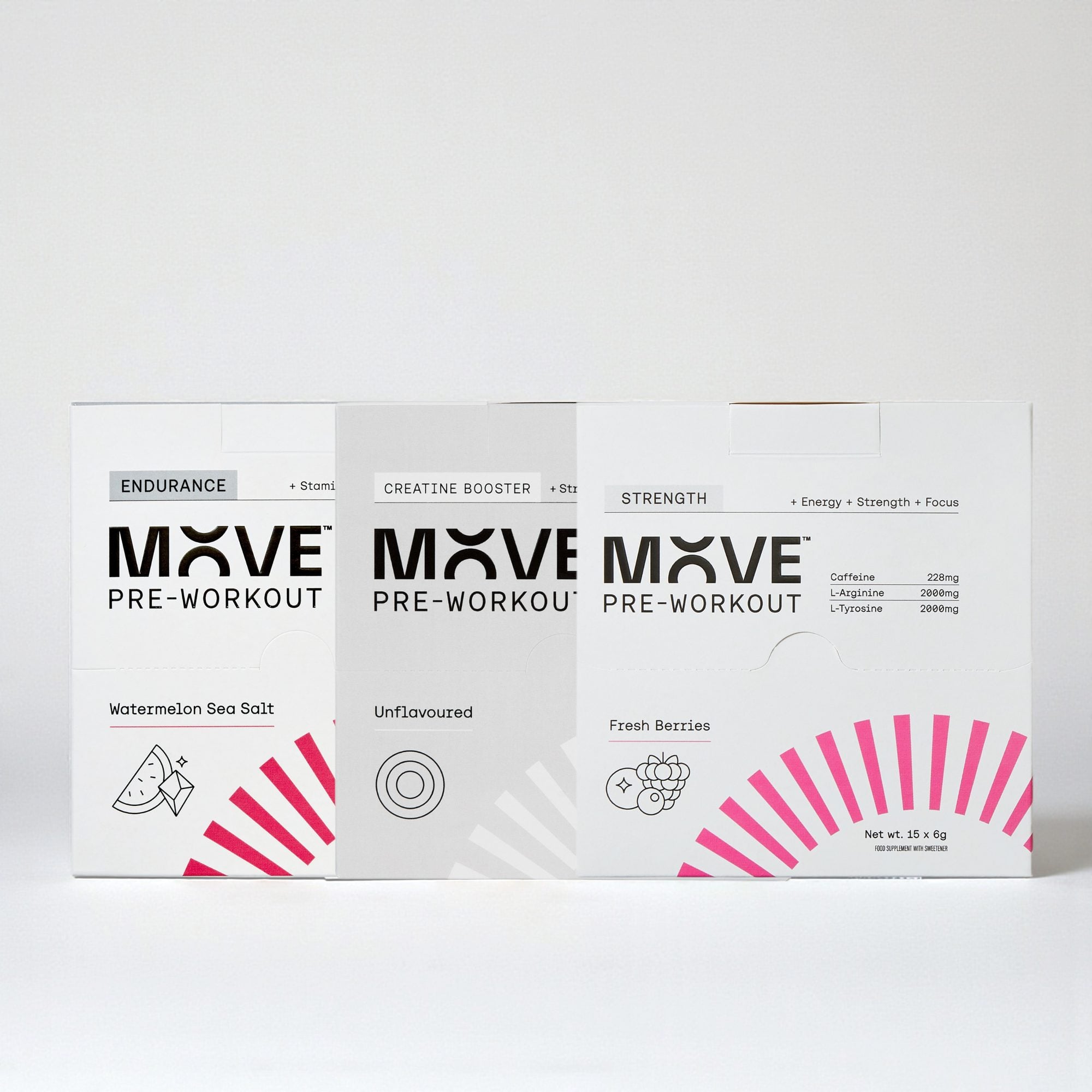
MOVE Strength Formula is built around 228mg of caffeine for sustained energy, paired with L-Tyrosine to support focus during heavy lifting. Notably, it leaves out beta-alanine, which some lifters avoid because of the tingling sensation it can cause. The formula is positioned for strength training specifically, rather than as a general-purpose energy product.
For athletes prioritising clean mental focus during compound lifts, this combination is a defining feature of the Strength line. It is available as both sachets and a tub, which adds some flexibility for a training bag or a home setup. That format choice matters for athletes who split time between a gym and travel.
MOVE Endurance Formula: Hydration and Stamina Support for Longer Sessions

MOVE Endurance Formula takes a different ingredient approach, built around L-arginine, caffeine, and electrolytes. These are aimed at supporting VO₂ max and fatigue resistance across longer cardio efforts, such as half-marathon training. The inclusion of electrolytes reflects the different demand of endurance work, where hydration becomes a bigger factor than it is in a short strength session.
The Endurance line is sold in both sachet and tub formats, including a trial pack of seven sachets for a short introduction to the formula. It is described as built for runners, cyclists, and others covering distance, which separates its intended use from the Strength formula’s focus on lifting sessions. Olympic silver medallist Laura Muir has spoken about using it to hold intensity through harder sessions.
MOVE Decaf Formula: Sustained Performance for Evening and Double-Training Days
MOVE Decaf Formula removes caffeine entirely, which changes when and how it fits into a schedule. It is described as built for late-day sessions, double training days, and situations where overstimulation is a concern, and that caffeine-free design is what sets it apart among Move Pre-Workout formulas rather than making it a weaker version of the other two. The formula still aims to support strength, focus, and endurance, according to the brand, just without the stimulant component.
It is available in two flavours as a 15-pack of sachets, and a free trial pack also exists for testing it beforehand. For training scheduled in the evening or a second session later in the day, the absence of caffeine is the defining practical difference.
How Training Type Determines Formula Selection
The three formulas map fairly directly onto three types of training demand. Strength sessions call for focus and short-duration power, which is where the Strength formula’s caffeine and L-Tyrosine combination is positioned. Endurance sessions call for sustained output and hydration, which is the role of the Endurance formula’s electrolyte and L-arginine content.
Timing adds another layer on top of training type. A morning heavy-lift session and a late-evening recovery run are not interchangeable in terms of stimulant tolerance, even though both involve exercise. This is where Decaf becomes relevant, since it allows training to continue later in the day without adding to the caffeine load of the other two formulas.
- A morning strength session before work favours the Strength formula’s caffeine and focus-oriented ingredients.
- A long weekend run or cycling session aligns with the Endurance formula’s electrolyte and stamina-focused composition.
- An evening gym visit after a full day of caffeine intake suits the caffeine-free Decaf formula better than a stimulant-based option.
- A second training session on a double-training day can rely on Decaf to avoid compounding stimulant intake from an earlier Strength or Endurance serving.
- Half-marathon or distance-running blocks are the specific discipline the Endurance formula’s sachets and trial pack are built around.
Stacking Formulas: The Complete Hybrid Setup Approach
Because training needs shift across a week, some athletes do not rely on a single formula at all. Move Pre-Workout offers a Complete Hybrid Setup that bundles Strength, Endurance, and Decaf together, allowing the choice to shift with how and when training happens. The same bundle logic appears in the Complete Strength Setup, which pairs Strength formula with a Creatine Booster, and the Complete Endurance Setup, which pairs Endurance formula with a Carb Booster, each available in three flavours.
A Hybrid Starter Bundle combines Strength, Endurance, and Creatine Booster sachets, plus a premium shaker and a performance tee, for athletes who train across both disciplines. A Limited Edition Discovery Bundle offers a smaller introduction, combining Strength, Endurance, and Creatine Booster sachets for side-by-side comparison. Across all of these, the underlying logic stays the same, matching the formula to the session ahead rather than picking a single default tub.
Training cycles rarely stay fixed for long, and fuelling choices can shift alongside them without switching brands entirely. That kind of flexibility, built across three distinct formulas, is likely to matter more as schedules get busier.
