
Share This Article
Search IQ vs Social IQ describes two separate paths ad built for advertisers chasing customers who already show buying intent, each tied to a distinct type of inventory rather than a shared auction. Deciding between the two often comes down to where an audience already signals readiness to buy, and what an advertiser already has running. Ad.net positions both marketplaces under one intent-driven advertising approach, built on more than 20 years of experience serving global brands and agencies.
What Search IQ Does: Intent-Driven Search Beyond Google and Bing
Search IQ connects advertisers with millions of in-market customers outside the reach of Google and Bing. Instead of competing solely in those two auctions, campaigns running through Search IQ tap into It.net’s own search marketplace, powered by Keyword Intent Technology. This proprietary approach drives performance at scale by delivering high-intent customers directly to a brand’s site. As a result, search budgets can stretch into inventory that sits outside the usual two engines every advertiser already bids on.
What Social IQ Does: Keyword Intent Meets Premium Publisher Handles
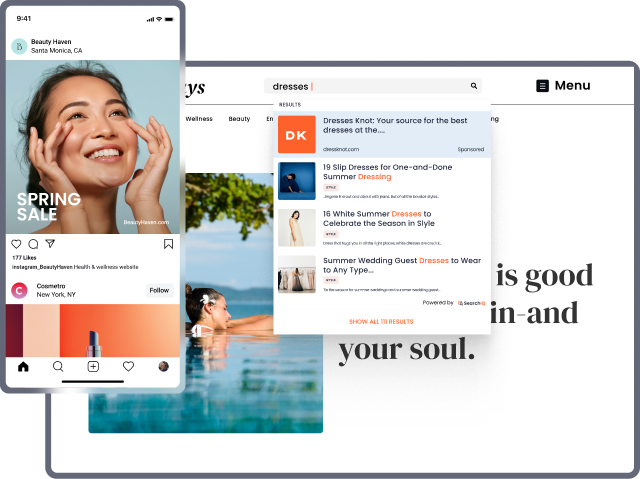
Ads placed through Social IQ appear on established accounts across Facebook and Instagram rather than through a brand’s own social pages. That structure is meant to engage target audiences while adding a layer of credibility, since the ad shows up on a handle the audience already follows. Social IQ leverages keyword search intent data combined with these trusted publisher handles to reach unique audiences beyond an advertiser’s existing social media buys. For advertisers weighing Search IQ vs Social IQ, this publisher-handle placement is the clearest structural difference between the two marketplaces. The two were therefore not designed to replace one another but to cover different parts of an intent-driven strategy.
Smart Pricing™ and Keyword Intent Technology in Search IQ

Search IQ relies on two named components to support advertiser goals. Smart Pricing™ is Ad.net’s innovative algorithm for adjusting cost per click so that brand KPIs are met. Alongside it, Keyword Intent Technology powers the proprietary search marketplace, aiming to deliver high-intent customers directly to a brand’s site at scale. The integration process is handled by Ad.net’s team, described as quick, effective, and hassle-free, with onboarding and testing managed end-to-end.
Top Tier Social Handles and First-Party Data in Social IQ
Social IQ’s distinguishing feature is its access to top tier social handles across Facebook and Instagram. These premium accounts reach audiences built around lifestyle, beauty, media, and similar interest categories. On top of that, Social IQ layers in keyword intent first-party data, combining search signals with social placement to reach audiences beyond a brand’s existing social media buys. This combination of credibility and reach ties the handle’s established following to the advertiser’s message. ad.net positions this as Trusted Social Sells, emphasizing the credibility boost that comes from having an the brand featured on a well-established publisher handle rather than appearing solely through paid placements on generic inventory.
When to Use Search IQ vs. Social IQ: Use Cases Across Industries
A retailer wanting to supplement existing Google and Bing campaigns with additional search volume may lean toward Search IQ. A brand in beauty, lifestyle, or media looking for a credibility lift through recognized social accounts may find Social IQ more aligned with that goal. ad.net’s published case studies span retail, automotive, financial services, and telecom, covering both new customer acquisition and in-store driving efforts. This variety of applications reflects how both marketplaces can be applied across different advertiser goals and industries rather than fitting one fixed category.
- Search IQ draws from search-style queries outside Google and Bing through Keyword Intent Technology, while Social IQ reaches audiences through existing publisher handles on Facebook and Instagram with first-party data.
- Search IQ integration runs through managed onboarding and testing handled by Ad.net’s team, whereas Social IQ combines search intent data with established social placements on premium handles.
- Search IQ applies Smart Pricing™ to adjust cost per click against campaign KPIs, while Social IQ’s value centers on the credibility and reach of top tier social handles that audiences already follow.
- Search IQ suits advertisers chasing additional in-market search volume beyond the two dominant engines, while Social IQ suits advertisers seeking social reach paired with established publisher trust.
Search IQ extends search reach beyond the dominant engines, while Social IQ extends social reach beyond a brand’s own handles by borrowing credibility from established accounts. Many of ad.net’s case studies, spanning retail, automotive, financial services, and telecom, show advertisers using intent-driven strategies to diversify how new customers get found rather than relying on one channel alone. Weighing Search IQ vs Social IQ often means matching the marketplace to whichever channel the advertiser has yet to fully tap into.
Both marketplaces open new doors for intent-based advertising without requiring brands to step away from the channels already in place.
