
Share This Article
The market for performance running shoes spans daily trainers, carbon-plated racers, and trail-ready builds that handle mud and rain alike. Mapping a single brand onto that landscape means looking at how its collections split between everyday mileage, race day, and rough terrain. Saucony is one of the established names in that space, with a lineup that covers most of those categories at once.
How the Running Shoe Market Splits by Purpose
Shoes are usually judged on cushioning, weight, stability, and how well they hold up across repeated training sessions. The category also includes apparel and accessories built for the same purpose, from moisture-managing tops to weather-resistant jackets. Buyers shopping this segment tend to separate shoes by purpose, such as daily training, speed work, or trail conditions, rather than by a single all-purpose model. That segmentation shapes how most running brands organize their catalogs, including Saucony.
Gear in this space also includes lifestyle sneakers that borrow design cues from running silhouettes without the same technical focus. The line between performance and lifestyle has blurred in recent years, with some models serving both purposes. Understanding where a brand draws that line helps explain the shape of its product range.
Saucony’s Approach to Running Shoe Design and Testing
Saucony describes itself as a maker of performance running shoes, accessories, and apparel, with an ongoing focus on studying the human body and testing products for quality and durability. That framing positions the brand around continuous refinement rather than a single signature technology, organizing the catalog by purpose, training, racing, trail, and everyday wear, instead of around one flagship shoe. The stated aim is the running experience itself, whether that means a first kilometer or longer-distance training.
This emphasis on testing shows up across the range as distinct product families built for different purposes rather than a single universal shoe. That structure gives a sense of how the brand segments its range before even looking at individual models.
Daily Training Shoes: The ProGrid and Guide Collections
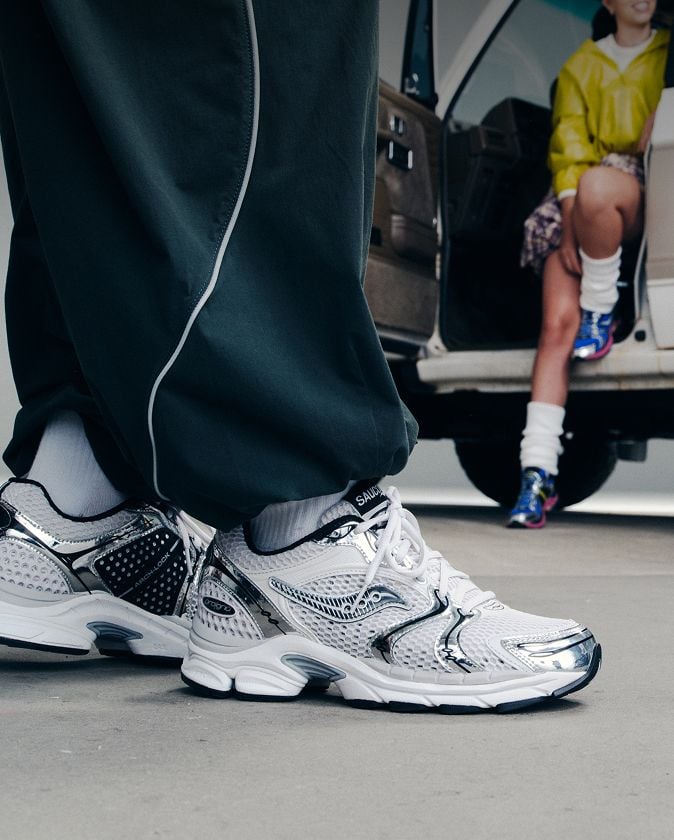
For everyday mileage, Saucony lists models such as the Ride 19, Triumph 24, Guide 19, and Guide 19 Wide, alongside the Cohesion 19 and Omni ST 23 for daily stability needs. These are described as daily trainers, a premium trainer, or an accessible ride option, depending on the specific model. The Procyon Max joins the Hurricane 26 and Paramount Max as additional max comfort options within the same daily-use category.
That range of daily trainers, from accessible to max comfort, shows how one brand can address multiple training needs under a shared naming structure. It also illustrates how shoes for everyday mileage differ from the lighter builds made for race day.
Racing and Speed-Focused Shoes: The Endorphin Series

Speed work and race day get their own naming convention through the Endorphin series. The lineup includes the Endorphin Speed 6, described as offering lighter, faster foam, alongside the Endorphin Pro 5 as a premium race option and the Endorphin Elite 3 as a performance trainer for racing. The Endorphin Azura is listed as a performance trainer as well, while the Kinvara 16 is described as a light and minimal shoe.
This split between race-day models and lighter trainers reflects a common pattern across performance running shoes generally, where racing flats and super shoes sit apart from daily mileage footwear. Saucony keeps the Endorphin name attached specifically to its faster, race-oriented models, which sets that series apart from the daily trainers covered earlier.
Trail Running and Weather-Resistant Options: Peregrine and Gore-Tex Footwear
Outside of road running, Saucony lists trail-specific models including the Peregrine 16, alongside Shadow 6000 GTX and Shadow 5000 for lifestyle-leaning trail styles. The ProGrid naming also appears on models like the ProGrid Guide 7, ProGrid Omni 9 GTX, ProGrid Triumph 4, and ProGrid Ride 1, with Gore-Tex construction carried on the ProGrid Omni 9 GTX and the Triumph 24 GTX, listed as a waterproof trainer. The brand frames its Gore-Tex shoes around handling changing weather conditions during training.
Trail and weather-resistant footwear forms a distinct segment within performance running shoes because it addresses terrain and conditions that road-focused models are not built for. By keeping dedicated trail names like Peregrine alongside Gore-Tex versions of road models, the catalog covers muddy trails and wet pavement at the same time.
Beyond Shoes: Saucony’s Running Apparel and the Community Philosophy
Saucony‘s range extends past footwear into apparel, listing men’s and women’s tops, leggings and shorts, and men’s pants and shorts, alongside a lifestyle clothing category. A seasonal collection, described as a sweater weather collection drawing on 90’s heritage, shows the apparel side reaching into more casual wear as well. This broadens the brand beyond strictly technical running gear into everyday clothing with a running heritage.
The brand also frames its identity around a running community, referenced through a program called Run as One, which it describes as a way of finding pace and community together. It points to events and community content as part of that broader positioning. That combination of footwear, apparel, and community messaging shows how the brand frames its place in the shoes market.
- Daily training shoes such as the Ride, Triumph, Guide, Cohesion, Omni, Hurricane, and Procyon Max lines cover stability and cushioning needs for regular mileage.
- The Endorphin series, including the Speed 6, Pro 5, Elite 3, and Azura, addresses racing and faster training sessions.
- Trail and weather-resistant footwear includes the Peregrine 16, Shadow 6000 GTX, Shadow 5000, and Gore-Tex versions of road models such as the Triumph 24 GTX.
- Lifestyle sneakers and casual collections sit alongside the technical running range.
- Running apparel spans men’s and women’s tops, leggings, shorts, and pants, plus a seasonal lifestyle clothing collection.
That structure gives a clear picture of where the brand sits within the broader performance running shoes market, covering training, racing, trail, and everyday wear under one name.
