
Share This Article
Reliable backup power has become a bigger priority for households and outdoor enthusiasts alike. Portable power stations and home backup systems now sit alongside solar panels and generators as part of a broader renewable energy category. anker solix has built a range that spans both ends of this spectrum, from compact units for travel to whole-home systems designed for extended outages. This article looks at how these categories work and where the brand’s lineup fits within them.
What Are Portable Power Stations and Home Backup Systems
Portable power stations are self-contained battery units that store electricity and release it through standard outlets or USB ports. They charge from wall power, a vehicle, or solar panels, and they can run small appliances, electronics, or tools without a fixed installation. Home backup systems, by contrast, connect directly into a household’s electrical panel, and they keep larger circuits, or an entire home, running during a grid outage.
Both fall under the renewable energy umbrella because many of them pair with solar panels to recharge without relying solely on grid electricity. The distinction is really about scale and installation rather than purpose. A portable unit can travel to a campsite, while a whole-home system stays wired in place. anker solix sells across both ends of this range, from pocketable stations to installed systems.
Key Differences Between Portable and Whole-Home Backup Solutions
The core difference between a portable station and a home backup setup comes down to capacity, installation, and intended duration of use. A portable unit is meant for short bursts of power away from home, while a whole-home system is built to sustain a property through hours or days of an outage. Output capability also differs sharply, since whole-home units start demanding loads like central air conditioning, something a smaller portable device is not designed to do.
- Camping trips and outdoor events typically call for a lightweight, portable station that can charge phones, lights, and small coolers.
- Severe weather preparedness often favors a whole-home backup system that can switch over automatically when the grid fails.
- Grid outages affecting an entire neighborhood tend to require higher battery capacity than a single portable unit can provide.
- Remote work setups or tailgating scenarios lean on portable stations because of their size and ease of transport.
- Homes with central air conditioning or well pumps generally need a system capable of higher output than typical portable options.
Anker Solix S2000: Portable Power for Outdoor and Travel Use
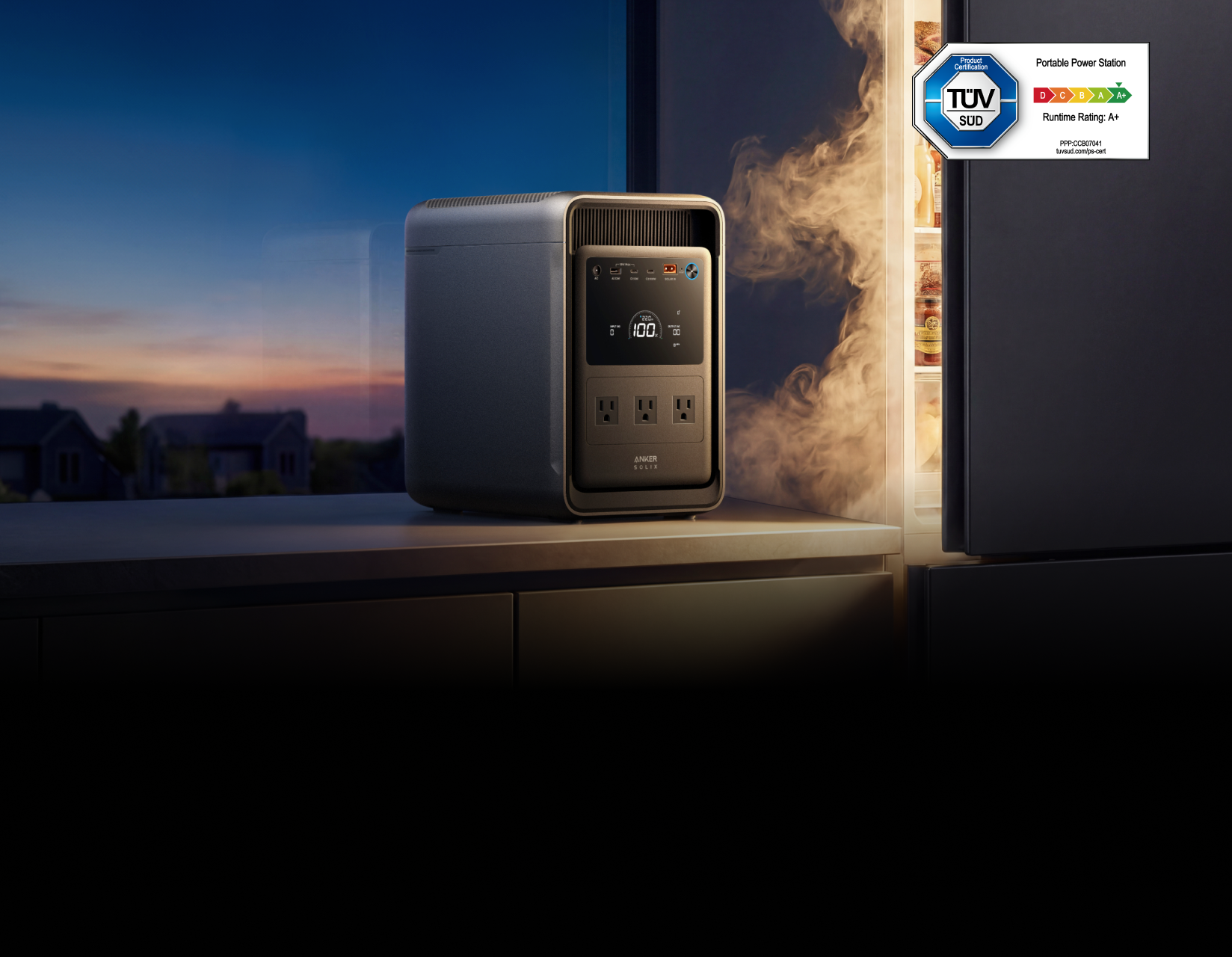
anker solix markets the S2000 as the longest-lasting 2kWh portable power station in its current lineup. It suits scenarios where a fridge, lighting, or small electronics need power away from a fixed outlet. According to the brand, the S2000 can sustain up to 35 hours of fridge backup, which makes it relevant for both outdoor trips and short home interruptions. Its compact format keeps it relevant to portable power stations and home backup discussions without the installation commitment of a larger system.
Anker Solix E10: Whole-Home Backup with Expandable Battery Capacity

At the other end of the range sits the E10, described as the world’s first smart hybrid whole-home backup system. It carries UL9540 and UL9540A certification and offers battery capacity that expands from 6kWh up to 90kWh depending on configuration. That range lets a household scale capacity according to its own needs rather than being locked into one fixed size.
The E10 also lists turbo output between 10kW and 30kW, solar input between 9kW and 27kW, and support for a 4.5kW smart generator. It can start a 5-ton central air conditioner and switches to backup power in ≤20ms. The system also monitors severe weather and auto-charges through solar and grid sources ahead of an expected outage, then switches to battery power once the grid goes down.
Solar Integration and Charging Flexibility Across the Range
Solar charging is a consistent thread across several products, not just the flagship whole-home system. The F3000, listed as UL9540 certified, supports dual solar charging up to 2,400W and can reach a full charge in under two hours under optimal sunlight. It also offers pass-through charging at 3,600W, letting a unit charge and power devices simultaneously without shutting down, and its single-unit configuration can expand up to 24kWh of capacity.
The F3800 line follows a similar pattern, with solar input up to 2,400W across dual 60V inputs and a recharge time under two hours in good sunlight. Two F3800 units paired with expansion batteries can scale up to a combined 53.8kWh of capacity. The units also support direct EV and RV charging and carry EV-grade LFP batteries with a stated lifespan of 10 or more years and a 5-year warranty. This shared emphasis on solar input across different product sizes shows how anker solix positions itself within the renewable energy category rather than as a pure battery backup maker.
Choosing Between Portable and Whole-Home Systems
Deciding between a portable unit and a whole-home system largely comes down to how much of a property needs to stay powered and for how long. A single room, a weekend trip, or a handful of devices points toward a compact station like the S2000. A property that needs to keep lighting, refrigeration, and larger appliances running through an extended outage points toward a system with expandable capacity, such as the E10 or the F3000 and F3800 configurations.
The presence of options across both categories means the choice between portable power stations and home backup systems is less about availability and more about matching capacity, output, and installation type to the situation at hand. anker solix offers both outdoor-oriented stations and home-installed systems that scale with additional battery packs.
As outages and extreme weather grow more common, the line between outdoor equipment and household infrastructure keeps blurring.
