
Share This Article
Selecting among the many gaming pc cases on the market often comes down to form factor, cooling design, and how a build looks on a desk. AlphaCores organises its case range into clear categories, from compact showcase builds to full-tower performance chassis, covering fish tank designs, gamer cases, high performance cases, and small cases. The sections below walk through what each category offers and how the options compare.
Gaming Cases and Mid-Tower Options at AlphaCores
The gamer cases section at AlphaCores lists dozens of mid-tower builds aimed at everyday gaming setups. Models such as the 1st Player Firebase XP Mid Tower Case arrive with six RGB fans already installed, while the Go6 series offers both black and white ATX chassis with four FRGB fans. The Rainbow R6-A rounds out the range with a four-fan mid-tower layout built for straightforward ATX builds.
These mid-tower gaming pc cases tend to favour accessible front panels and multiple pre-installed fans rather than extensive customisation. That makes them a practical starting point for builders who want lighting and airflow sorted without sourcing extra parts separately. Several models, including the IS3-BK and IS3-WH, come in both black and white finishes, giving some room to match an existing setup.
Fish Tank Cases: Showcase Builds with Compact Footprints
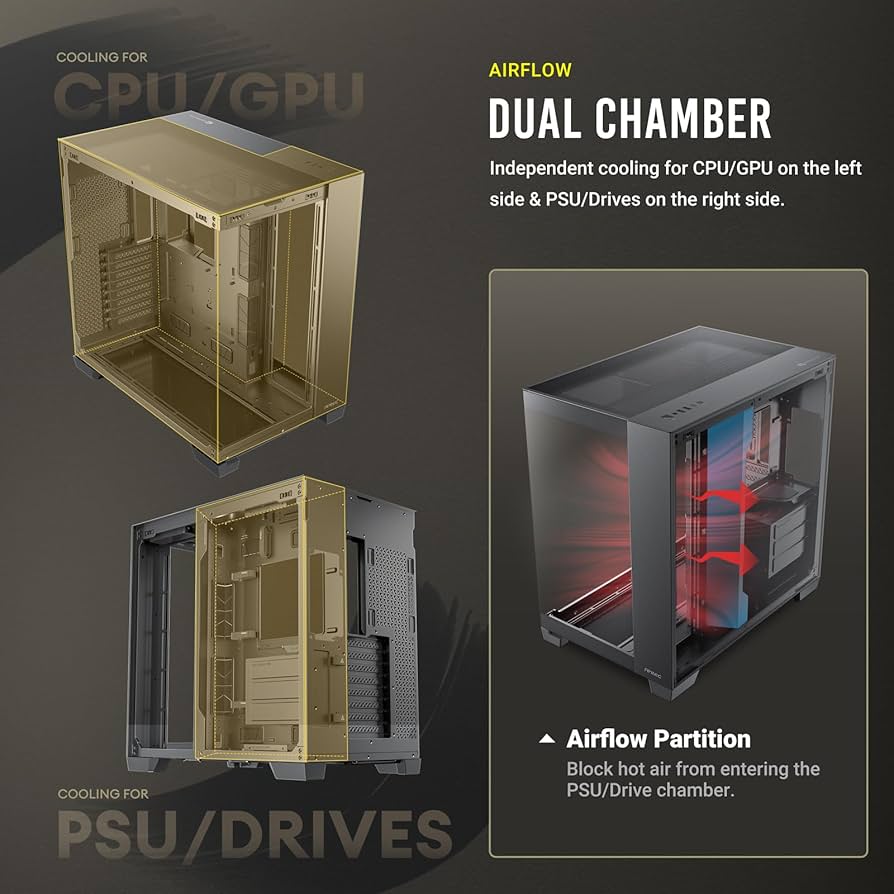
The brand groups its fish tank cases around builds designed to display internal hardware clearly, often through expansive glass panelling. The MIKU Mi8 White Mid Tower Case ships with seven ARGB fans, making it one of the more heavily illuminated options in this group. The 1st Player Steampunk SP7 and SP8 series offer alternative mid-tower shapes in both black and white, each aimed at visible, showcase-style builds.
Alongside these, the UV6 line from 1st Player appears in micro-ATX form, with versions offering three RGB fans in either black or white. This gives builders working with smaller motherboards a route into the fish tank aesthetic without needing a full ATX tower. The variety across the fish tank range shows how the catalogue treats visual display as a core design goal rather than an afterthought.
High Performance Cases: Full-Tower and E-ATX Solutions

For larger builds, the high performance cases category includes full-tower and E-ATX options built around airflow and expansion space. The Antec 900 Full Tower ATX Case supports E-ATX motherboards and includes USB-C connectivity alongside six PWM fans and tempered glass panelling. The Antec Flux PRO Full Tower Tempered Glass E-ATX case follows a similar full-tower approach, pairing a black and wood finish with tempered glass.
The Antec P20CE Solid E-ATX Mid Tower Case takes a different route within the same category, using a metal mesh front panel with three 120mm PWM front fans for airflow. It supports E-ATX, ATX, micro-ATX, and ITX motherboards, which gives it unusual flexibility for a mid-tower chassis. Connectivity on the P20CE includes two USB 3.0 Type-A ports and one USB 3.2 Gen 2 Type-C port, positioned at the top of the case for easy access.
Antec FLUX Series: Hybrid Design and Thermal Performance
The Antec FLUX platform, described as an abbreviation of Flow Luxury, is built around case structure intended for airflow. Within the high performance cases category, the Antec FLUX ARGB Gaming Case comes in both an E-ATX black version with a glass side panel and mesh and wood front marked as BTF ready, and a micro-ATX variant, the Antec FLUX M Gaming Case, that brings the same mesh and wood styling to a smaller footprint with ARGB fans included. That spread lets the same design language cover builds at two different sizes.
The Antec Flux Pro Full Tower Case extends the line further, with a built-in ARGB and PWM fan control hub that syncs with the motherboard. Across its variants, the FLUX series pairs tempered glass, mesh panelling, and wood front accents in different combinations depending on size. AlphaCores lists these alongside the standard FLUX ARGB models rather than as a separate line.
Small Cases and Micro-ATX Form Factors
The small cases category covers micro-ATX and compact chassis for builders working with limited desk space. The CiT S8i SFF Micro-ATX Case offers a compact black chassis with USB 3.0 and an 80mm fan, while the CiT Mentor Micro-ATX Case takes a more office-style black design with a rear 80mm fan and USB-C. The DeepCool CH160 Mini-ITX case pushes the form factor smaller still, described as an ultra-portable gaming case available in black or white.
Other small-case entries include the 1st Player MIKU Mi6-EV Emotion View and the IS3-PK Micro ATX Pink Case, which brings a colour option not common elsewhere in the lineup. The CiT S014C Slim Micro-ATX Case uses a 300W TFX power supply format, suited to builds where internal space is tightly constrained. Together these models show that compact gaming pc cases do not have to drop every feature found in larger chassis.
Cooling, Airflow, and Build Compatibility Across the Range
Across its full catalogue, AlphaCores lists cases with differing approaches to cooling, from mesh front panels to multiple pre-installed fan configurations. The Antec P20CE, for instance, relies on a removable metal mesh front panel paired with a full-size dust filter for airflow and dust control. Other models lean on fan count instead, with several gamer cases shipping with four to seven fans already fitted.
- Airflow design varies from mesh front panels with dust filters to multi-fan configurations built into the front and sides of the chassis.
- Form factor ranges from mini-ITX and micro-ATX up to full ATX and E-ATX, affecting which motherboards and components a case can accommodate.
- Tempered glass panelling appears across several ranges, including the Antec 900 and the Antec FLUX series, for visibility into the build.
- ARGB fan integration is common in the fish tank and gamer categories, with some models including as many as seven fans.
- Aesthetic options include wood front accents, colour finishes such as white or pink, and BTF-ready layouts for cable routing.
Compatibility also varies by model, with the P20CE supporting four different motherboard formats in a single mid-tower shell. That breadth matters for anyone comparing gaming pc cases against a specific motherboard size before settling on a chassis. Builders working from a defined parts list can narrow choices by cross-checking motherboard support alongside fan count and panel material, and the catalogue keeps those specifications listed case by case.
Gaming pc cases ultimately differ by form factor, cooling style, and finish rather than by any single standout spec. The range covered here spans that spread end to end.
