
Share This Article
Choosing between lab grown vs natural diamonds often comes down to certification, visual grading, and how each stone fits into a finished piece of jewellery. Finediam stocks both categories across rings, earrings, bracelets, and necklaces, and a dedicated ready-to-ship section on the site covers all four categories with free ring resizing and a 30 day free return window attached to orders. Understanding how the two collections differ in grading, carat weight, and metal pairing makes it easier to see what each range actually offers.
Lab-Grown Diamonds in the Finediam Range: IGI-Certified Options and Quality Grades
Finediam lists a wide spread of lab-grown diamond pieces, each carrying an IGI certificate that states colour and clarity grades. Examples include a 0.53ct D/VVS lab-grown oval diamond solitaire ring in 9k gold, a 2.02ct D/VVS lab-grown oval diamond bezel-set solitaire ring in 18k gold, a 1.51 carat D/VS lab-grown round diamond solitaire ring in 18k yellow gold, and a 2.10 carat DE/VS lab-grown diamond solitaire ring in 9k yellow gold. One of its three-stone engagement ring designs is also offered across four carat options, 0.50, 1.00, 1.50, and 2.00 carat, spanning metals from sterling silver through to 950 platinum. These grading combinations, D to E colour paired with VS to VVS clarity, appear repeatedly across the lab-grown range, giving a consistent reference point for comparing pieces within that group.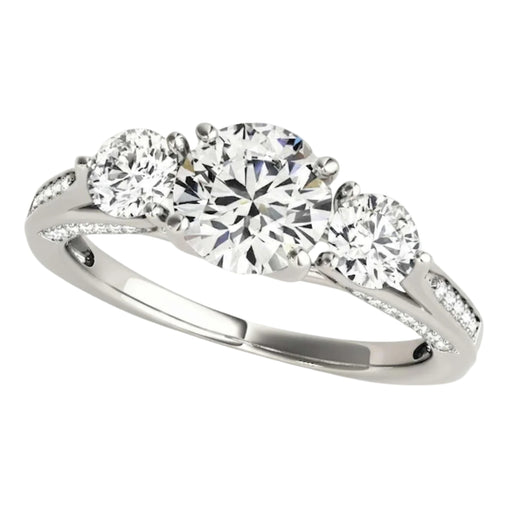
Natural Diamonds at Finediam: IGI Certification and Traditional Authenticity
The natural diamond listings at Finediam also carry IGI certification, applied to stones sourced through traditional mining rather than laboratory growth. Stud earrings in the natural range include a 1.72ct round cut pair in 18K white gold and a 0.64ct version in the same metal, alongside a smaller 0.1ct pair in 18K yellow gold and a 1.03ct pair in 18K white gold, covering a noticeable spread of sizes within one earring style. NAJ membership and Assay Office hallmark assurance are noted on the natural diamond pieces, reinforcing the traditional authenticity angle that separates this range from the lab-grown side. A natural diamond tennis bracelet at 7.50ct, prong set in 9K white gold with a box clasp, and a 3.40ct FG/VS-SI natural diamond tennis bracelet in round cut also sit within this category, showing that natural stones extend beyond rings and earrings into bracelet designs.
Diamond Cuts and Settings: How Finediam Structures Both Collections
Across both collections, round, oval, and cluster cuts appear depending on the piece. The lab-grown range includes oval cuts in bezel and solitaire settings, while round cuts appear in solitaire rings and pendant designs such as Finediam‘s 9ct white gold 1ct lab-grown diamond cluster pendant. On the natural side, round cut stones dominate the stud earring and tennis bracelet listings, set in prong or claw styles that keep the stone visible from multiple angles. Trilogy and three-stone settings also appear in the lab-grown engagement ring listings, offering a structural choice separate from single-stone solitaire designs.
Carat Weight Variations Across Lab-Grown and Natural Diamond Pieces
Carat weight spans a noticeably wide range in both collections. Lab-grown pieces run from smaller stones near 0.53ct up through larger statement pieces such as a 9.2 carat D-E/VS lab-grown diamond listing and a 5.1 carat D-E/VS lab-grown diamond tennis necklace in 9k yellow gold. Natural diamond pieces show a similar spread, from a 0.1ct stud earring up to a 1.72ct stud earring pair and a 7.50ct tennis bracelet. As a result, anyone weighing lab grown vs natural diamonds at Finediam can find comparable carat weights represented in both groups, rather than one category being limited to smaller stones.
Metal Choices and Their Impact on Lab-Grown and Natural Diamond Jewellery
Finediam pairs its diamonds with a consistent set of metal options, including 9k and 18k gold in white, yellow, and rose finishes, sterling silver, and 950 platinum. The 2ct D-E/VS lab-grown round-cut diamond three-stone engagement ring, for instance, is available across all of these metal variants. Natural diamond stud earrings and tennis bracelets lean more heavily on 18K and 9K white gold in the listings reviewed, though the broader site structure suggests metal choice functions as a separate variable from stone type. This separation means a shopper can weigh lab grown versus natural diamonds independently of deciding on gold tone or platinum.
Ready-to-Ship Availability in Both Lab-Grown and Natural Diamond Collections
Within the ready-to-ship category, listings are marked for next day UK delivery, with free insured shipping noted on individual product pages. Both the 2.02ct D/VVS lab-grown oval diamond ring and the 1.72ct natural diamond stud earrings appear under this ready-to-ship label, indicating that availability is not limited to one stone type. For anyone comparing lab grown vs natural diamonds without wanting to wait on a made-to-order piece, this segment covers both options directly from stock.
- Lab-grown and natural diamonds sold by the brand both carry IGI certification stating colour and clarity grades.
- Lab-grown listings frequently show D to E colour with VS to VVS clarity, while natural listings include grading such as FG/VS-SI on the tennis bracelet range.
- Natural diamonds form through geological processes over long periods, while lab-grown diamonds are produced in controlled laboratory conditions, a distinction often raised in ethical and sourcing discussions.
- Carat weights overlap significantly between the two groups, with small stud earrings and large statement pieces present in both the lab-grown and natural ranges.
- Visually, both stone types are certified to the same grading scales, so the differences buyers notice tend to relate to origin and certification language rather than appearance alone.
Either collection gives a shopper a certified starting point, so the real decision rests on origin, carat, and setting rather than on appearance alone.
