
Share This Article
Shoppers browsing college apparel often repeat claims they heard secondhand rather than facts drawn from a licensed retailer’s own product pages. Many official Ivy League apparel myths concern fabric, sizing, and licensing, and most of them fall apart once the actual garment descriptions are checked. This article looks at what ivy sport actually lists for its Harvard, Princeton, Yale, Dartmouth, Brown, Cornell, and Penn collections, and separates assumption from documented detail.
What Makes Official Ivy League Apparel Authentic
A persistent misconception holds that any shirt printed with a college name counts as official merchandise. In reality, authentic gear carries explicit licensing language tied to the school itself. ivy sport lists garments as “Officially Licensed by Brown University” or “Officially Licensed by Dartmouth College,” naming the school directly rather than a generic trademark claim. That distinction matters more than color or logo placement when judging whether a piece is genuine.
Manufacturing credit is also part of the authenticity picture. Several hooded sweatshirts are described as “Manufactured and Officially Licensed by New Agenda for Ivysport,” which ties a named manufacturer to the licensed product line. This level of specificity is not something counterfeit sellers typically replicate, which is one reason official Ivy League apparel myths about “all college gear looking the same” do not hold up under scrutiny.
Fabric Quality and Construction in Ivy Sport Collections
Another common myth suggests that licensed college shirts are made from a single generic cotton blend. The product data from ivy sport tells a more varied story. Brown Crest and Brown Heritage T-shirts, for example, are listed at a fabric weight of 5.0 to 5.3 oz/yd² (170-180 g/m²), built from open-end yarn with a tubular fabric construction.
Color variation changes the blend too, which is a detail frequently missed. Sport Grey versions run 90% cotton and 10% polyester, Ash Grey is 99% cotton and 1% polyester, and heather colors shift to a 50% cotton, 50% polyester mix. That kind of per-color breakdown shows construction decisions are made shirt by shirt rather than applied uniformly across an entire catalog.
Heritage vs. Crest vs. Classic: Understanding Ivy Sport Design Categories

A frequent point of confusion is assuming Heritage, Crest, and Classic are just marketing labels for the same shirt. They actually describe distinct front designs. The Brown Heritage T-Shirt features an arched “Brown University” with the crest below it, while the Brown Crest T-Shirt arranges an arched “Brown,” the crest centered, and “University” underneath.
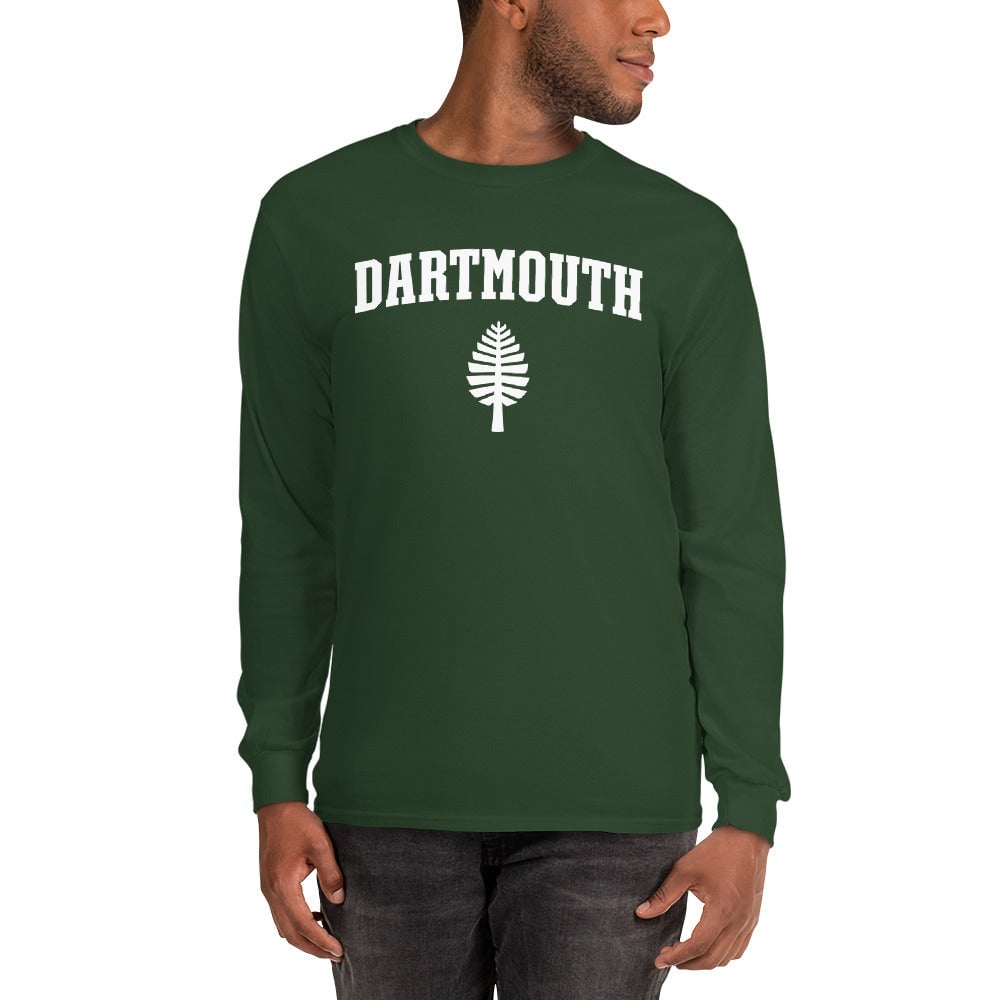
Dartmouth’s Classic line follows a different approach again, with an arched “Dartmouth” treatment distinct from its own Crest and Heritage counterparts. Because these names map to specific graphic layouts rather than interchangeable branding, assuming they are cosmetic synonyms is one of the more easily disproven official Ivy League apparel myths.
Long Sleeves, Hooded Sweatshirts, and Alternate Apparel Beyond T-Shirts
Some shoppers assume licensed college retailers only stock short-sleeve tees. The long sleeve lineup alone contradicts that, with Yale Heritage, Brown Crest, Cornell Crest, and Brown Heritage long sleeve shirts all appearing as named products. The Dartmouth Heritage Long Sleeve T-Shirt specifically features “Dartmouth” paired with the Lone Pine logo on the front panel.
Hooded sweatshirts form another category entirely at ivy sport, built from a rugged 8.0 oz. fabric at 50% cotton and 50% polyester. Princeton, Yale, Penn, MIT, and Harvard versions each carry drawstrings on the hood and a front pouch pocket. Beyond apparel, the range extends to wool felt pennants measuring 12 inches by 30 inches, plus baseball and trucker hats made from 100% cotton twill.
Material Composition Across Different Ivysport Product Lines
Treating every product from ivy sport as having identical fabric content is another assumption worth checking. The Dartmouth College Classic Hood Sweatshirt uses a preshrunk 50% cotton, 50% polyester blend with double-needle coverstitching throughout. That stands apart from the 100% cotton construction used in several Heritage and Crest long sleeve shirts.
Headwear adds yet another material profile to the mix. The Brown University Sideline Trucker Hat combines a 100% cotton twill front panel and brim with a polyester mesh back and plastic snap closure. Each hat is described as double-washed before and after construction, a finishing step noted specifically for headwear rather than applied as a blanket claim across the apparel catalog.
Debunking Size, Fit, and Durability Assumptions About College Gear
Fit terminology gets misread often, especially the word “classic.” In the Dartmouth Heritage Long Sleeve T-Shirt listing, “classic fit” refers to a long-sleeve, rib-cuffed silhouette with a seamless double-needle 7/8 inch collar, not a vague marketing term. The same listing notes a pre-shrunk jersey knit and a double-needle bottom hem, both construction choices tied to that specific shirt.
Durability claims are sometimes dismissed as filler copy, yet the product pages tie them to concrete manufacturing steps. The Dartmouth College Spirit Baseball Hat lists unique raised bean stitching on the brim and 360 pro-stitching, alongside double washing before and after assembly. These are documented construction choices, not vague reassurances, which undercuts the idea that all licensed headwear is built the same way.
- Some shoppers assume a logo alone proves a garment is officially licensed, when licensing language naming the specific university is the actual indicator.
- Many believe all cotton college shirts share one fabric weight, though Brown’s Crest and Heritage shirts are specifically listed at 5.0 to 5.3 oz/yd².
- A common assumption is that Heritage, Crest, and Classic names are interchangeable, despite each referring to a distinct front design.
- Shoppers sometimes think licensed retailers only sell T-shirts, overlooking long sleeve shirts, hooded sweatshirts, pennants, and hats in the same catalog.
- It is often assumed every sweatshirt uses pure cotton, while several hooded styles are built from a 50% cotton, 50% polyester blend instead.
- Color options are sometimes thought to be purely cosmetic, yet heather colors and Sport Grey variants carry different cotton-to-polyester ratios than the primary colorway.
None of this means every claim about college apparel is false, only that specifics matter more than assumptions. Checking a product listing for fabric weight, blend percentage, and named licensing is a more reliable way to separate fact from official Ivy League apparel myths than trusting a logo alone. For anyone comparing options across schools and categories, ivy sport‘s own product descriptions remain the most direct source to verify before buying.
