
Share This Article
Choosing between an electric unicycle vs scooter often comes down to balance style, intended terrain, and how easily a rider wants to carry a device onto a train or up a flight of stairs. Inmotion builds both categories side by side, which gives shoppers a direct way to compare self-balancing wheels against handlebar-equipped scooters. This article walks through the core design differences, the current lineups, and how power, comfort, and terrain ability compare across the two platforms.
Electric Unicycles vs Electric Scooters: Core Design Differences
An electric unicycle has no handlebar and relies on a single wheel, so the rider balances through lean and body position. A scooter, by contrast, has a handlebar, a deck, and typically two wheels, giving riders a more familiar stance. This difference shapes the learning curve and the storage footprint, and it is usually the first thing worth weighing in any electric unicycle vs scooter comparison.
Inmotion treats both formats as serious personal transportation, building suspension, water resistance, and companion features into models across both lines. That shared approach means the choice between formats depends more on riding style than on which category gets more attention. The sections below break down what each lineup actually includes.
Inmotion Electric Unicycle Lineup: From Compact Wheels to High-Performance Builds
Inmotion’s unicycle range spans several distinct models, each with its own motor, battery, and suspension setup. The V9 is the lightest wheel with suspension in the lineup at only 24kg, and it includes RideConnect anti-theft protection along with UL certification. The V11Y steps up with a 2500W motor, torque up to 100N·m, 85mm of suspension travel, and a range rated at 75 miles.
The V12S adds 90mm of upgraded hydraulic suspension, a 4.3-inch automotive-grade touchscreen, and Group Ride Audio Sync for riding alongside others. The V14 Pro raises top speed to 50 mph and torque to 276N·m, with a custom progressive suspension built to handle inclines up to 50 degrees. The X1 and the P6 round out the range, with the X1 built for trail use through 150mm of adjustable suspension and a 2,100 Wh battery, and the P6 aimed at outright speed through a 93mph top speed and a 235V high-voltage platform.
Inmotion Electric Scooter Range: Portable and Commuter-Focused Options
On the scooter side, the Inmotion lineup covers a wide spread of use cases, from pocketable commuter models to rugged all-terrain machines. The Air and Air Pro sit at the portable end, with the Air offering a 22 mile range and 19 mph max speed, and the Air Pro extending that to a 30 mile range and 22mph max speed. Both share a folding, lightweight build meant for easy carrying rather than long-distance riding.
The C10 and S1F both target daily city commuting. The C10 combines dual-motor power, up to 30% climbing ability, a 21.8 mph top speed, front and rear suspension, and 10-inch pneumatic tires meant to smooth out cracks and rough pavement. The S1F offers a 59 mile range, a 1000W motor, three ride modes, and the ability to climb 30% inclines. Further along the range, the Climber, RS Jet, and RS III move toward higher power and more rugged capability.
Power, Speed, and Terrain Capability Across Both Product Categories

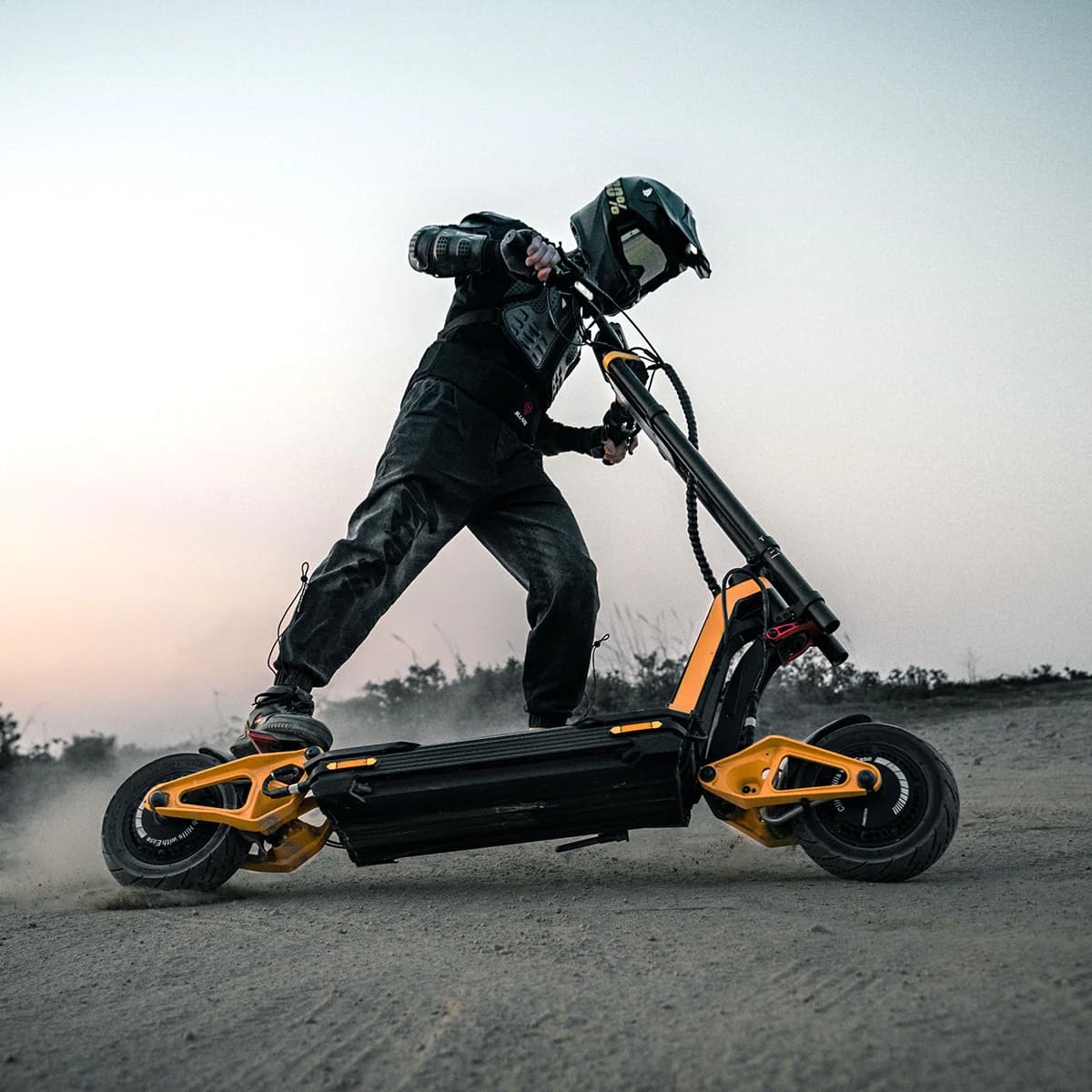
Terrain capability varies widely once the comparison moves past basic commuter models. The Climber scooter uses dual 750W motors with a peak power of 1500w and can handle 36% inclines, while carrying an IP56 rating against rain. The RS Jet carries dual 1200W motors, a 50 mph top speed, and up to 62 miles of range, with RideConnect anti-theft features built in.
At the top of the scooter range, the RS III introduces a transforming pedal system with four selectable height settings from 183mm to 303mm. It reaches 75 mph of speed and 100 miles of range, backed by an IP56 waterproof rating on the body and IPX7 protection for the battery and controller. On the unicycle side, the P6 and X1 represent the performance ceiling, with the P6 reaching a 93mph top speed and the X1 generating 340 N·m of peak torque for technical climbs.
- The V9 unicycle is the lightest suspension-equipped wheel in the lineup at 24kg.
- The V11Y unicycle delivers a 2500W motor paired with a 75-mile range.
- The V12S unicycle includes 90mm of hydraulic suspension travel alongside a 4.3-inch touchscreen.
- The V14 Pro unicycle reaches a 50 mph top speed and climbs inclines up to 50 degrees.
- The X1 unicycle offers 150mm of adjustable suspension and a 2,100 Wh battery.
- The P6 unicycle tops the range with a 93mph top speed and 20KW peak power.
- The Climber scooter manages 36% inclines using dual 750W motors.
- The RS III scooter combines a 75 mph top speed with 100 miles of range and an IP56 waterproof rating.
Suspension, Comfort, and Ride Quality Comparison
Suspension design differs between the two platforms in ways that affect daily comfort. Unicycles such as the V12S and V14 Pro rely on hydraulic or progressive suspension built into the wheel assembly, aiming to smooth out bumps while the rider balances. The P6 goes further with 90mm of hydraulic suspension and dual-speed damping that adjusts to absorb impacts.
Scooters handle comfort differently, since the rider stands on a flat deck rather than balancing directly over the wheel. Inmotion‘s RS Jet includes smooth suspension control alongside an adjustable ride height, which lets the setup suit different rider preferences. That adjustability sits alongside the dual-motor, suspension-equipped approach already seen in the C10, giving the scooter range more than one way to manage rough terrain.
Choosing Between Unicycle and Scooter Platforms
Deciding factors in an electric unicycle vs scooter decision often come down to portability, riding posture, and the type of terrain a rider expects to cover regularly. Unicycles demand more initial balance skill but offer a smaller footprint, which matters for storage or carrying onto public transport. Scooters, with their handlebar and wider deck, tend to feel more immediately familiar to new riders, which is a separate consideration from raw performance.
Inmotion‘s range gives shoppers enough variation within each category that the format choice does not have to mean sacrificing power or range. Someone drawn to off-road riding, for instance, can compare the X1 unicycle against the Climber scooter rather than assuming one format automatically wins. Terrain, climbing ability, and suspension travel all factor into that kind of side-by-side evaluation across the catalogue.
Both formats keep evolving, which is exactly what keeps the electric unicycle vs scooter question worth revisiting.
