
Share This Article
Dohar buyers who already own one or two cotton blankets tend to ask sharper questions about construction and print. Shades of Cool London (UK) offers both hand-block printed dohars and an unprinted striped-edge version, and the gap between the two runs across several named collections, each carrying its own print depth and motif. Looking closely at how each is made, sized, and finished shows how a design choice shapes the finished blanket.
What Sets Hand-Block Printed Dohars Apart from Unprinted Versions
The core build stays the same across the range: every piece is a three-layer cotton blanket meant to sit between a sheet and a duvet. What changes is the surface treatment. Some dohars carry hand-applied block prints in repeating motifs, while the Original Unprinted Dohar relies on plain cotton with a striped edge instead of an overall pattern. Shades of Cool London (UK) treats this as a visual and tactile choice rather than a change to the underlying fabric.
Because the printed pieces are decorated by hand, no two lengths of fabric carry identical placement of the motif, so each printed dohar reads as a one-off rather than an exact repeat of the next. That variation sits only on the surface, however; it changes how a blanket looks on a shelf or a bed, not how it performs once laid down. The unprinted version keeps its character in the woven stripe along the border instead, offering a steadier, more uniform look for settings where consistency matters more than one-off patterning.
The Original Unprinted Dohar with Striped Edging: Minimalist Design and Core Construction
The Original Unprinted Cotton Dohar with striped edging is described on the site as a soft, breathable three-layer cotton blanket built for cooler, more comfortable sleep. It leaves the main body of the fabric plain and uses a striped border as its only decorative element. That restraint suits settings where a plain coverlet is preferred over a printed one.
This piece has appeared as an out-of-stock listing, which suggests demand for the simpler, unprinted format runs alongside demand for the printed collections sold by Shades of Cool London (UK). Its construction otherwise follows the same lightweight, airy approach used across the wider dohar range.
Hand-Block Printed Collections: The Cowdray, Japanese Wave, and Single-Print Range Compared
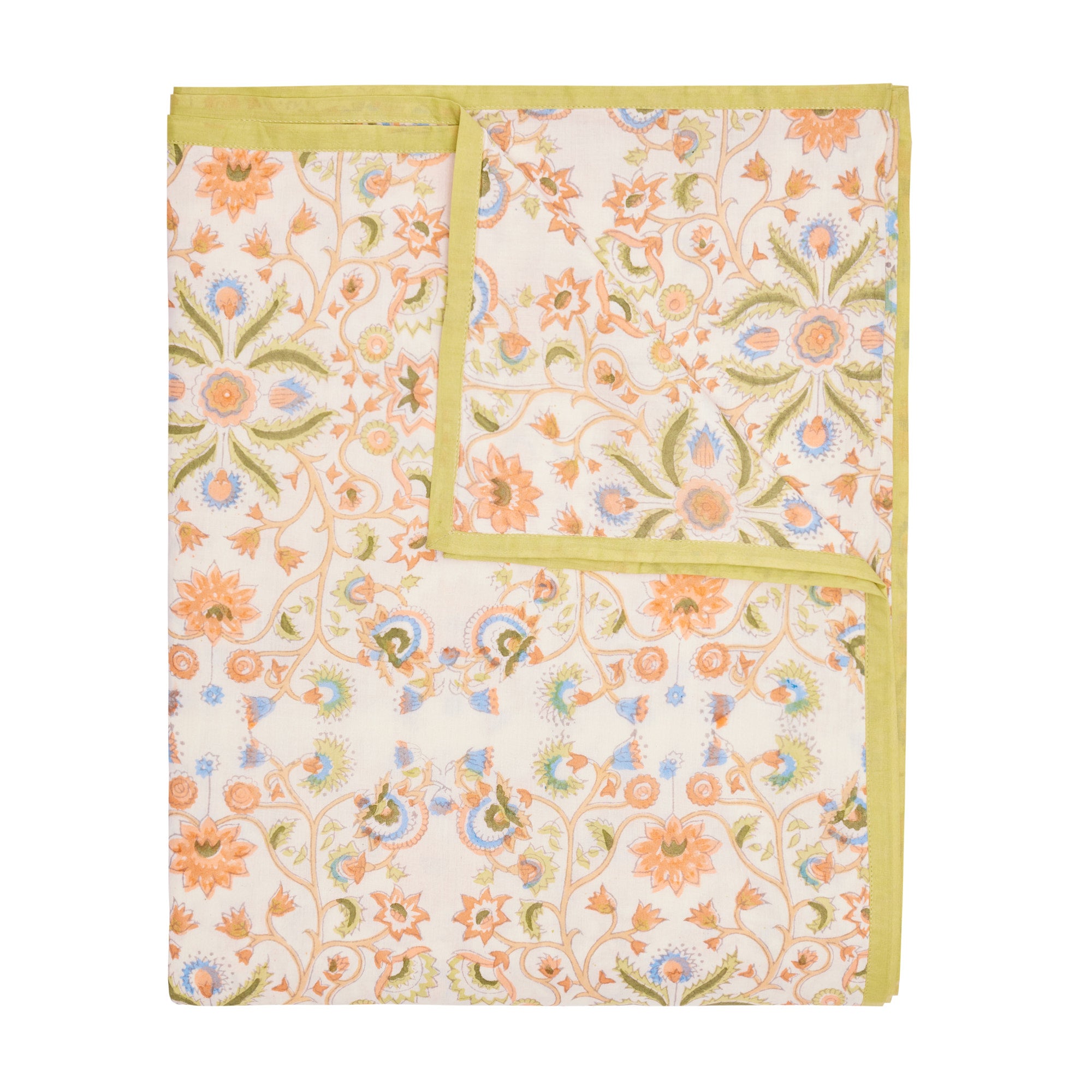
The Cowdray Collection appears in both a double-printed Sleep Dohar™ version and an original single-print version, named explicitly in listings such as the Sky Blue Cowdray and Pistachio Cowdray pieces. The double-printed option carries a denser, more layered pattern across the fabric, while the single-print original keeps the motif lighter and more spaced out. The Japanese Wave Coral Dohar is described as a newer addition to the range, carrying a wave-inspired motif rather than the Cowdray pattern.
Other named designs include the Lemon Striped Dohar, the Jay-Feather Dohar, and the Camellia Dohar, each built from three layers of cotton or, in the Camellia’s case, organic cotton. The Jay-Feather Dohar in particular is crafted from fine muslin cotton and finished with hand block printing. Taken together, these collections show a wide spread of colourways and motifs rather than a single signature print.
Artisan Production Methods: Traditional Hand-Block Printing vs Unprinted Cotton Weaving

Shades of Cool London (UK) manufactures its dohars in small batches by skilled Indian artisans, using eco-friendly production processes. The hand-block printing itself is carried out by a team of artisans based in Jaipur, using azo-free eco dyes according to the brand’s quilt listings, a detail that applies to its broader hand-block printed homeware alongside the dohars. That hand-applied step is what gives printed pieces such as the Cowdray and Japanese Wave designs their piece-to-piece variation, a trait a machine-stamped print would not produce.
The unprinted dohar skips that printing stage entirely, since its character comes from the weave and the striped edge rather than an applied design. Both approaches sit under the same small-batch, artisan-led production described by the brand, just with printing added or left out depending on the style chosen.
Size Variations Across Printed and Unprinted Styles
Sizing stays consistent across several of the adult dohars from Shades of Cool London (UK), with King Size, Queen Size, and Single options listed for pieces such as the Lemon Striped Dohar. The King Size option measures 260 cm by 275 cm, the Queen Size measures 250 cm by 225 cm, and the Single measures 150 cm by 225 cm. These dimensions apply specifically to the Lemon Striped Dohar as listed on the site, though the same three-size structure appears across other adult pieces in the collection.
Beyond the adult range, a Kids Sleep Dohar™ line covers children aged 0 to 6, including Jay Feather, Cowdray Sky Blue, Mint Green, Japanese Wave Indigo, Japanese Wave Coral, and Camellia Yellow designs. These smaller dohars are made from organic cotton voile rather than the layered cotton used in the adult sizes.
Temperature Regulation and Breathability Across Design Types
Across both printed and unprinted styles, the dohars are described as natural temperature-regulating bedding. The layered cotton build keeps each blanket lightweight and almost weightless while still offering a layer of warmth. This applies equally to the Original Unprinted Dohar and to printed pieces such as the Cowdray and Japanese Wave collections, since the breathability comes from the cotton layering rather than the surface pattern. Hand-block printing changes appearance, not airflow.
- The Cowdray Collection is available in a double-printed Sleep Dohar™ version as well as an original single-print version, so the same colourway can appear in two distinct print depths.
- The Original Unprinted Dohar carries no printed motif at all and instead relies on a striped edge for its only decorative detail.
- The Japanese Wave Coral Dohar introduces a wave-pattern print that sits apart from the florals and feathers seen in collections like Camellia and Jay-Feather.
- The Lemon Striped Dohar combines a striped aesthetic with the layered cotton build shared across the wider range.
- Printed designs such as Cowdray and Japanese Wave show natural piece-to-piece variation because each is hand-block printed rather than machine-stamped, giving every blanket a slightly different placement of the motif.
The choice between a hand-block printed design and the Original Unprinted Dohar depends on how much pattern suits the bed, since the cotton foundation beneath either choice remains consistent.
