
Share This Article
Rural parts of Scotland have long faced a gap between what urban broadband customers take for granted and what is actually available down a single-track road. Full-fibre broadband is changing that picture by replacing old copper connections with fibre optic cable all the way to the premises. Highland Broadband has built its business around closing that gap, bringing ultrafast, gigabit-capable connections to communities that other providers have often overlooked.
What Is Broadband and How Does It Differ From Traditional Broadband?
Full-fibre broadband, also called Fibre-to-the-Premises or Fibre-to-the-Home, delivers high-speed internet access using optical fibre cables run directly into a home or business. Traditional broadband, by contrast, usually finishes its journey over old copper telephone wiring, which slows data down before it ever reaches a router. That final stretch of copper is the bottleneck that full-fibre technology removes entirely.
Because the signal travels as light rather than electricity, a full-fibre connection avoids much of the degradation that copper cables suffer over distance. Highland Broadband builds this kind of network from the ground up in areas where it operates, rather than adapting an older copper setup. That distinction matters most in rural settings, where properties sit far from exchanges and copper performance tends to drop off sharply.
Why Full-Fibre Networks Matter for Rural Scotland
Many rural and semi-rural Scottish communities have waited years for broadband that matches what is standard in cities. Distance from telephone exchanges, challenging terrain, and low population density have all made these areas less commercially attractive to legacy network builders. As a result, some households have been left relying on slow, unreliable connections long after urban neighbours moved on.
Broadband changes the economics of rural connectivity because the technology does not depend on proximity to an exchange in the same way copper does. Highland Broadband has focused specifically on these underserved areas, extending gigabit-capable infrastructure to places that previous rollouts bypassed. That approach also supports more stable connections in conditions where extreme weather is common, since fibre is less susceptible to environmental interference than copper lines.
Highland Broadband’s Full-Fibre Infrastructure Across Rural Communities
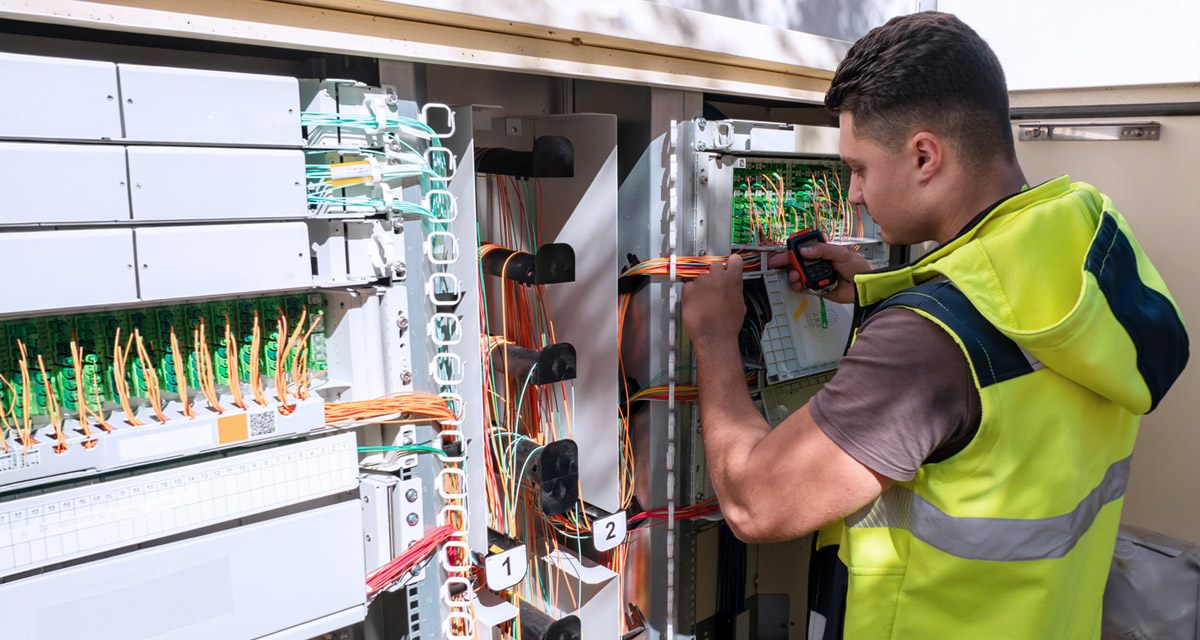
Building a rural fibre network starts with a fibre optic backbone, which typically runs along major roads and connects back to data centres. From there, cables reach street cabinets, and finally a dedicated fibre line is taken to each individual property once an order is placed. Highland Broadband carries out this installation with full local authority and highway team permissions in place before any work begins.
A small white connection box fitted outside a connected property marks the point where the fibre cable enters the building through a small drilled hole, after which the line is terminated inside the home ready for the router connection. Where telegraph poles already exist, the network sometimes uses those instead of underground routes, depending on the local terrain. This methodical, street-by-street build-out is how full-fibre broadband has reached communities that previously had no realistic path to gigabit-capable service.

Speed Tiers and Connectivity Options in the Highland Broadband Range
Highland Broadband offers four broadband options, each built on the same full-fibre network but suited to different households. Essential 150 provides 150 Mbps upload and download speeds, described as suited to streaming and browsing in smaller households. Everyday 500 steps up to 500 Mbps, pitched at homes running multiple devices, online gaming, and home working at the same time.
The Family 1000 option delivers 1000 Mbps and includes Whole Home WiFi Guarantee, cyber security, and parental controls as part of the package. At the top of the range, Ultimate 5000 reaches 5000 Mbps and is also described as including a free Whole Home WiFi Guarantee. Each of these options can be checked against a property through an availability checker before anything is ordered.
Symmetrical Upload and Download Speeds: A Full-Fibre Advantage
One of the clearest distinctions between full-fibre broadband and older copper or hybrid connections is symmetry between upload and download speeds. Traditional broadband technology typically throttles upload speeds to a fraction of download speeds, which can make video calls and large file transfers slow going. Every plan across the Highland Broadband range offers matching upload and download speeds, from the 150 Mbps Essential option through to the 5000 Mbps Ultimate option.
That symmetry also changes how households handle tasks that push data outward rather than pulling it in, such as backing up photos to cloud storage or livestreaming a hobby. On a connection with limited upload capacity, those activities can stall other devices sharing the same line. Because upload and download run at matching speeds on a full-fibre connection, that kind of one-sided slowdown becomes far less likely.
- Broadband uses optical fibre cable all the way to the premises rather than finishing the final stretch over copper wiring.
- It delivers symmetrical upload and download speeds, unlike copper-based connections that typically throttle uploads.
- The technology is less susceptible to interference from electromagnetic sources and extreme weather than older copper networks.
- It supports low latency, which benefits video calls, online gaming, and other real-time applications.
- Full-fibre connections are gigabit-capable, allowing speeds that copper and hybrid fibre-to-the-cabinet setups cannot match.

Getting Connected: Service Setup and Support for New Customers
Signing up for a Highland Broadband plan starts with an availability check to confirm whether full-fibre broadband has reached a given property. Once an order is placed, installation is booked, and a dedicated fibre cable is run to the home following the same backbone-to-cabinet-to-premises process used across the wider network. That process keeps the same outdoor connection box and indoor termination described earlier in the build-out.
Beyond broadband itself, Highland Broadband also provides a Calls service built on Voice over Internet Protocol, which routes calls through the broadband connection instead of a traditional phone line. Setup involves downloading a Softphone app and using a QR code sent by email to link the service to a mobile device. Customers considering a switch can also take part in a Refer A Friend programme, which rewards successful referrals with a gift voucher.
Street-by-street fibre builds are slow by nature, but each new connection narrows a gap that copper never managed to close in these areas.
