
Share This Article
Picking a DJ controller often comes down to one practical question: which model fits the way someone actually plans to mix? A thoughtful DJ controller comparison looks past surface specs and weighs channel counts, platter types, and effects engines side by side. American Musical Supply carries a spread of controllers wide enough to make that comparison meaningful, from compact two-channel units to motorized four-channel systems built for club work.
Understanding DJ Controller Categories at American Musical Supply
American Musical Supply groups its DJ gear alongside live sound, lighting, and recording equipment, which makes it simple to shop controllers next to the speakers or microphones that might pair with them. The DJ section spans compact two-channel boards through motorized four-channel systems, so the practical differences between models become clear once they sit side by side. Looking at channel count, jog wheel type, and software bundle together produces a clearer comparison than judging any single model on its own.
American Musical Supply also backs purchases with a 45-day money back guarantee and a Gold Lock Warranty, and the retailer lists 0% Interest Payment Plans as a standing checkout option. That is a separate structure from any time-limited installment promotion tied to a specific number of products, so the general financing option applies across the DJ section rather than one narrow slice of it. For anyone running a full DJ controller comparison, financing terms and warranty coverage can matter as much as pad layout.
Pioneer DJ Models: From DDJFLX4 to DDJ FLX10
Pioneer DJ holds a wide footprint in the lineup, starting with the DDJFLX4, a controller built for straightforward two-deck mixing. Moving up, the DDJ-REV5 adds a scratch-oriented layout with a battle-style form factor suited to turntablist techniques. At the top of the Pioneer DJ range sits the DDJ FLX10, a four-channel professional controller with motorized platters and a more extensive pad and performance section.
The gap between these three models shows why a comparison needs to account for more than a brand name alone. The DDJFLX4 suits home or practice setups while the DDJ-REV5 shifts toward scratch-focused performance, and that split reflects a broader pattern across controllers in general: smaller formats tend to favor learning and casual mixing, while larger layouts support public sets. The DDJ FLX10 then scales up again with its four-channel layout and motorized decks, moving it closer to the club-ready systems further up the catalog.
Professional Systems: Rane ONE MKII and Rane System One
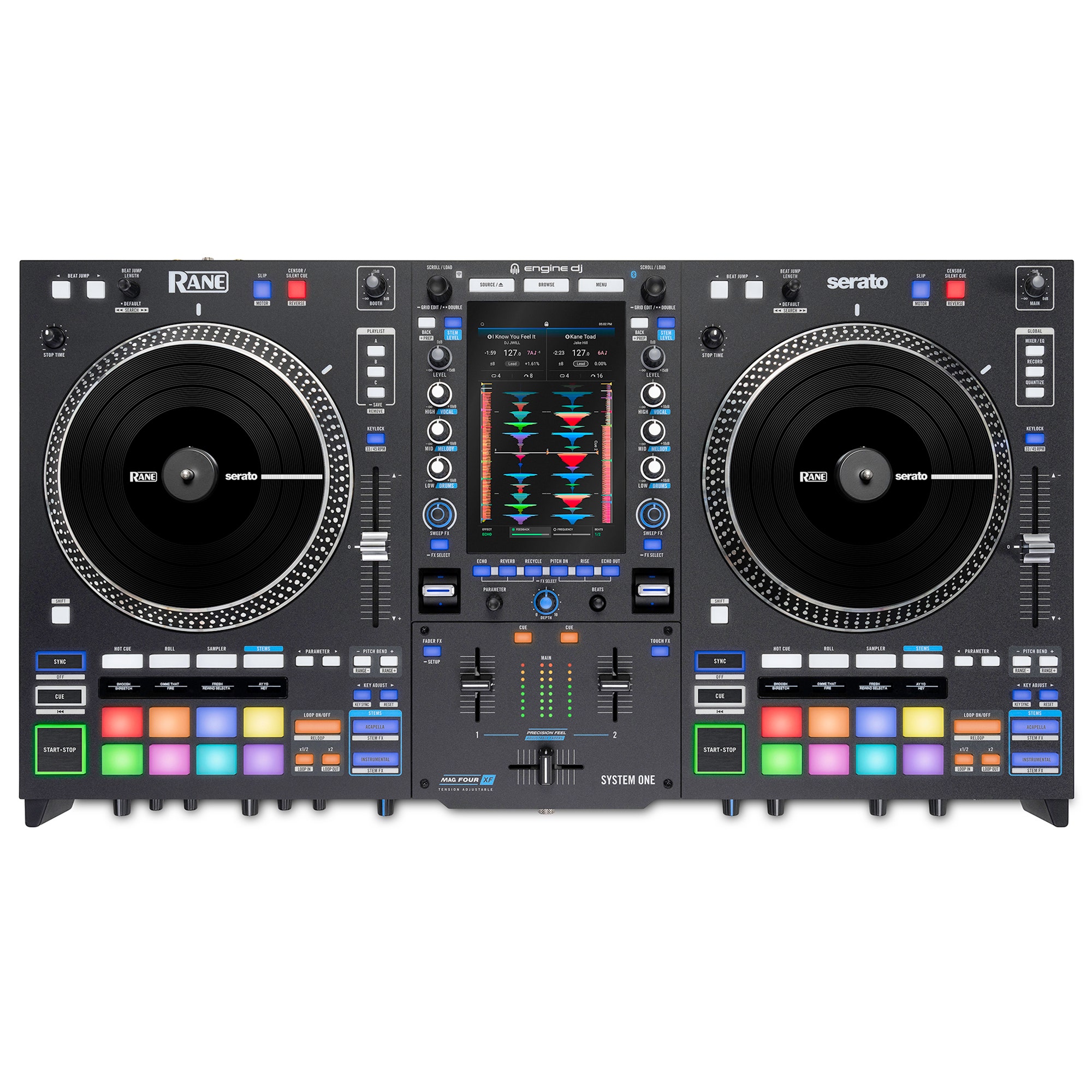
Rane’s presence in the catalog centers on two motorized systems, the Rane ONE MKII and the Rane System One. The Rane ONE MKII is listed as a professional motorized DJ controller, built around motorized platters rather than the touch-sensitive jog wheels found on smaller units. The Rane System One rounds out the pairing as a full DJ system with motorized platters designed for a club-style standalone setup, and listings show it holds a 4.8-star rating alongside the Rane ONE MKII’s 4.9-star score.
Motorized platters spin and respond physically in a way that mirrors vinyl turntables, which is one reason scratch DJs and club performers often favor that mechanism over a static jog wheel. As a result, these two models tend to get grouped together rather than alongside the smaller Pioneer DJ units. When shopping through American Musical Supply‘s offerings, a thorough comparison across the range will likely end up weighing these two against each other before deciding anything else.
Hercules DJControl T10: Premium Mid-Range Option

The Hercules DJControl T10 is listed as a professional DJ controller, sitting apart from both the compact Pioneer DJ units and the motorized Rane systems. It gives Hercules a seat at the same table as the bigger names without copying their motorized platter approach. That positioning makes it a distinct choice rather than a simple substitute for either brand already mentioned.
Because the DJControl T10 is marketed as a professional unit, it tends to draw performers who want a feature-rich layout without a motorized deck mechanism. That combination of positioning and feature set gives the catalog another angle on the upper end of the market. It also means a full comparison across the range has to weigh feature depth separately from motorization, since the two do not always move together.
Key Features and Specifications Across the Range
Across the lineup, the biggest structural differences come down to motor type, channel count, effects access, and connectivity options. A compact two-channel board handles simple mixing tasks, while a four-channel motorized system supports more complex routing and live performance work. Comparing those specifications side by side is what turns a casual browse into an actual DJ controller comparison.
- Motorized platters appear on the Rane ONE MKII, the Rane System One, and the Pioneer DJ DDJ FLX10, while the DDJFLX4 and DDJ-REV5 rely on jog wheels instead.
- Channel count ranges from two-channel entries like the DDJFLX4 up to four-channel systems such as the DDJ FLX10 and the Rane System One.
- Effects capability expands noticeably on the higher-numbered Pioneer DJ models and on both Rane systems, which carry larger performance pad sections.
- Connectivity varies by model, with some units built for a single laptop setup and others designed as standalone systems within the Rane System One.
Choosing Between American Musical Supply DJ Controllers by Use Case
Someone mixing casually at home has different needs than a touring DJ running back-to-back club sets. American Musical Supply lists all of these models side by side, which keeps a direct comparison straightforward rather than scattered across separate pages. Further up the range, the DDJ FLX10 and the Hercules DJControl T10 serve more demanding performance needs without requiring a fully standalone system.
In addition, the Rane ONE MKII and the Rane System One sit at the very top for anyone wanting motorized platters built directly into the hardware. That structure helps narrow down a purchase based on mixing style rather than guesswork. A clear-eyed DJ controller comparison, built around channel count, motorization, and feature depth, tends to point toward an obvious answer.
Ultimately, the right controller comes down to how it gets used night after night, not which badge sits on the chassis.
