
Share This Article
Many households still follow fabric care habits passed down for generations, yet several of these routines rest on shaky science. Separating genuine fabric care myths from fact matters, especially when it comes to wrinkle removal, odour control, and garment preservation. A closer look at ironing, washing, and closet storage reveals that some of the most trusted habits do little good and occasionally cause harm.
The Heat Damage Myth: Why High-Temperature Ironing Isn’t the Only Answer
Most people assume that stubborn creases only yield to a hot iron. In reality, a standard iron reaches temperatures above 200°C, which is hotter than many home ovens. That intensity can scorch delicate fibres, flatten texture, and shorten the life of a garment over time.
The belief that heat is the only path to smooth fabric is one of the more persistent fabric care myths in everyday laundry routines. Fibres respond to moisture and mechanical relaxation just as much as they respond to heat, which opens the door to gentler methods that do not rely on scorching temperatures at all.
Odour Myths Debunked: Fresh Sweat Versus Bacterial Breakdown
A common assumption is that sweat itself causes unpleasant smells. Fresh sweat is largely odourless, and the smell actually develops once bacteria begin breaking it down on fabric or skin. This distinction matters because it shifts the focus from masking scent to addressing the bacteria responsible for it.
Wool offers a useful comparison point here. Wool fibres absorb and release moisture vapour, which makes them less hospitable to odour-causing bacteria than many synthetic materials. That is part of why cashmere garments often do not need frequent washing, since airing between wears can be enough to maintain freshness.
Liquid Iron Technology: How Molecular Ironing Works Without Heat

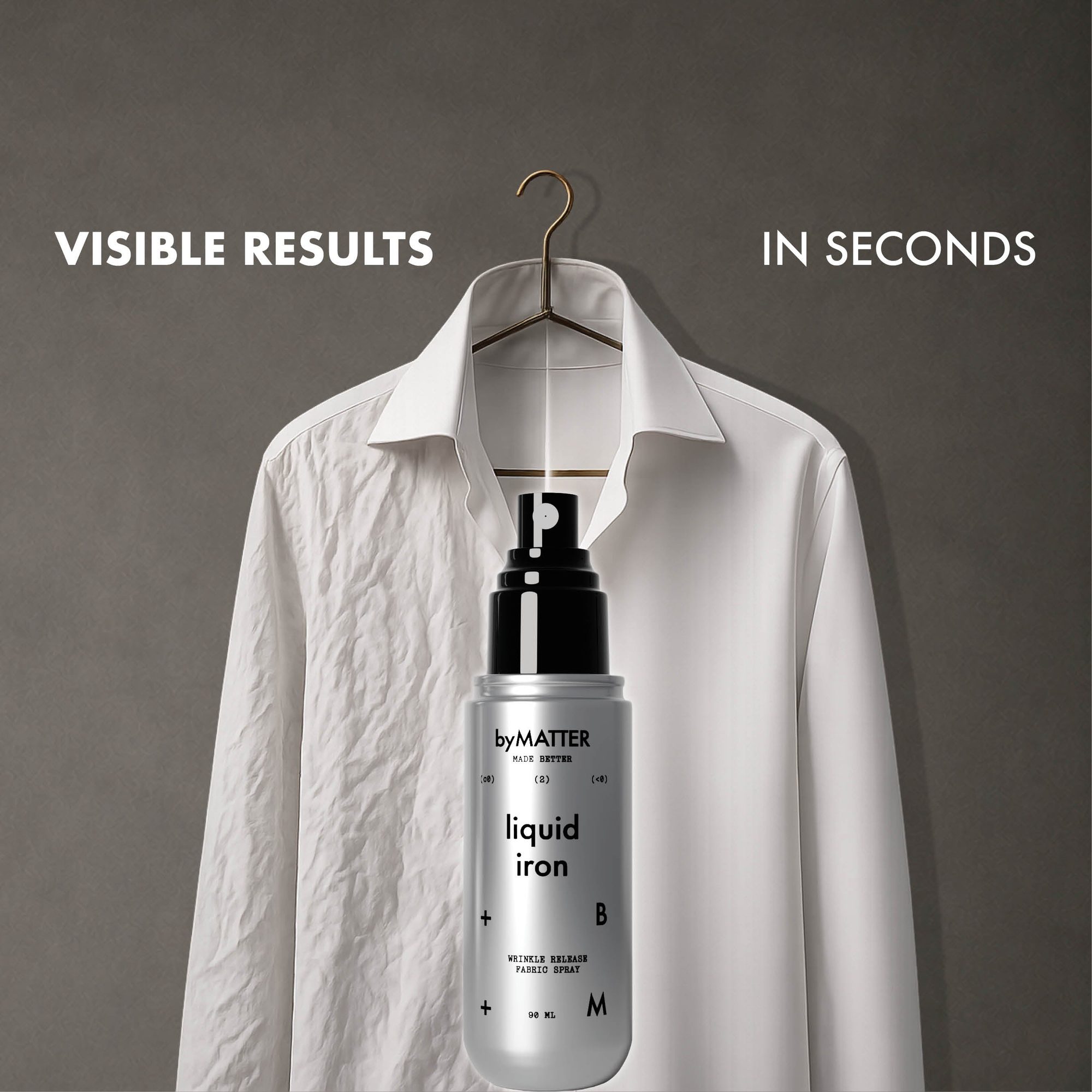
byMATTER offers a product called Liquid Iron, a wrinkle release spray built around what the brand describes as Molecular Ironing Technology. An advanced bio-ingredient relaxes fabric fibres on contact, releasing creases in seconds without heat, ironing, or steam. This approach challenges the long-standing fabric care myths that treat a hot iron as the only route to crease-free clothing.
Because the spray works without an appliance, it also removes the need to heat up equipment just to deal with a few wrinkles. The product sits within byMATTER‘s wider SMOOTH category, positioned specifically for garments that benefit from a no-heat approach to wrinkle release.
Beyond Frequent Washing: Extending Garment Lifespan With Another Day Fabric Freshener
Frequent washing is often treated as the default way to keep clothes feeling clean, yet repeated washing cycles can wear down fibres over time. Another Day, a fabric freshener from byMATTER, is designed to revive fabrics between washes rather than replace washing altogether. Rather than simply masking smells with fragrance, its formula uses probiotics intended to work on odour-causing bacteria at the source.
The brand states that this probiotic blend stays dormant until it meets fabric, at which point it begins working at a microbial level. This stands in contrast to fresheners that rely purely on fragrance and chemicals to cover odour temporarily. Another Day is available as a full-size product and also appears within several of byMATTER‘s bundled sets, including The Fabric Kit and The Re-Fresh Edit.
Moth Prevention Misconceptions: What Closet Guardian Actually Targets
Mothballs and strong synthetic repellents are the common first response to moth concerns, but they are not the only option available. Closet Guardian, part of byMATTER‘s PROTECT range, is described as a next-generation moth repellent built around lavender-based Bio-Active fragrance technology. The set includes a scented ceramic medallion along with a fragrance mist meant for enclosed spaces such as wardrobes and drawers.
According to the brand, the lavender-based formula is designed to trigger avoidance behaviour in moths rather than eliminate them through harsh chemical exposure. Regular use of the Recharge Spray is described as the way to maintain that moth-free environment over time. Closet Guardian also appears bundled with Another Day in the brand’s Closet Kit, pairing moth deterrence with fabric refreshing in one grouping.
Bio-Active Cleaning: Why Plant-Based Probiotics Outperform Chemical Disinfectants
Beyond clothing-specific products, byMATTER also produces an All-Purpose Cleaner built on what it calls a multi-layered cleaning action. The brand states that it delivers a microscopic deep clean that lasts for up to 3 days and is effective against harmful bacteria, including certain superbugs. It is also formulated to be kind to little ones, without relying on harsh chemicals.
This plant-based, bio-active approach reflects a broader theme across the range, including Liquid Iron, Another Day, and Closet Guardian. All of the brand’s products are described as dermatologist tested, plant-based, bleach-free, and cruelty-free. That combination addresses several widespread fabric care myths at once, since it shows that effective cleaning and freshening do not necessarily require aggressive chemical formulas.
- Many people believe that only high heat can remove wrinkles, when fibre relaxation can be achieved through other means.
- Sweat is often blamed for odour, even though fresh sweat is largely odourless until bacteria break it down.
- Frequent washing is assumed to be the only way to keep garments fresh, despite airing being sufficient for some fabrics like cashmere.
- Mothballs are often seen as the sole solution for moth prevention, overlooking scent-based avoidance methods.
- Fragrance sprays are frequently mistaken for odour elimination, when they may only mask smells rather than address bacteria.
- Harsh chemical cleaners are often assumed necessary for effective disinfection, even where plant-based formulas are available.
Reconsidering these habits does not require abandoning routine care altogether. It simply means matching the method to what fabric actually needs, rather than repeating old assumptions out of habit.
