

Share This Article
Choosing between anamorphic glass and standard spherical cinema lenses comes down to several technical variables that shape the final image. An anamorphic lens comparison usually starts with squeeze ratio, moves through aperture speed, and ends with how flares and bokeh behave on screen. SIRUI‘s lineup offers a useful case study because it spans multiple squeeze ratios, construction materials, and flare treatments within one catalog. Looking at the Saturn, Venus, and Astra series side by side shows how these variables trade off against each other in practice.
Understanding 1.6x vs. 1.33x Anamorphic Squeeze Ratios in SIRUI Lenses
Squeeze ratio determines how much the image is horizontally compressed on the sensor before being stretched back out in post. SIRUI produces lenses in both 1.6x and 1.33x squeeze, and the two numbers point to different shooting goals. The 1.6x options, found in the Saturn and Venus series, deliver a stronger compression that produces the wider, more elongated bokeh shapes commonly associated with anamorphic photography.
The 1.33x ratio, used in the Astra series, is a gentler squeeze. It is closer to the ratio historically used in some theatrical formats and tends to be easier to work with when matching footage to certain finishing pipelines. Any thorough anamorphic lens comparison has to weigh squeeze ratio first, since it affects framing, dewarping math, and the overall look of oval highlights before any other spec is even considered.
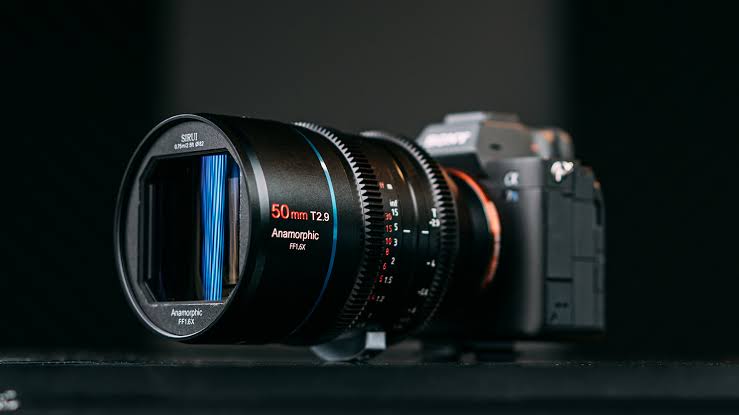
Saturn Series: Carbon Fiber Construction and Full-Frame 1.6x Anamorphic Performance
The Saturn series is built around a carbon fiber housing, a choice that keeps the barrels under 500 grams per lens according to SIRUI‘s own listings. Three focal lengths make up the set, 35mm, 50mm, and 75mm, each sharing a constant T2.9 aperture across a full-frame 1.6x squeeze. That consistency across the set matters for productions that need to cut between focal lengths without a visible shift in color or contrast.
SIRUI ships the Saturn lenses in Classic Blue Flares or Neutral Flares as separate configurations, and offers the set across E, L, and RF mounts, giving a cinematographer a mount choice independent of flare preference. The carbon fiber build is also the main differentiator against the newer Saturn V2, which keeps the same focal lengths and T2.9 1.6x spec but changes the physical shooting format, discussed further below.
Venus Series: Budget-Friendly Full-Frame 1.6x Anamorphic Lenses with Extended Focal Lengths
Where Saturn concentrates on three focal lengths, the Venus series widens the range to six, adding 100mm, 135mm, and 150mm on top of 35mm, 50mm, and 75mm. The 35mm through 100mm lenses share a 1.6x squeeze at T2.9, while the 135mm keeps the T2.9 aperture but shifts to a 1.8x squeeze ratio, giving the set an additional optical character within the same focal range. A 1.25x anamorphic adapter is also sold as an add-on, giving the series further flexibility beyond its native squeeze.
SIRUI positions Venus as a more accessible entry into full-frame anamorphic shooting, pairing blue lens flares with the stretched oval bokeh typical of the format. Mount options include RF, L, and E, covering a wide range of camera bodies. For productions building out a full set of focal lengths without committing to carbon fiber construction, Venus fills that specific niche within the catalog.

Astra Series: Autofocus Capability and T1.8 Aperture in 1.33x Anamorphic Design
The Astra series marks a distinct departure from Saturn and Venus by introducing autofocus to anamorphic cinema glass, something SIRUI describes as the world’s first full-frame AF anamorphic lens. Unlike the manual-focus design of Saturn and Venus, Astra covers 50mm, 75mm, and 100mm focal lengths at a constant T1.8 aperture and a 1.33x squeeze ratio. The faster T-stop compared to the T2.9 of Saturn and most of Venus gives Astra an advantage in lower light without sacrificing the anamorphic look.
Astra also offers a choice between Neutral and Blue streak flares, along with E, L, and Z mount options, plus AF and MF switching. For documentary-style or run-and-gun anamorphic work where manual focus pulling is impractical, this autofocus capability changes what kinds of projects the format can realistically serve. Separately, 20mm and 40mm autofocus T1.8 1.33x anamorphic lenses extend the same AF concept to wider focal lengths.
Neutral vs. Blue Flare Aesthetics Across SIRUI Anamorphic Lens Lines
Flare color is one of the more subjective but highly visible differences in any anamorphic lens comparison, and SIRUI treats it as a selectable feature rather than a fixed trait. Saturn’s flare choice locks in at the point of purchase, since Classic Blue and Neutral ship as distinct configurations rather than a field-adjustable element. Venus, by contrast, lists its blue flare character as a fixed trait across all six focal lengths, including the 135mm lens’s 1.8x squeeze, with no neutral alternative offered within that line.
Astra carries both Neutral and Blue options into its 1.33x primes as well as the newer 20mm and 40mm optics, which keeps flare choice tied to the lens line rather than to squeeze ratio alone. A cinematographer who wants the long blue streak associated with classic anamorphic photography is not limited to one product line. Conversely, anyone wanting a cleaner, less colored flare for a more neutral grading starting point can select Neutral versions within Saturn or Astra.
Horizontal and Vertical Shooting: Saturn V2’s Switchable Design Innovation
Saturn V2 keeps the original Saturn’s three focal lengths and T2.9 1.6x squeeze ratio, but adds a mechanical switch that lets the same lens pivot between horizontal and vertical shooting without a rebuild of the rig. Unlike the original Saturn, which ships in both Classic Blue and Neutral flare options, the V2 listing shows Neutral as the sole flare configuration. SIRUI offers Saturn V2 across E, L, RF, and Z mounts, either individually per focal length or as a three-lens set.
For studios producing both traditional cinema output and vertical social content, the Saturn V2 avoids the need to own two separate optical sets. This switchable capability stands out as the clearest functional upgrade over the original Saturn carbon fiber line, even though the core optical formula stays close to its predecessor.
- Saturn carbon fiber lenses cover 35mm, 50mm, and 75mm at T2.9 with a 1.6x squeeze ratio.
- Venus extends focal length coverage to 35mm, 50mm, 75mm, 100mm, 135mm, and 150mm, with the 135mm shifting to a 1.8x squeeze.
- Astra introduces autofocus at a constant T1.8 aperture across 50mm, 75mm, and 100mm with a 1.33x squeeze.
- A separate 20mm and 40mm autofocus line extends the same T1.8 1.33x anamorphic design to wider focal lengths.
- Flare styles include Neutral and Classic Blue options, selectable independently across the Saturn and Astra lines.
- Mount availability spans E, L, RF, and Z depending on the series and specific lens chosen.
Taken together, these differences show that no single line is simply a smaller or larger version of another. Saturn offers a lightweight carbon fiber build at a steady 1.6x squeeze, Venus expands the focal range for full-frame work, and Astra brings autofocus into a 1.33x format. An informed anamorphic lens comparison, in the end, depends less on any single spec and more on how squeeze ratio, aperture speed, flare treatment, and mechanical features line up with the specific production at hand.
Each series ultimately answers a different production question rather than competing head to head.
