
Share This Article
There are flashlights, and then there are Acebeam flashlights. The difference becomes clear the moment you hold one. Founded in 2014 and now available in over 100 countries, Acebeam has spent over a decade developing portable lighting products that go well beyond what most people think a torch is capable of. From compact everyday carry lights that fit on a keychain to handheld searchlights that throw a beam over two kilometres, the range is built around one principle: reliable, high-performance light for the people who need it most.
Built for Demanding Users
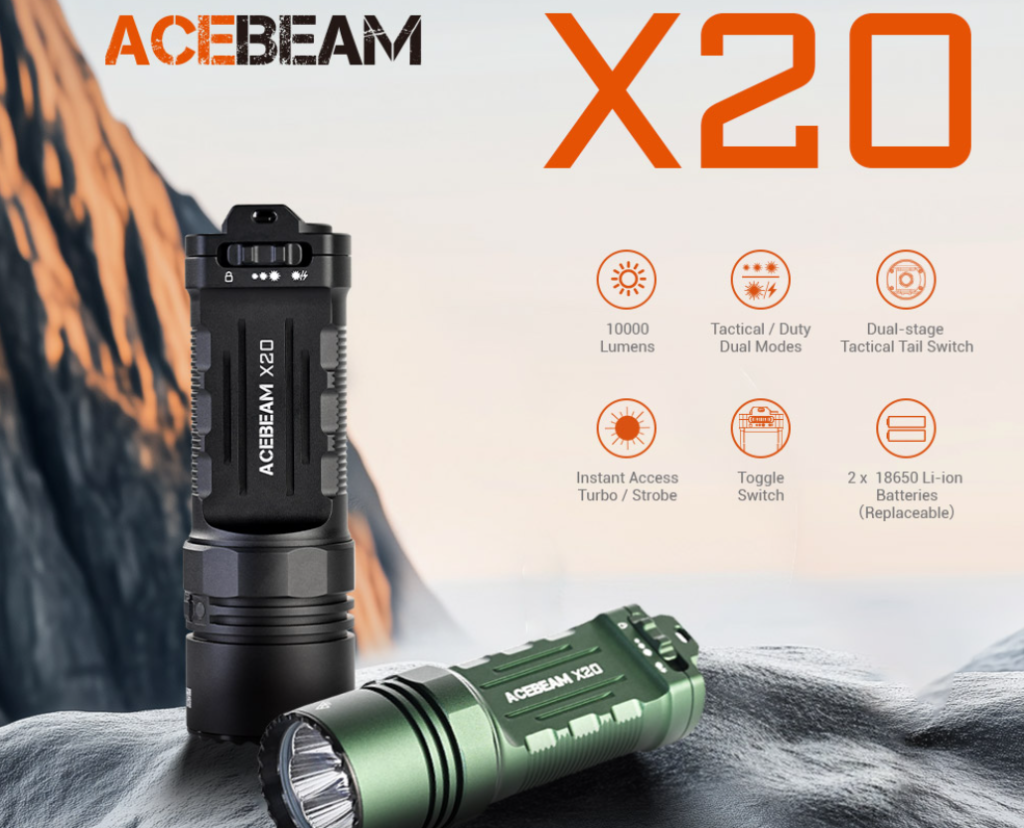
Acebeam does not make flashlights for the casual user who occasionally needs to find something under the sofa. The brand’s products are designed for people who work or spend time in conditions where lighting genuinely matters. Law enforcement officers, military personnel, firefighters, paramedics, hunters, cave explorers, divers, security professionals, and outdoor enthusiasts make up the core audience, and the engineering reflects those demands in everything from the thermal management systems to the choice of LED technology and battery configuration.
That focus on demanding use cases has not made the products inaccessible. The EDC range is well suited to everyday carry, the headlamps cover everything from weekend hiking to professional mining environments, and the pricing sits at a level that reflects quality without pushing into the territory of niche collector items. The brand’s reputation has grown steadily because the products work as described, consistently and repeatedly, in conditions that reveal the shortcomings of lesser alternatives.
The LEDs and Technology That Power the Range

Understanding what makes Acebeam products stand out requires a brief look at what is happening inside them. The brand uses high-grade LEDs from manufacturers including CREE, Nichia, OSRAM, and SFT, each chosen for specific performance characteristics depending on the application.
High-CRI LEDs like the Nichia 519A appear in EDC and headlamp models where accurate colour rendering matters, producing light that shows the true colours of objects rather than the washed-out output of lower-quality alternatives. High-output LEDs like the CREE XHP70.3 HI power the tactical and search models where raw brightness and throw distance are the priority. For the longest beam distances, LEP technology, Laser Excited Phosphor, produces an extremely tight, focused beam that conventional LED optics simply cannot replicate, extending useful illumination to ranges measured in kilometres rather than metres.
Thermal management is another area where Acebeam invests engineering effort that cheaper brands ignore. High-output flashlights generate significant heat, and without proper heat dissipation, performance degrades rapidly. The X75, which reaches 80,000 lumens, includes a detachable fan and a constant current boost driver operating at 98% efficiency, allowing it to maintain output levels that would overwhelm a poorly designed circuit entirely.
What the Range Covers
The product lineup divides naturally into several categories, each addressing a specific set of use cases.
The tactical series covers the needs of law enforcement and military users, with models designed for weapon mounting, one-handed operation, and immediate activation under pressure. The L35 2.0 delivers 5,000 lumens, the Defender P17 reaches 4,900 lumens with a 445-metre beam and IP68 waterproofing, and the UC25 provides multi-light tactical capability in a single unit. Dual tail switches, remote pressure switch compatibility, and stainless steel strike bezels are features that distinguish these models from standard high-output torches.
The hunting range is built around long throw distances, quiet operation, and discreet lighting. The L19 2.0 throws a beam over 1,083 metres from a compact form factor, making it among the longest-throwing hunting flashlights available. Green and red LED options are available across several models, both for preserving night vision and for specific hunting applications where white light would spook prey or compromise position. The L17 adds a one-button, near-silent tailcap switch that operates without any audible click.
The EDC range prioritises balance. The Pokelit AA accepts both a rechargeable 14500 lithium battery via USB-C and a standard AA alkaline, meaning it functions reliably whether fully prepared or using whatever battery is available at the time. The E75 delivers high-performance output in a pocket-friendly format, and the Keylite 500 brings USB-C rechargeable lighting to a form factor small enough to live on a keyring without being noticed.
Headlamps are a meaningful part of the lineup. The H30 is one of the brightest single-battery headlamps available and includes red, UV, and high-CRI auxiliary LEDs alongside the main white output, covering night vision preservation, forensic work, and general use from a single unit. The H16 uses a 519A LED and a corner-mounted design that produces a wider, softer beam pattern than most forward-facing headlamps, reducing eye strain during extended use.
At the extreme end sits the X series. The X75 at 80,000 lumens and the X80 GT at 32,500 lumens are in a category of their own, suited to search and rescue operations, illuminating large structures during tactical clearance, and any application where handheld lighting needs to cover an area rather than a single point.
Five Years of Warranty, One Standard of Build
Every Acebeam product carries a five-year warranty, which reflects a level of confidence in manufacturing quality that is unusual in the flashlight market. Aircraft-grade aluminium alloy bodies with hard-anodised finishes, IP68 waterproofing on most tactical and outdoor models, and impact resistance tested to at least 1.5 metres are standard across the range rather than premium additions.
USB-C charging is now available across a growing number of models, removing the need for proprietary chargers. Battery compatibility is designed to be practical, with many models accepting both dedicated high-performance cells and widely available alternatives, so a flat battery in a remote location does not mean an unusable tool.
For anyone who has relied on cheap flashlights and found them wanting at the wrong moment, Acebeam represents the point at which portable lighting stops being an afterthought and starts being a properly engineered piece of equipment.