
Share This Article
Picture a builder weighing a neon-drenched cyberpunk tower against a snow-dusted cabin with an indoor fire pit. The two sets look nothing alike once the lights come on, and that difference is the point. Lumibricks lighting systems span cyberpunk cityscapes, retro cabins, and film-licensed scenes, each with its own count of LED points, color palette, and power method. Looking closely at how those systems differ across product lines reveals more variety than a basic feature list usually suggests, from COB strips to reflective metallic finishes.
Patented Lighting Design: How Lumibricks Integrates LEDs Into Brick Architecture
Lumibricks describes its lighting approach as a patented structure built around natural wiring that runs through the bricks themselves rather than sitting on top of them. This means the electrical path is part of the build sequence, not an accessory added afterward. The company pairs this with high-definition printing instead of stickers, so illuminated panels keep their detail even when lit from behind.
That wiring approach underlies every themed line sold under this design, from cyberpunk towers to countryside cabins. Because the lighting sits inside the architecture, builders assemble the circuit as they construct walls and floors. As a result, light points look like part of the structure’s own design lines rather than an add-on.
Cyberpunk Neon Lighting: Detective’s Office, Neon Elite Lounge, and Game Stack
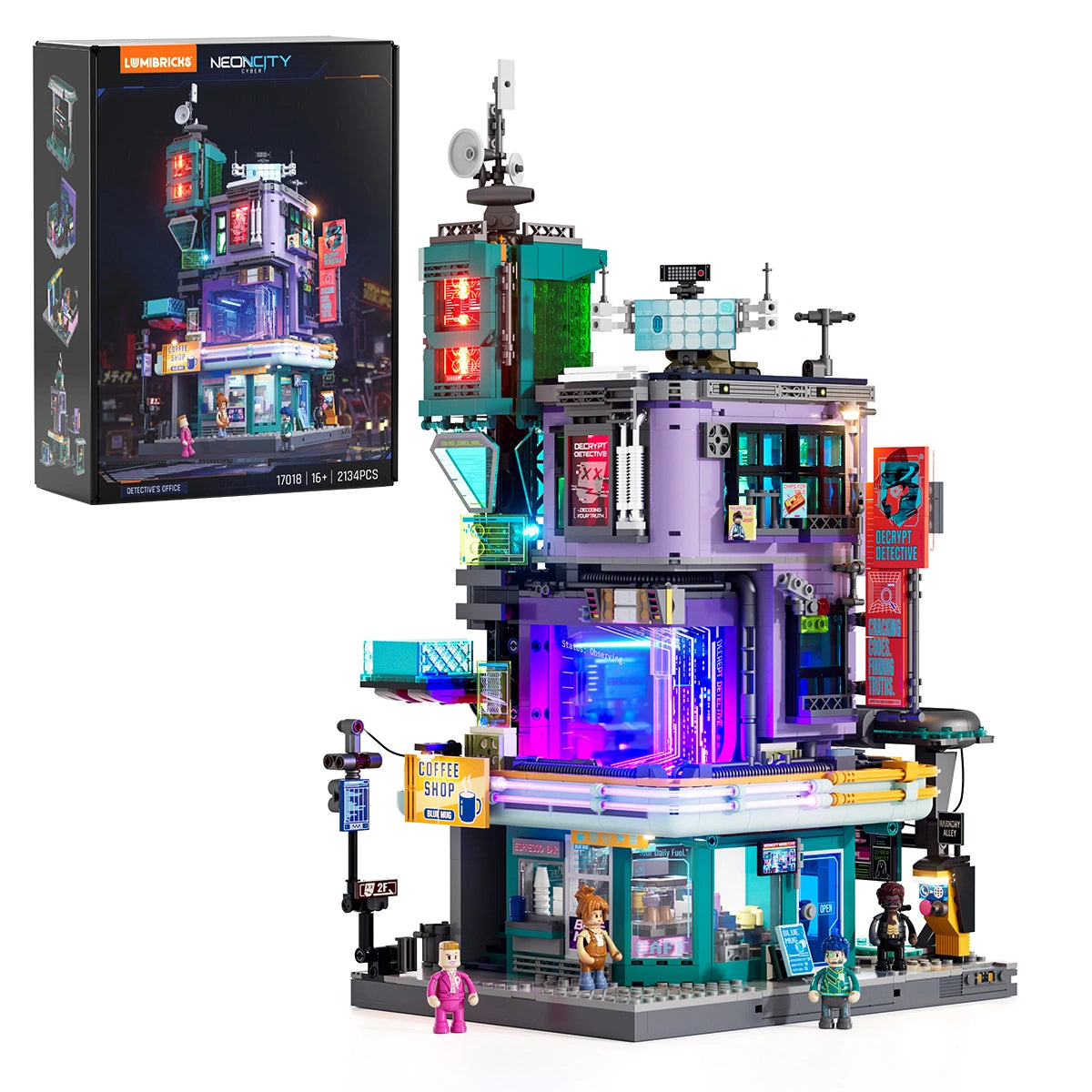
The Cyberpunk collection leans on dense, multicolor lighting to suggest a futuristic cityscape, and this is where Lumibricks lighting systems show their busiest configurations. Detective’s Office uses 19 LED light points along with 2 COB light strips, combining blue, purple, pink, and warm white tones into a vibrant futuristic atmosphere. Large curved acrylic panels carry flowing data-stream patterns that catch the light across the facade.
Neon Elite Lounge takes a different visual route within the same theme. It uses metallic gold, purple, and silver spray-painted parts positioned along key architectural lines, so the structure functions as a reflective sculpture under its own lighting. Game Stack, meanwhile, is built around a vertically stacked entertainment district inspired by the Metabolism architectural movement, pairing dynamic lighting with the cyberpunk color range the line is known for.
Atmospheric Lighting for Retro and Nature Themes: Aurora Cabin, Misty Forest Cabin, and Explorer Treehouse

The Retro House line takes a quieter approach than the neon-heavy cyberpunk sets. Aurora Cabin centers on a Nordic aurora-viewing theme, recreating snow-covered polar scenery alongside an indoor fire pit design inside a glass cabin structure. The lighting here echoes natural phenomena rather than urban glow, which puts Lumibricks on a visibly different footing between its two biggest lines.
Misty Forest Cabin sits in the same line but adds a feature outside the lighting circuit entirely. The set includes an Innovative Rainforest Mist System, powered by a micro-atomization device built into the model, and the brand describes it as its first creation to carry this feature. It runs alongside the set’s LEDs rather than as part of them, giving the cabin a physical effect layered next to its illumination instead of inside it. Explorer Treehouse, by contrast, spreads its lighting across a multi-level jungle scene built around an outpost, a hammock, an observation deck, and a hidden cave.
Power Systems and Battery Requirements Across Set Sizes
Nearly every set relies on a dedicated battery box, though the exact battery type depends on the individual model. Depending on the set, builders may need AA, AAA, or CR2032 batteries, none of which come included in the box. Some models also accept USB-A or USB-C power, drawing from a power bank or a household outlet instead of disposable batteries.
That mix of options means the specific power requirement has to be checked against the product page or instruction manual for each set. A compact set and a large architectural build will not necessarily share the same battery format. This flexibility lets the lighting setup match the scale of the structure rather than forcing one power method across the entire catalog.
Specialty Lighting Features: COB Strips, Metallic Reflective Elements, and Mist Systems
Beyond standard LED points, certain sets introduce extra lighting hardware tied to their theme, and the spread shows how varied Lumibricks lighting systems can get within one catalog. Detective’s Office pairs its 19 LED points with 2 COB light strips for broader, more even illumination across larger panels. Neon Elite Lounge instead relies on metallic gold, purple, and silver painted surfaces to bounce light rather than emit it directly.
Midnight Haunted Mansion takes a different specialty route with 15 illuminated zones built around a dim yellow glow accented by green tones. These examples show that illumination hardware is not limited to a single bulb type or placement strategy across the lineup.
- Detective’s Office combines 19 LED light points with 2 COB light strips across blue, purple, pink, and warm white tones.
- Neon Elite Lounge relies on metallic gold, purple, and silver painted elements to create reflective lighting effects rather than direct LED color washes.
- Game Stack layers dynamic lighting across a vertically stacked cyberpunk district inspired by the Metabolism architectural movement.
- Midnight Haunted Mansion uses 15 illuminated zones built around a dim yellow glow accented by green lighting.
- Misty Forest Cabin pairs its LED lighting with a separate Innovative Rainforest Mist System driven by a micro-atomization device.
Multi-Zone Illumination: Building Complexity in Larger Architectural Sets
Larger architectural sets tend to divide their lighting into distinct zones rather than running one uniform circuit, and Lumibricks lighting systems scale this way as a model grows in size. Midnight Haunted Mansion illustrates this with its 15 separate illuminated areas, each contributing to the overall yellow-and-green atmosphere instead of a single flat glow. That zoning approach lets different rooms or levels carry their own color accents within one model.
Explorer Treehouse applies a related idea by spreading lighting across multiple levels, from the hammock area down through the hidden cave. In sets like these, the lighting plan has to follow the physical layout rather than sitting in one block. On top of that, larger builds demand more planning around where each light point sits in the structure, since a single circuit would flatten the detail across so many rooms.
Illumination complexity generally tracks with a set’s physical scale across the wider themed building category. A small kiosk-style build rarely needs the same zoning that a multi-room mansion or treehouse does. That relationship between size and lighting layout appears consistently across the larger releases in this catalog.
What stands out across the lineup is less the theme itself and more how differently each set solves the same problem of wiring a room without flattening its detail.
