
Share This Article
Comparing security camera systems can feel overwhelming once lens counts, power sources, and tracking features enter the conversation. Reolink organizes its outdoor lineup into three distinct families: OMVI, Altas, and Duo, each built around a different approach to coverage and installation. Looking at how these three lines diverge helps clarify which design fits a given property or monitoring goal.
OMVI Series: Dual-Lens Pan-Tilt-Zoom Cameras
The OMVI series pairs a fixed wide-angle bullet lens with an independently rotating pan-tilt lens on the same housing. The Reolink OMVI 2i Ultra is a representative model, combining 4K and 3K resolution across its two lenses for 360° coverage without blind spots. One lens holds the overview while the other lens, mounted separately, can swivel to track a subject across the full rotation range.
This dual-view design means one camera effectively watches two separate scenes at once. The wide lens keeps the broader area in frame while the PT lens follows movement in detail, which is a layout distinct from a single rotating head. The OMVI 3i PoE model extends this concept further with a triple-lens panoramic PT configuration rated at 18MP combined resolution.
Altas Series: Battery-Powered Surveillance with Extended Runtime
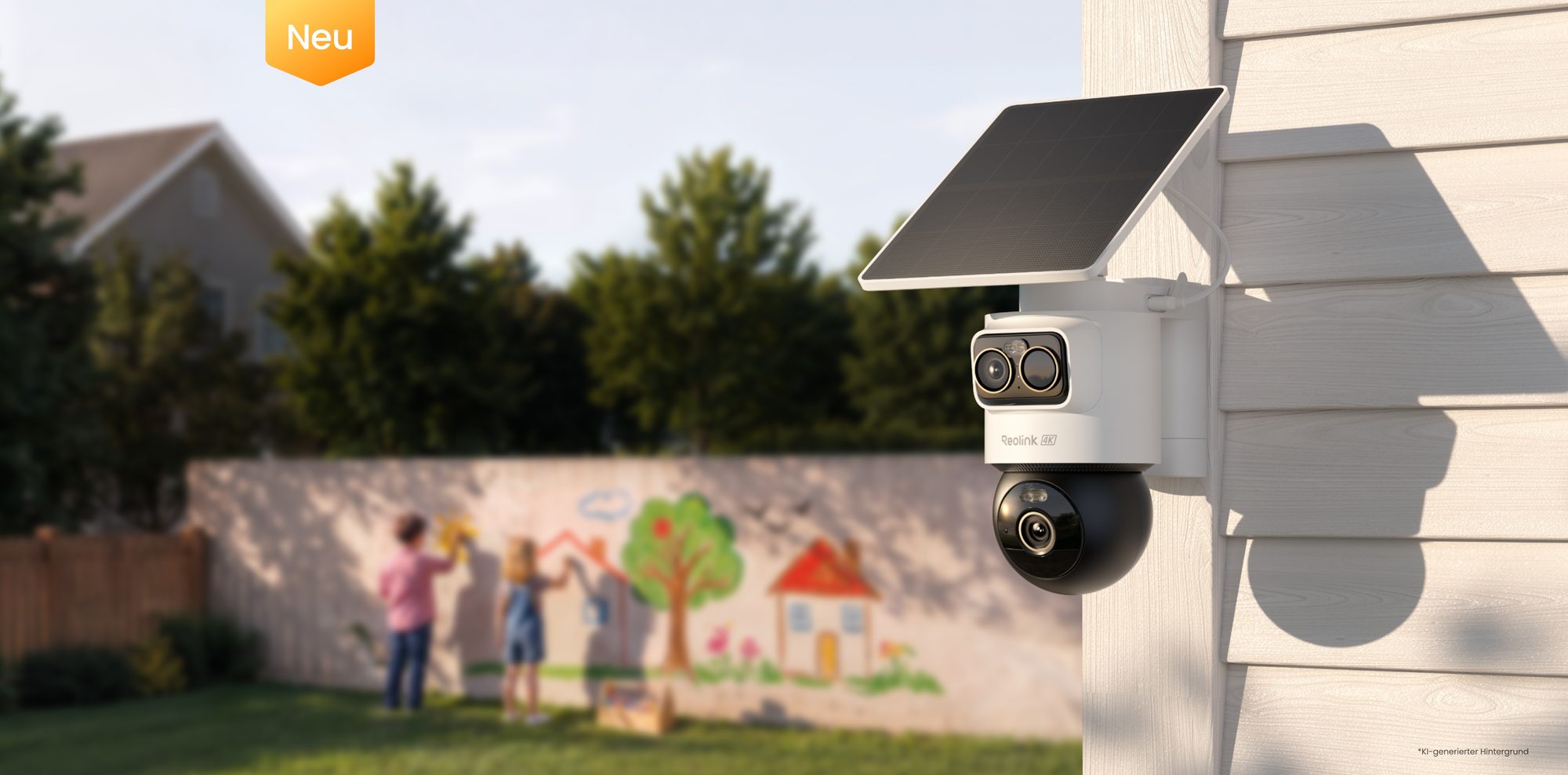
The Altas line centers on wire-free operation with battery power as the primary design choice rather than a secondary option. The Altas PT Ultra 4K is built around 360° pan-tilt movement in a cordless housing, intended for locations where running cable is impractical. Its positioning in the lineup emphasizes extended runtime over a wired connection, which separates it from the PoE-dependent OMVI 3i model.
Because Altas cameras rely on stored charge rather than continuous mains power, placement tends to favor entry points, driveways, and yard perimeters away from outlets. The series is paired in some configurations with a Home Hub, such as the Home Hub with Argus PT Ultra 4K system, which links multiple battery-powered PT cameras into one wireless setup. That hub-based structure is a notable contrast to the point-to-point PoE wiring used elsewhere in the catalog.
Duo Series: Dual-Camera Coverage for Wider Viewing Angles
Where OMVI mixes a fixed lens with a moving one, the Duo series mounts two lenses side by side to widen the horizontal field of view in a single fixed unit. Duo 3 PoE and Duo 3 WiFi are the two connectivity variants of this design, letting a single camera cover a broader span than a standard single-lens unit without needing to pan. This approach suits wide driveways, parking areas, or building facades where panning motion is less useful than a continuously wide static frame.
The dual-lens technology behind the Duo line has been part of the catalog for some time, having first appeared alongside the TrackMix series. Reolink also offers the TrackMix WiFi 4K PTZ, which combines dual-lens imaging with Wi-Fi 6 connectivity in a configuration that sits between the fixed-angle Duo approach and the fully rotating OMVI design.
Power and Connectivity Differences Across Lines

Across OMVI, Altas, and Duo, the connectivity method is one of the clearest dividing lines. PoE variants, such as OMVI 3i PoE and Duo 3 PoE, draw power and data through a single ethernet cable, which suits installations where cabling is already planned. WiFi variants of the same product families drop the cable requirement but still depend on a nearby power source.
Altas cameras remove the power cable question entirely by running on battery charge, with some Altas configurations using solar charging to offset battery drain. The OMVI 2i Ultra uses Reolink SolarEase alongside Wi-Fi 6 to operate without a continuous wired power feed. Choosing between these three connectivity paths generally comes down to how much existing wiring infrastructure a site already has in place.
Tracking and AI Detection: Motion-Following Capabilities by Series
Motion-following capability varies meaningfully by series rather than being a uniform feature across the catalog. The OMVI 2i Ultra uses a SyncTrack system, where the upper wide-angle lens detects motion and the lower PT lens coordinates automatically to keep tracking the same target across the full 360° range, even after it leaves the wide lens’s frame. Auto-Framing then zooms the PT lens in or out so the detected subject stays clearly positioned, and a Pinpoint function lets someone tap the panoramic view to redirect the PT lens instantly.
AI detection for person, vehicle, and animal categories is built into the OMVI 2i Ultra as well, filtering motion alerts by subject type. The RLK8-800TM4 system, a 4K dual-lens PoE kit, adds auto-zoom tracking to a wired NVR-based setup rather than a standalone wireless camera. Duo models, by contrast, rely on their static dual-lens width rather than active pan-tilt tracking to keep moving subjects in frame.
- OMVI models combine a fixed wide lens with an independently rotating PT lens for 360° coverage, as seen in the OMVI 2i Ultra at 4K plus 3K resolution.
- Altas models, including the Altas PT Ultra 4K, run on battery power with 360° pan-tilt movement and no PoE cabling requirement.
- Duo models, such as Duo 3 PoE and Duo 3 WiFi, place two lenses side by side in one fixed housing to widen the static field of view.
- PoE variants transmit power and data over ethernet, while WiFi variants need a nearby outlet, and Altas cameras depend on stored battery charge instead.
- OMVI’s SyncTrack and Auto-Framing features provide active motion tracking, a capability the fixed-lens Duo series does not use in the same way.
Matching Installation Type to the Right Series
Sites with existing ethernet runs and a need for active tracking across a wide perimeter tend to align with the PoE OMVI or RLK8-800TM4 configurations. Locations without easy cable access, such as detached gates or remote yard corners, fit the wire-free Altas design better, particularly where a Home Hub can tie several battery cameras into one system. Reolink‘s products serve both home and business security use cases, which is reflected in how the three lines target different physical constraints.
The OMVI 2i Ultra supports local storage on microSD cards up to 512GB without a subscription requirement. For facades, driveways, or parking areas where a single wide static frame matters more than pan-tilt movement, the Duo series offers dual-lens coverage without the added mechanical tracking of the OMVI line.
Each line addresses a distinct installation scenario, with power source, connectivity, and tracking capability serving as the primary differentiators across the range.
