
Share This Article
Fitting a genuine cinema screen into a living room used to mean pulling furniture away from a wall and running a long throw distance across the floor. An ultra-short-throw laser projector removes that requirement by sitting inches from the screen and still filling it with a large, bright image. Nothingprojector has built a catalogue around this category, pairing laser engines from Formovie and Wemax with screens and cabinetry designed specifically for short-throw geometry.
How Ultra-Short-Throw Placement Changes a Room
An ultra-short-throw laser projector works close to the wall, typically within a few centimetres, and throws an image upward at a steep angle rather than across a room. This eliminates the shadow problem that plagues long-throw setups, where anyone walking past the beam blocks part of the picture. Because the unit sits low and near the wall, it can double as a piece of furniture rather than a ceiling fixture, which matters in rooms that were never built with a projection booth in mind. The laser light source also tends to hold brightness and colour consistency longer than lamp-based engines, a detail that matters for anyone planning years of regular viewing.
Unlike a standard projector, a UST unit uses a specially shaped mirror and lens assembly to bend the image path over a very short distance. That compact geometry is what allows a 100-inch picture to appear from a box sitting directly below the screen. Laser light sources used in this category, including the ALPD triple-colour technology found in several Formovie models, are built to sustain output and colour accuracy across long operating lifespans compared with older lamp engines. The result is a setup that behaves more like a flat-panel television in terms of placement, while still delivering the scale of a cinema screen.
Formovie Theater Premium: 4K Triple Laser Cinema in Compact Spaces
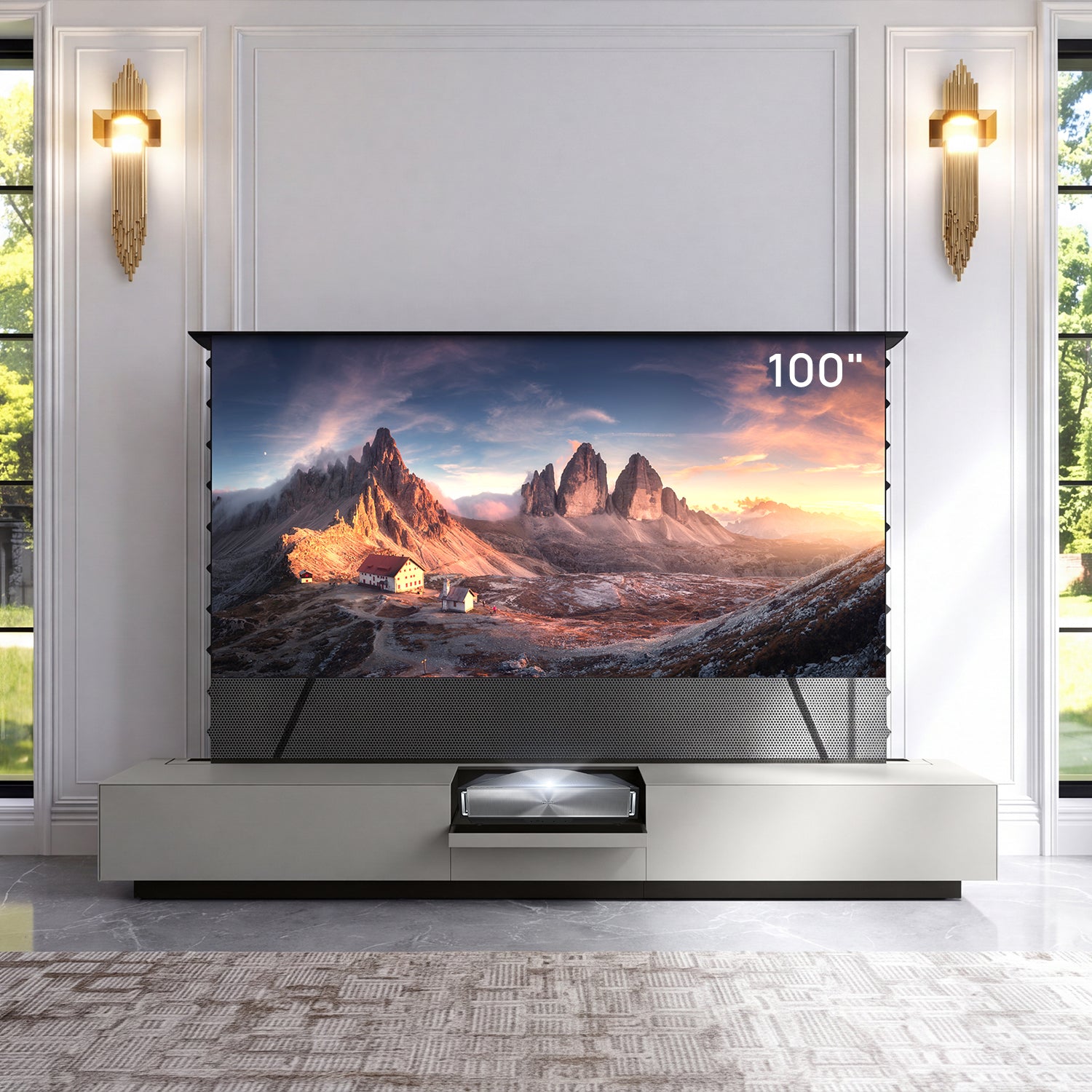
The Formovie Theater Premium, listed by Nothingprojector, is built around triple laser technology using ALPD RGB+ 4.0 colour processing. It outputs 2200 ISO Lumens and renders native 4K resolution with a contrast ratio of 3000:1 full on/off. That combination of brightness and contrast is intended to keep detail visible even when a room cannot be fully darkened, which is often the limiting factor in living-space installations. The unit supports Dolby Vision and Atmos sound pass-through along with Netflix access, positioning it as a single box that replaces both a disc player and a traditional television for film viewing.
Because the Theater Premium is a UST model, it sits directly beneath or in front of the screen rather than requiring a ceiling mount or a long room. This makes it one of the more realistic 4K cinema options for apartments or converted spare rooms where a nine- or ten-metre throw distance simply does not exist. Nothingprojector lists bundle options that pair the projector with screen and calibration add-ons, reflecting how closely the brand treats the projector and screen as a single system rather than separate purchases.
The Wemax D30 and Alternative Laser Options for Different Room Sizes

Not every room calls for the same laser engine, and the Wemax D30 offers a different point in the range. It runs on ALPD 3.0 laser technology with a 3000 ANSI brightness rating, delivering real 4K output through Fengmi’s operating system. The catalogue also carries the Bomaker Polaris, a 4K UST model using triple-colour laser technology and DLP processing rated at 2500 ANSI lumens, alongside the Dangbei DBOX02 line for buyers who want a standard-throw laser alternative. Spreading the range across the Theater Premium, the D30, and the Polaris gives buyers a choice between brightness levels and laser technologies rather than a single fixed configuration.
- Resolution matters first, since native 4K panels resolve more fine detail than upscaled 1080p sources.
- ISO or ANSI lumen rating determines how well the image holds up against ambient light in a living room.
- The laser light source type, whether single-colour, dual-colour, or triple-colour ALPD, affects colour range and saturation.
- Contrast ratio, such as the 3000:1 full on/off figure on the Theater Premium, affects how deep shadow detail appears.
- Screen size compatibility should be checked against the intended UST screen, since most ranges list a supported inch span.
- Audio format support, including Dolby Atmos or DTS pass-through, determines whether external speakers are strictly necessary.
Motorized Cabinets and Precision Mounting: Housing UST Projectors Correctly
Because an ultra-short-throw laser projector depends on being placed at a precise distance and angle from the screen, housing it correctly is not a cosmetic afterthought. Nothingprojector sells motorized laser TV cabinets, including a pre-assembled gray model with a smart motorized extending platform that moves to the optimal throw position at a single touch and includes position memory. A separate walnut cabinet uses a flip-and-extend motorized platform, opening and gliding forward to the correct projection angle before retracting flush when not in use. A solid wood option is built for 100 to 120 inch motorized floor-rising screens, following a mortise-and-tenon construction style.
These cabinets solve a specific problem with UST installations: even a small shift in projector position can throw off focus and image geometry on a screen placed several metres away. A motorized platform that returns to the same throw position every time removes that recurring adjustment. This also lets the unit stay hidden inside furniture between viewing sessions rather than sitting exposed on an open shelf.
Screen Selection for Ultra-Short-Throw Setups: Matte White and ALR Surfaces
Screen choice changes how a UST image actually looks once installed. The Nothingprojector Black Series screen is built with a 95% ambient light rejection rating and a 0.6 gain, using an ST Carbon Black coating suited to rooms with some daylight or lamp exposure. It supports 16:9, 4:3, or custom aspect ratios and is compatible with 84 to 150 inch sizes depending on the floor-rising or fixed-frame variant chosen.
The alternative is the Matte White motorized floor-rising screen, available in a 100 to 120 inch size, which uses a high-gain PVC material rated at 1.3 gain for a stated 25% brightness boost compared with projecting onto a plain wall. It supports resolution up to 8K without pixel degradation and Active 3D playback, and its tab-tensioned construction is rated at 97% surface flatness to avoid ripples or edge curling. A 170-degree viewing angle keeps brightness and colour consistent across a wide seating area, which matters for rooms with more than two or three viewers.
Sound, Calibration, and the Complete Cinema Experience
Picture quality is only part of a home cinema build, and several of the projectors in the Nothingprojector catalogue already include built-in audio support. The Theater Premium carries Dolby Atmos sound pass-through, meaning external speaker systems can layer on top of the built-in output rather than replace it entirely. For buyers purchasing the Theater Premium, Nothingprojector lists a PVA calibration service as an available bundle addition in EU and AU regions, intended to fine-tune image setup after installation.
Bundled accessories extend further than audio and calibration. Depending on the configuration chosen, a projector purchase can be paired with a Black Series screen or a calibration service as part of the same order, which keeps the projector, screen, and setup service tied together rather than sourced from separate vendors. That bundling approach reflects how the brand positions itself, not just as a projector seller, but as a source for the full set of hardware a short-throw cinema installation actually requires.
Ultra-short-throw laser projection has moved from a niche category into a realistic path toward a proper home cinema, even in rooms never designed for one.
