
Share This Article
Shoppers researching radiofrequency, microcurrent, and LED tools for home use run into a lot of noise before they ever plug a device in. Marketing shorthand, clinic comparisons, and secondhand reviews all feed into a set of at-home anti-aging device myths that shape expectations long before a session starts. Some of these ideas come from confusing a handheld unit with a professional machine built for an entirely different scale of energy. The sections below work through the most persistent claims and explain where each one tends to fall apart.
Myth: At-Home RF Devices Deliver Results as Fast as Professional Treatments
A common assumption is that a handheld radiofrequency device should work at the same speed as an in-office procedure. Clinic machines run at higher energy outputs under professional supervision, while at-home units are built for repeated, lower-intensity sessions spread over weeks. That gap in design is exactly why consistency matters more than any single session for a device used at home. Expecting a dramatic overnight change is one of the more stubborn at-home anti-aging device myths, and it sets a bar that a few minutes of weekly use was never meant to clear.
The EVENSKYN AFFILIATE PROGRAM frames its radiofrequency handset, the Lumo⁺, around a few minutes of use a few times a week rather than a one-time fix. That framing matches how the device is described on the brand’s own product pages, which emphasize ongoing use over instant change. Treating a home device as a substitute for one powerful clinic visit skips over how differently the two categories are meant to operate.
Myth: One Device Can Replace an Entire Skincare Routine
Another widespread belief is that one gadget can cover every skincare need at once, from firmness to cleansing to serum absorption. In practice, most device ranges split these jobs across separate tools instead of folding them into one catch-all unit. That split is visible in how skincare brands build multi-device kits rather than a single device meant to do everything.
The EVENSKYN AFFILIATE PROGRAM lineup reflects that same split, with its catalog organized around distinct handsets rather than one unit meant to do it all. The MicroInfuser™ pairs sterile treatment heads with sealed Syntha-Pep™ serum ampoules for micro-infusion sessions, a function neither the Lumo⁺ nor the Venus performs. Expecting a single handset to also cleanse, infuse, and treat the eye area overlooks how these categories are generally designed to complement each other rather than merge into one tool.
Understanding the Lumo+ and Venus: What These Devices Actually Do
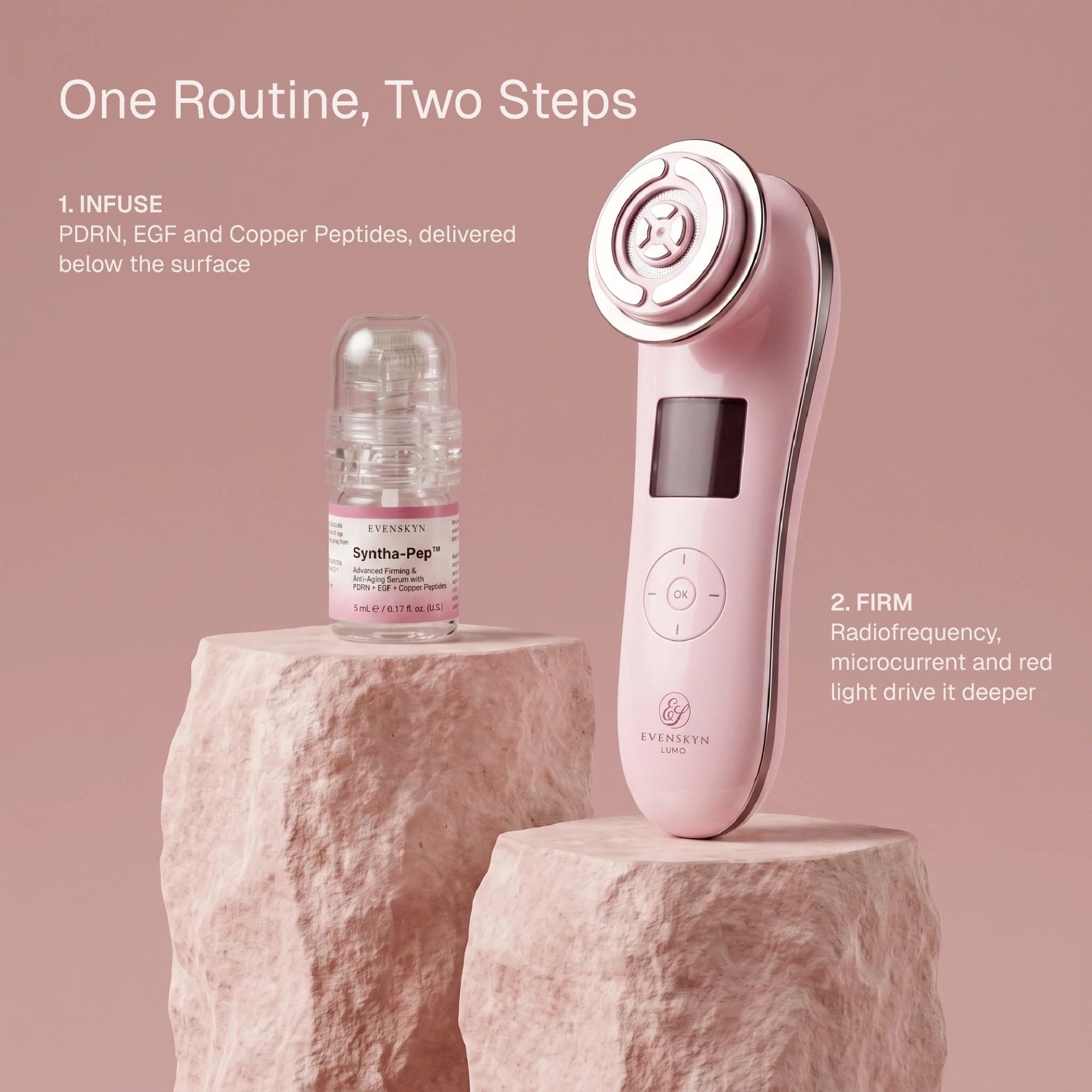
Within the EVENSKYN AFFILIATE PROGRAM range, the Lumo⁺ is described as a 3-in-1 handset bringing radiofrequency, EMS, and red and blue LED light therapy together for the face and neck. It ships as a kit that includes a travel case with pockets for the Venus, a charging base, a power adapter, and a user manual, backed by a 2-year warranty. The Venus, by contrast, is built around LED and sonic therapy aimed specifically at the eye area, targeting the look of eye wrinkles, dark circles, and under-eye puffiness.
Because these two devices target different zones of the face, pairing them is framed as a routine built from two tools rather than one. This distinction helps clear up at-home anti-aging device myths about interchangeable devices, since a face-and-neck handset and an eye-area tool are not built to cover the same ground. Recognizing which device is meant for which zone is part of using either one as intended.
Common Application Mistakes With Radiofrequency and Microcurrent Technology
Several recurring errors show up across reviews and support questions about radiofrequency and microcurrent tools in general. Most relate less to the technology itself and more to how a device gets handled during a session. A few of these mistakes are easy to overlook because they seem minor at first glance.
- Skipping the conductive gel step is one of the most common errors, since dry contact changes how energy transfers between the device head and skin.
- Inconsistent usage, such as sporadic sessions instead of a steady weekly pattern, undercuts the gradual approach these devices are designed around.
- Using a radiofrequency or microcurrent device on skin types or conditions it was not designed for is another frequent misstep, since not every device suits every skin.
- Confusing which areas a given device targets, such as applying a face-and-neck handset to the eye area, misapplies tools built for distinct zones.
The Conductive Gel Requirement: Why It Matters for RF and Microcurrent Devices

Radiofrequency, microcurrent, EMS, and ultrasound devices all depend on a conductive medium rather than treating it as an optional extra, and the EVENSKYN AFFILIATE PROGRAM sells a 300 mL gel formulated for exactly that purpose, with several device kits bundling a bottle directly alongside the handset. A water-based gel sits between the metal contact and the skin surface so energy transfers evenly instead of being lost against dry skin. The same gel formula is listed as compatible across RF, microcurrent, EMS, and ultrasound devices rather than being tied to a single handset in the catalog.
Without it, a session may feel incomplete or uneven, no matter how capable the handset itself is. Treating gel as something to skip for convenience is one of the more avoidable at-home anti-aging device myths, since it affects the mechanics of a session rather than just comfort.
Realistic Timelines and Maintenance for Sustained Skin Firmness
Because these devices are built for repeated use rather than one strong dose, expectations around timelines need to match that pattern. A session a few times a week, kept up over an extended stretch, is the structure these tools are generally built around rather than a quick before-and-after. Maintenance plays a role too, since stopping use after early results may mean those results do not hold, a point that sits at the center of at-home anti-aging device myths about timelines.
The EVENSKYN AFFILIATE PROGRAM also sells bundled sets, such as the Lumo⁺ paired with the Phoenix microcurrent bar or the Mirage LED mask, built around combining tools for a fuller routine rather than relying on one device alone. The Phoenix itself is a four-roller microcurrent bar that runs on a solar cell, with no battery to charge. A realistic view of pacing tends to match how these devices are actually described and sold, rather than how a single ad might frame them.
Looking Past the Shortcuts
Clearing up these myths does not make radiofrequency, microcurrent, or LED devices simpler than they are. It just means meeting them with expectations that match how they are actually built to work, one session at a time.
