
Share This Article
Bookshelf speakers sit between compact desktop drivers and full floor-standing towers, offering fuller sound without the footprint of a tower cabinet. Edifier bookshelf speakers cover a wide stretch of that space, from passive wired pairs to powered wireless systems with studio-grade components. Ventmere Ltd carries a broad selection of these speakers, and this article breaks down how the different lines differ in connectivity, power delivery, and sound tuning, so the distinctions between models are easier to follow before comparing specific pairs.
What Are Bookshelf Speakers and Why Edifier Dominates the Category
A bookshelf speaker is a compact two-way or three-way cabinet built to sit on a shelf, stand, or desk rather than the floor. The format balances a smaller footprint against fuller sound than typical computer speakers, which is why it remains popular for living rooms, studios, and home offices alike. The lineup spans dozens of models across feature sets, and Ventmere Ltd carries a large share of that range for shoppers comparing options side by side.
What separates one pair of Edifier bookshelf speakers from another is rarely the cabinet shape. It is almost always the combination of connectivity, amplification, and driver tuning packed inside. Understanding those three variables makes it easier to match a pair to a specific room or source setup, rather than choosing by appearance alone.
Passive vs. Powered: Understanding R1280DB and R1280DBs Technology
The R1280DB Bluetooth Bookshelf Speakers add Bluetooth to the classic R1280 design while the R1280DBs Powered Bluetooth Bookshelf Speakers move to a fully active layout, so the two models share a driver lineage but split on where the amplification lives. The R1280DB still relies on RCA, optical, and coaxial connections plus a speaker cable linking the two cabinets, with one housing the amplifier and feeding the other. A redesigned remote handles basic control from a distance on this model.
The R1280DBs adds Bluetooth 5.0 alongside optical, coaxial, and dual RCA inputs, and a front bass reflex port plus a subwoofer output set it apart from the plain R1280DB. That output lets lower frequencies pass on to an external unit when needed. Ventmere Ltd lists both models alongside each other, which makes the wiring difference easy to spot before deciding between them.
The R1700BT and R1700BTs: Bluetooth Multifunctionality and Active Audio
The R1700BT Multifunctional Speakers pair Eagle Eye tweeters with a 4-inch bass unit, and the line leans on DSP and DRC processing to limit distortion. Bluetooth pairing is built in, and the included remote is compact enough to fit in a pocket, which suits a casual living-room setup. This model sits in the middle of the range, offering more tuning refinement than entry wired pairs without stepping up to studio-monitor components.
The R1700BTs Active Bluetooth Bookshelf Speakers carry the same front bass reflex port and subwoofer output forward, but add Qualcomm AptX HD decoding over Bluetooth 5.0 for higher-resolution streaming. A wireless remote ships with the pair for everyday control. Together, the R1700BT and R1700BTs show how Speakers can share a driver concept while differing meaningfully in codec support and output options.
Studio-Grade Sound: MR4 and S2000Pro Monitor Speakers

The MR4 Powered Studio Monitor uses a 1-inch silk dome tweeter with 4-inch diaphragm woofers, and it supports both TRS balanced input and AUX or RCA unbalanced connections. It also includes monitor and music modes, a tuning distinction rather than a separate hardware tier, letting the same cabinet serve reference listening or more casual playback. This makes the MR4 a point of reference when comparing consumer-tuned pairs against monitor-style alternatives.
The S2000Pro Bookshelf Studio Monitor Speakers go further with a flat diaphragm tweeter, four EQ modes, and a wireless remote. Input support spans coaxial, optical, RCA or AUX, XLR, and Bluetooth, a notably broad set for a monitor-focused cabinet. Ventmere Ltd groups this model with other studio-leaning options, since the XLR input signals a production orientation rather than a purely domestic listening setup.
Premium Wireless Performance with the S3000MKII
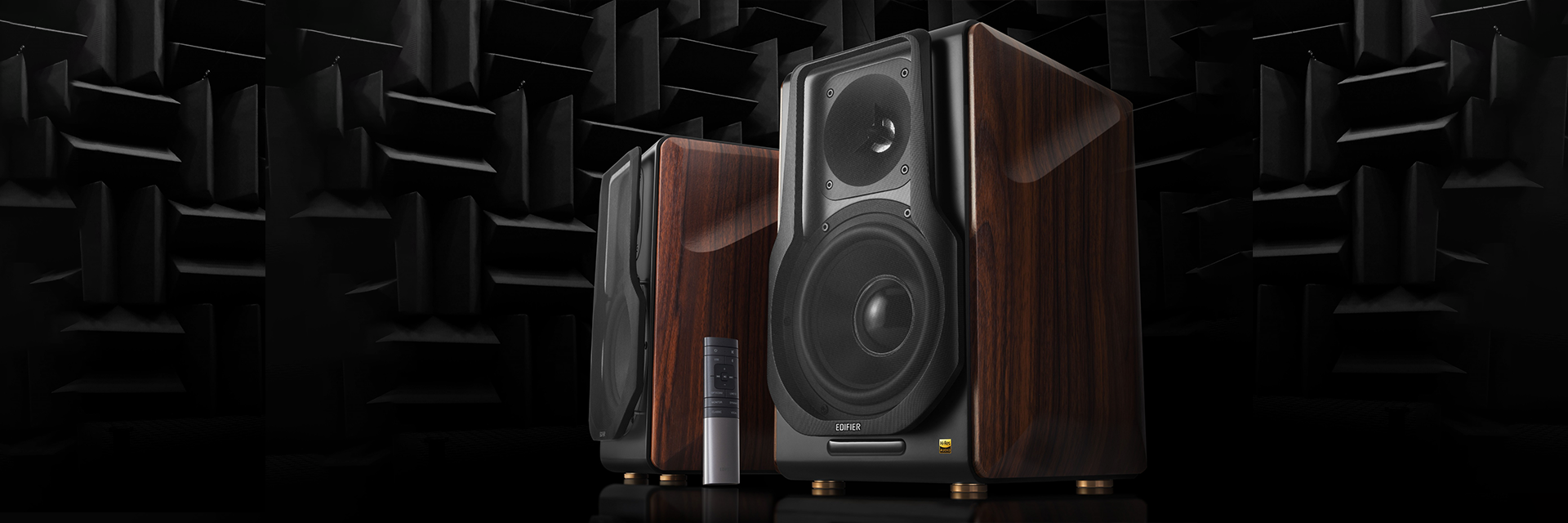
The S3000MKII Powered Wireless Bookshelf Speakers sit at the top of the catalogue in terms of component complexity. Horn-loaded planar magnetic tweeters pair with 6.5-inch long-throw aluminum diaphragm mid-bass drivers, and the system is Hi-Res certified. Wireless connectivity runs through a 5.8GHz and 5.2GHz dual-band link, alongside Bluetooth V5.0 with Qualcomm aptX HD decoding.
An IR remote control handles day-to-day adjustments, and the pair also works with the Edifier ConneX Mobile App for additional control. The combination of dual-band wireless and high-resolution codec support distinguishes this pair from the Bluetooth-only models further down the range offered through Ventmere Ltd.
Subwoofer Outputs and Expandability Across the Range
Several Edifier bookshelf speakers include a dedicated subwoofer output, which allows an external subwoofer to extend low-frequency response beyond what the main cabinets handle alone. The R1280DBs, R1700BTs, R1850DB, and R2750DB MKII all include this feature according to their published specifications. The R1850DB in particular pairs a 10-degree angled sound design with a jet-black MDF enclosure and a dedicated subwoofer output.
The R2750DB MKII Powered Bookshelf Speakers extend expandability further with a 3-way acoustic design, 144W RMS output, and HDMI eARC with CEC for one-cable TV audio control. It also includes SUB OUT for an external subwoofer, plus Bluetooth with LDAC and multipoint pairing. Listings for Edifier bookshelf speakers at Ventmere Ltd show that subwoofer output is not confined to one model but appears across several configurations with different driver layouts.
Connectivity is often the deciding factor when comparing these speakers, since it determines which existing equipment a pair can plug into without an adapter. The list below summarizes the main input and output types found across the range.
- Bluetooth versions range from 4.0 on the R2000DB up to 5.0 with Qualcomm aptX HD decoding on models like the S3000MKII and R1700BTs.
- RCA and dual RCA inputs appear on wired-focused models such as the R1280T and R1280DB for connecting multiple analog sources.
- Optical and coaxial digital inputs are available on the R1280DB, R1280DBs, and S2000Pro, among others.
- XLR input is included on the S2000Pro Bookshelf Studio Monitor Speakers, aimed at balanced studio-style connections.
- Subwoofer or SUB OUT ports appear on the R1280DBs, R1700BTs, R1850DB, and R2750DB MKII for pairing with an external low-frequency unit.
- HDMI eARC with CEC is included on the R2750DB MKII, enabling single-cable television audio control.
Taken together, these connectivity options show why newcomers to the category often find the lineup easier to navigate once inputs and outputs are compared side by side, rather than judging models purely by driver size or cabinet finish.
Matching connectivity, power handling, and tuning to a listening space separates one pair of Edifier bookshelf speakers from another across this range.
