
Share This Article
Arriving at a destination only to find a massive phone bill waiting is a familiar travel headache. International roaming charges can turn a short trip into an expensive surprise, especially once maps, messaging, and social media start chewing through data. An affordable portable wifi hotspot offers a way around that problem, letting a traveler log onto local networks without a foreign SIM card or a shock invoice. uCloudlink America Ltd. builds a lineup of such devices, sold under the GlocalMe name, aimed at keeping connectivity costs predictable across borders.
Why Roaming Fees Make Travel Expensive, and How GlocalMe Changes That
Roaming fees are charged by a traveler’s home carrier whenever a phone connects to a foreign network abroad. Those per-megabyte or per-minute charges add up quickly on a multi-country itinerary, often pushing the final bill well past what was planned. Carriers also tend to bill in blocks, so a few minutes of use abroad can trigger charges for a much larger chunk of data. This is why many travelers now search for an affordable portable wifi hotspot instead of leaving a phone plan active overseas.
A portable hotspot sidesteps the issue by connecting a separate device, rather than a phone’s home SIM, to local networks. Multiple gadgets, phones, tablets, and laptops, can then share that single connection over WiFi. uCloudlink America Ltd. designs its devices around this idea, removing the need to buy and swap a local SIM in every country visited.
The U3: GlocalMe’s Most Budget-Friendly Portable Hotspot
The U3 sits at the accessible end of the GlocalMe range. It runs on HyperConn™ technology to deliver a 4G full-speed WiFi connection and is powered by a Qualcomm chipset. Despite packing that networking hardware, the device weighs just 0.28lb, light enough to slip into a jacket pocket or small bag.
The U3 connects up to 10 devices at once over WiFi, enough to cover a phone, laptop, and tablet for a solo traveler or a small group. As a result, it works as a straightforward, lightweight option for occasional trips rather than constant travel. For anyone comparing an hotspot against a stack of prepaid SIM cards, the U3 represents one of the simpler starting points in the catalog.
MeowGo G40 Pro and DuoTurbo: Mid-Range Devices with Advanced Features
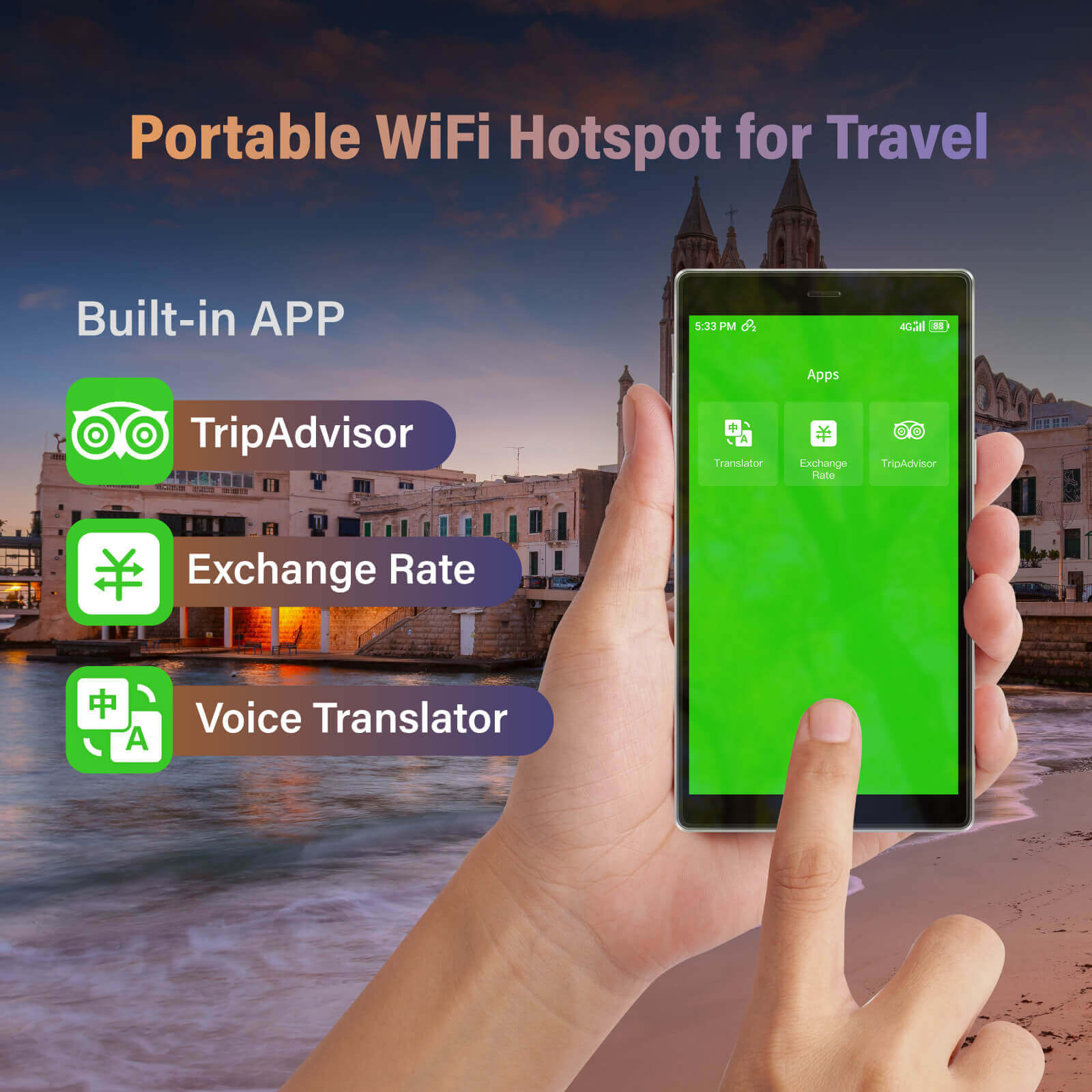
The MeowGo G40 Pro adds Wi-Fi 5 technology alongside HyperConn™ and CloudSIM, paired with 4G CAT13 connectivity for a faster, more reliable link. It also weighs 0.28lb and shares WiFi with up to 10 devices, but its battery stretches to 15 hours of use. That extra runtime helps on longer travel days, such as flight layovers or a full day of sightseeing.
The DuoTurbo takes a different approach with a dual modem, twin-chip design built for complex network environments. It carries a 3,500mAh battery rated for up to 12 hours and weighs 0.326lb, slightly heavier than the MeowGo G40 Pro. Both devices rely on CloudSIM, but the DuoTurbo’s twin chips are meant for more flexible switching when signal conditions vary from place to place.
- The U3 supports up to 10 connected devices, matching the connectivity capacity of both the MeowGo G40 Pro and the DuoTurbo.
- The MeowGo G40 Pro offers the longest battery life of the three, at up to 15 hours, compared with up to 12 hours on the DuoTurbo.
- The U3 and the MeowGo G40 Pro are the lightest models, at 0.28lb each, while the DuoTurbo weighs slightly more at 0.326lb.
- The DuoTurbo’s twin-chip, dual-modem design is a feature neither the U3 nor the MeowGo G40 Pro includes, built for switching networks in busy signal environments.
- The MeowGo G40 Pro layers Wi-Fi 5 technology and 4G CAT13 speed on top of the HyperConn™ and CloudSIM features shared across the range.
CloudSIM Technology and Automatic Network Switching Explained

CloudSIM is the core networking technology behind the hotspot range from uCloudlink America Ltd., replacing a physical SIM card with a system that finds and connects to local carrier networks on its own. HyperConn™ builds on this with network switching that links to the best available signal among partner carriers. Together, these let a single device work across borders without a SIM swap at every airport, which is part of what makes an affordable portable wifi hotspot practical for frequent travel.
Models across the lineup use CloudSIM’s automatic switching to move between 4G operators as a traveler crosses a border. This removes the step of stopping to find a local SIM vendor or activate an eSIM by hand. For frequent flyers, that handoff between networks is often the main draw of choosing a hotspot device over a pile of prepaid SIM cards.
Global Coverage Across 200+ Countries Without SIM Cards
The device range draws on more than 390 carrier networks spread across over 200 countries and regions. Because of this scale, the same hotspot can travel across several continents on one trip without any hardware changes. That breadth of coverage is a large part of what separates a genuinely affordable portable wifi hotspot from a device that only works well in a handful of markets.
Since network selection happens without a physical or electronic SIM card, there is no need to pre-register an eSIM profile before departure. A traveler moving between several countries on one trip can rely on the same hotspot throughout, rather than juggling separate SIMs or eSIM installs for each stop. uCloudlink America Ltd. positions this as one of the main reasons its devices suit people chasing broad coverage without extra setup at the airport.
Flexible Data Plans and Pay-As-You-Go Pricing Models
Alongside the hardware, uCloudlink America Ltd. offers a range of data options rather than a single bundled plan. Country-specific eSIM data packages cover destinations including Australia, Hong Kong & Macao, the Philippines, Vietnam, Malaysia, Canada, and the United States. Broader packages also exist, such as a 10GB 180-day global data package spanning dozens of countries at once.
Data is added only for the destinations a given trip actually covers, instead of binding a traveler to a long-term mobile contract. Regional bundles, such as a package covering the USA, Canada, and Mexico, or one spanning a wide set of European countries, group nearby destinations together for multi-country travel. That range of options is one of the practical reasons a well-specified, affordable portable wifi hotspot can replace a traditional roaming plan for occasional travelers.
Across the lineup, the common thread is a device built to work the moment it is switched on, wherever the trip leads.
