
Share This Article
Respiratory training devices fall into a handful of distinct categories, and picking the right one depends on what the breathing goal actually is. Some tools build muscle strength against resistance, while others use oscillating pressure to help clear airways. AirVantage produces examples of both approaches, offering a useful case study in how these two methods differ in daily use.
Understanding Respiratory Muscle Training vs. OPEP Technology
Respiratory Muscle Training, often shortened to RMT, works by adding resistance to the act of breathing in and out. The muscles involved in inhaling and exhaling adapt to that resistance over repeated sessions, similar to how any muscle responds to a loaded exercise. Oscillating Positive Expiratory Pressure, known as OPEP, instead creates a fluttering back-pressure during exhalation, a mechanism associated with airway clearance and lung expansion support, and it is this distinction between resistance training and pressure-based clearance that separates the two categories of respiratory training devices.
These are not interchangeable goals. Someone focused on lung capacity and endurance is working toward a different outcome than someone interested in mucus clearance or general airway support. AirVantage structures its catalogue around this exact split, offering a Respiratory Muscle Training collection alongside a separate Oscillations Vibrating Exhalers collection under the Physio name.
How the AirVantage BreathBooster Builds Inspiratory and Expiratory Strength
The It BreathBooster is described as a portable breathing trainer built around adjustable resistance. Resistance can be tailored to individual breathing exercises rather than relying on a single fixed level. That adjustability is paired with a compact design, which the brand states is lightweight enough for use at home or away from it.
According to the product listing, the device is intended for breathing exercises generally and is not designed to diagnose, treat, cure, or prevent any medical condition. AirVantage recommends consulting a healthcare professional before starting any new exercise program involving the tool. The BreathBooster is also offered in two colour options, black and white, giving a small amount of choice without altering the function.
How the AirVantage Physio Uses Oscillations for Airflow Support
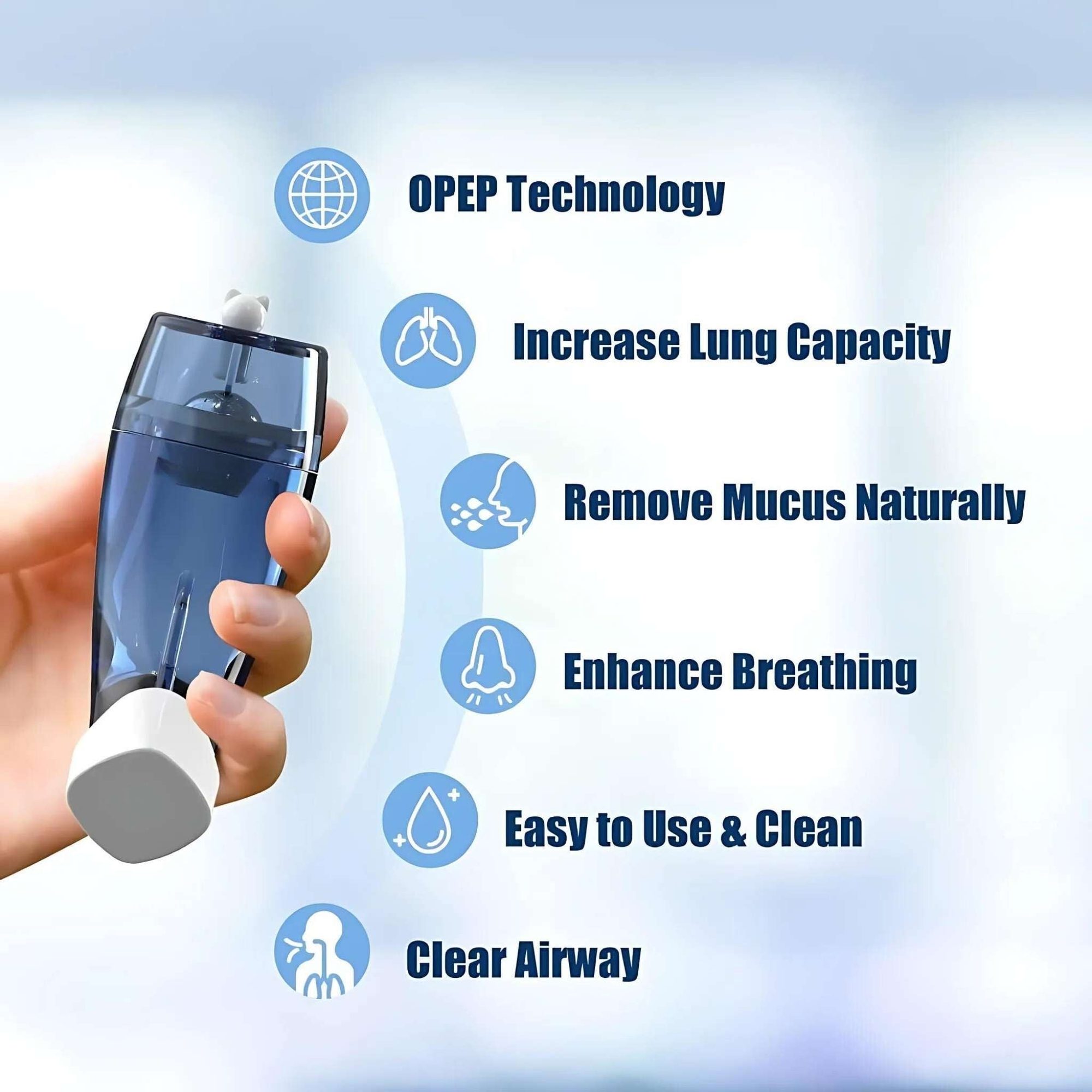
The standard AirVantage Physio model features adjustable pressure settings using three interchangeable stainless steel ball bearings, which allow the resistance level to be customized for different users. It requires no batteries or refills, which the brand frames as a maintenance-free, natural way to use the device on a regular basis. This places the Physio firmly in the OPEP category of devices rather than the resistance-based category occupied by the BreathBooster.
Within the same family sits the AirVantage Physio Vintage, which uses a fixed resistance design rather than the interchangeable bearings found in the standard Physio. The brand describes this fixed setup as suited to straightforward, consistent use without needing adjustment between sessions. There is also an AirVantage Physio Mini, a more compact version with an ergonomic mouthpiece, aimed at portability for daily use at home or while traveling.
Key Differences Between BreathBooster and Physio Devices

Set side by side, the BreathBooster and the Physio line represent two separate philosophies among respiratory training devices. One is about building strength through resistance over time, while the other assists airflow and clearance through oscillation during exhalation. The practical mechanics, from how resistance is changed to how each is cleaned, reflect that split clearly.
- The BreathBooster uses an adjustable resistance dial, while the standard Physio changes resistance by swapping between three stainless steel ball bearings.
- The Physio line, including the Vintage and Mini versions, needs no batteries or refills, whereas the BreathBooster relies purely on its mechanical resistance mechanism without electronic parts either.
- Both device families are described as portable and lightweight, suitable for use at home, in an office, or while traveling.
- The standard Physio carries a recommended usage of 1 to 5 minutes, one to two times daily, according to the product page.
- Cleaning requirements across the range are tied to the mouthpiece and interchangeable parts, since the devices sit in the mouth during use.
Portability and Design Across the AirVantage Range
Across both lines, The brand leans on compact, travel-friendly design as a consistent theme. The AirVantage ExhalePro, another breathing support trainer in the wider catalogue, is also described as portable and intended for daily respiratory exercise. This suggests a broader pattern across the brand’s respiratory training devices rather than a feature unique to just one product.
The Physio Mini pushes this portability further with its smaller form factor, built specifically for ease of use away from home. None of the devices in this comparison depend on charging or battery replacement, which keeps the physical footprint and maintenance routine fairly simple across the board. This consistency in design runs through the respiratory side of the catalogue, separate from sleep-focused products like the NightBreathe mouth guard or the Wundr mouth tape.
Choosing Between RMT and OPEP for Breathing Goals
The decision between a resistance-based trainer and an oscillating device comes down to the underlying goal. RMT tools like the BreathBooster target muscle strength and endurance tied to inhaling and exhaling against resistance, while OPEP tools like the Physio line support airway clearance and lung expansion through that same oscillating pressure mechanism applied on the exhale.
Both categories sit under the umbrella of respiratory training devices, but they are not solving identical problems. The FAQ page notes that AirVantage products work by strengthening respiratory muscles and improving lung capacity through RMT and OPEP therapy combined, which reflects why two separate product lines exist rather than one. Anyone exploring either category typically does so with a specific training or support goal already in mind, whether that is strength building or airway clearance.
Final Thoughts
Two mechanisms, one shared aim of supporting the breath, define this comparison. The real distinction lies in resistance-based muscle work versus oscillating pressure support, and that difference shapes which device fits which goal.
